
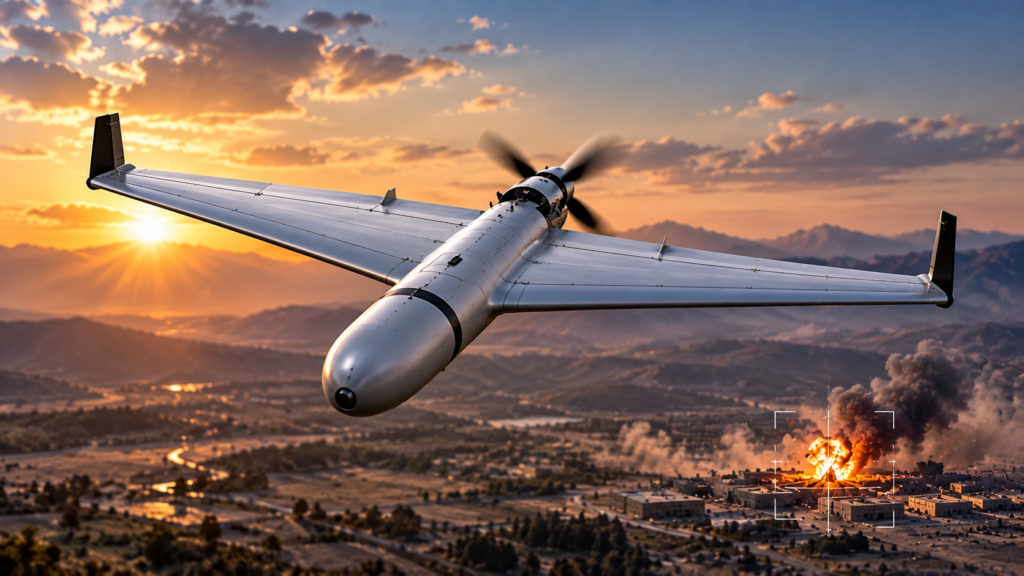
The rapid expansion of unmanned aircraft has changed the way military forces think about aerial warfare. Among the most discussed developments is the kamikaze drone, a type of uncrewed aircraft designed to destroy itself when it strikes its intended target.
Once a relatively specialised military technology, one-way attack drones have become a prominent feature of contemporary conflicts. Their use has attracted international attention, particularly following the appearance of Iranian-designed Shahed drones in the Russia–Ukraine war.
Unlike conventional military aircraft, these systems are generally expendable. Their importance lies not just in their flight capabilities but also in their comparatively low cost, scalability and ability to place additional demands on air defence systems.
For beginners, however, the terminology can be confusing. Kamikaze drones, loitering munitions and FPV attack drones are often discussed interchangeably, despite having important differences.
What is a kamikaze drone?
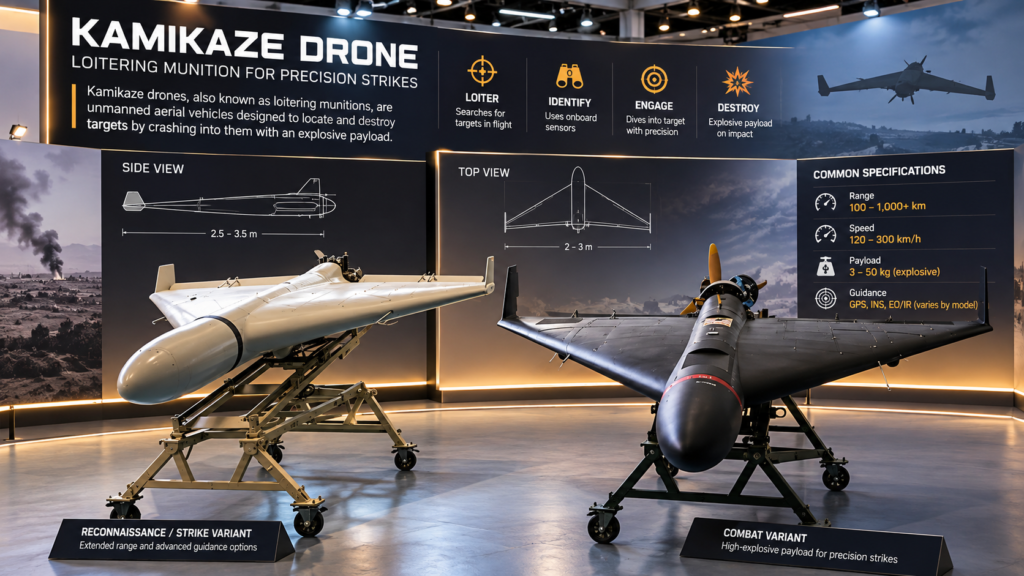
A kamikaze drone is an uncrewed aircraft designed to destroy itself upon impact with a target. Unlike a conventional surveillance drone, which is intended to return and be reused, a one-way attack drone is an expendable weapon.
The term kamikaze is derived from the Japanese military’s use of suicide aircraft during the Second World War. In modern reporting, it has become a widely recognised description for certain expendable attack drones.
However, the term is not a precise technical classification. Military researchers and manufacturers frequently use the more specific term one-way attack drone or loitering munition.
Kamikaze drone vs. loitering munition
A loitering munition is designed to remain airborne for some time, potentially allowing it to observe an area before an attack. Not every one-way attack drone has this capability.
The distinction matters because the two categories can have different navigation systems, operational roles and levels of autonomy. For example, the Shahed-136 is often called a kamikaze drone, but its original configuration is generally associated with preplanned, one-way flights rather than searching an area and independently selecting a target.
How did kamikaze drones originate?
The history of modern kamikaze drones is connected to the broader evolution of unmanned aircraft and precision-guided weapons.
From early unmanned aircraft to loitering munitions
Early military drones were primarily developed for reconnaissance, target practice and experimental military applications. As navigation, electronics and control technologies improved, designers began exploring aircraft that could carry out specialised missions without returning to base.
During the late twentieth century, militaries began developing systems that combined the characteristics of a drone and a guided weapon. Israel became an important participant in the development of this technology, with systems such as the Harpy illustrating the potential of expendable, autonomous attack aircraft.
Iran subsequently developed its own family of unmanned attack aircraft. The Shahed series became internationally prominent after attacks attributed to Iranian-designed drones and their subsequent use in Ukraine.
The influence of the Russia–Ukraine war
The Russia–Ukraine war brought one-way attack drones into the centre of international defence discussions. The use of Shahed-type drones demonstrated how relatively inexpensive aircraft could be employed repeatedly in a prolonged conflict. It also highlighted the challenges of defending large areas against substantial numbers of incoming drones.
The conflict helped accelerate international interest in both attack drones and counter-drone technologies.
How does a kamikaze drone work?
Although different models use different technologies, the fundamental principle is relatively straightforward: an aircraft carries out a one-way mission and is expended when it reaches its intended target. The level of automation, navigation capability and onboard sensing varies considerably between systems.
Navigation and flight control
Modern one-way attack drones may use satellite navigation, inertial navigation or combinations of different navigation technologies. These systems allow an aircraft to maintain its general flight path without requiring continuous manual control. More advanced loitering munitions may incorporate additional sensors and software.
However, autonomous navigation does not necessarily mean autonomous target selection. A drone can follow a programmed route while remaining dependent on decisions made before its flight.
Sensors and autonomy
Some loitering munitions incorporate optical or other sensors that support observation and target identification. Their capabilities differ substantially. Certain systems depend on human operators for important decisions, while others offer varying degrees of automated assistance.
It is important to distinguish automated flight, automated target recognition and autonomous engagement. These are three different capabilities, and the presence of one does not establish the presence of the others.
One-way operation
The defining feature of a kamikaze drone is its expendable nature. Unlike reusable aircraft, it is not expected to return after completing its mission. Its airframe and onboard systems are lost when the weapon strikes or otherwise terminates its flight.
This changes how military organisations evaluate such systems. Their cost, mission reliability, availability and the consequences of unsuccessful flights all become important considerations.
What are the different types of kamikaze drones?
Kamikaze drones are not a single category of aircraft. The term is commonly applied to several different systems with distinct characteristics.
| Type | General characteristics | Examples |
|---|---|---|
| Loitering munition | Can remain airborne for a period before an engagement | Harop, Switchblade |
| Long-range one-way attack drone | Designed primarily for a one-way flight to a target | Shahed-136 |
| FPV attack drone | Uses a first-person-view system and is adapted for expendable attacks | Various battlefield FPV systems |
| Small tactical loitering munition | Generally intended for more localised military applications | Switchblade 300 |
FPV kamikaze drones
An FPV kamikaze drone is a first-person-view aircraft adapted for a one-way attack. FPV refers to the pilot’s or operator’s view of the aircraft, typically transmitted through a camera system.
These drones have received considerable attention because of their use in recent conflicts. They are generally distinct from larger, long-range attack drones in terms of size, intended application and operating environment. The phrase describes a broad category rather than a single standardised product.
Long-range one-way attack drones
Long-range systems, including the Shahed-136, have become prominent in discussions of modern aerial warfare. Unlike many small FPV aircraft, these systems are designed for much longer journeys and are associated with strategic or operational-level attacks.
Their widespread use has also drawn attention to the economic relationship between relatively inexpensive attack aircraft and the more costly air defence systems used against them.
Which companies manufacture kamikaze drones?
There is no single company responsible for producing kamikaze drones worldwide. Different manufacturers specialise in systems with different intended roles, capabilities and levels of complexity.
Iran: Shahed series
The Shahed family is associated with Iran’s defence industry, including Shahed Aviation Industries and Iran Aircraft Manufacturing Industrial Company. The Shahed-136 is one of the most widely recognised one-way attack drones.
Israel Aerospace Industries
Israel Aerospace Industries manufactures the Harop, a well-known loitering munition. Its development illustrates the distinction between conventional one-way attack aircraft and systems designed to loiter.
AeroVironment
AeroVironment manufactures the Switchblade family of loitering munitions, including the Switchblade 300 and 600. These are distinct products intended for different military requirements.
India: Economic Explosives Limited
Economic Explosives Limited, part of Solar Industries India, developed Nagastra-1, an Indian loitering munition delivered to the Indian Army. It is an example of India’s domestic development of this category of military technology.
These examples illustrate the diversity of the market. A manufacturer of a small tactical loitering munition does not necessarily compete directly with a producer of a long-range one-way attack aircraft.
What is the price of a kamikaze drone?
The price of a kamikaze drone varies significantly depending on its size, capabilities, intended role and procurement arrangements. There is no universal market price. Public estimates may refer to different things, including the manufacturing cost of an individual aircraft or the price of a complete military procurement package.
The Shahed-136 illustrates this uncertainty. A CSIS analysis published in February 2025 used an estimated unit cost of approximately US$35,000, while other publicly reported estimates have differed.
Prices for other loitering munitions cannot be compared directly without accounting for their different specifications and procurement arrangements.
For military procurement, the cost of the aircraft is also only one part of the financial picture. Training, support infrastructure, communications, maintenance and associated equipment may contribute to total expenditure.
The cost of countering an attack is another important consideration. Comparing the price of an attack drone with the price of an interceptor alone may not adequately capture the wider economic consequences.
What are kamikaze drones used for in modern warfare?
One-way attack drones have been used in several military contexts, including attacks on infrastructure and military installations. Their appearance in recent conflicts has drawn attention to three broad issues.
Military and infrastructure attacks
Long-range one-way attack drones have been used against military facilities and infrastructure. Their employment in Ukraine has also demonstrated the potential consequences of attacks involving civilian infrastructure. Their impact depends on the target, the effectiveness of air defences and the circumstances of each engagement.
Air defence and military expenditure
The relatively low reported cost of certain one-way attack drones has created financial challenges for defenders. Expensive air defence interceptors may cost considerably more than the incoming drones they are intended to destroy. This has increased interest in lower-cost counter-drone systems and alternative defensive technologies.
However, the economic comparison varies by system, operational circumstances and the value of the asset being protected.
Changes in military planning
The wider adoption of uncrewed aircraft has encouraged military organisations to reassess how they approach aerial surveillance, defence and procurement. One-way attack drones have become part of broader discussions about the role of uncrewed systems alongside conventional aircraft, missiles and air defence networks.
Their use has also prompted renewed attention to the protection of civilian populations and the legal responsibilities associated with military operations.
Are kamikaze drones autonomous?
Not all kamikaze drones are autonomous, and autonomy itself is not a single capability. Some systems are remotely controlled. Others follow predetermined flight paths, while certain loitering munitions offer more advanced automated functions.
- Remote control: A human operator directly controls the aircraft.
- Automated operation: The aircraft performs predefined functions without continuous human input.
- Autonomous functions: The system performs certain functions without direct human intervention, potentially including aspects of target recognition.
These distinctions are particularly important when discussing weapons that can select or engage targets. The ICRC has raised concerns about autonomous weapon systems and the degree of human control over the use of force. However, not every loitering munition is an autonomous weapon system.
What are the advantages and limitations of kamikaze drones?
The growing interest in one-way attack drones reflects several potential military benefits. However, these systems also have important limitations.
| Consideration | Potential benefit | Limitation |
|---|---|---|
| Cost | Some models have comparatively low reported unit costs | Actual costs can be uncertain and vary considerably |
| Design | Certain systems use relatively simple airframes | Simplicity does not guarantee reliability |
| Deployment | Some systems are designed for mobile deployment | Effectiveness depends on supporting military infrastructure |
| Autonomy | Automated flight can reduce the need for continuous control | Automation does not eliminate navigation and identification uncertainties |
| Scale | Expendable systems can be procured in quantity | Large-scale procurement creates supply and logistical requirements |
| Air defence | Their use can impose additional demands on defenders | They can also be intercepted or fail to reach their intended destinations |
Their limitations are an essential part of understanding the technology. Public reporting that focuses exclusively on successful attacks risks presenting an incomplete picture of their military performance.
What is the future of kamikaze drones?
The future of kamikaze drones will depend on several factors, including advances in uncrewed aircraft, changes in defence procurement and the continuing development of counter-drone technologies.
One important trend is the increasing diversity of uncrewed systems. Different countries and manufacturers are pursuing aircraft with different levels of autonomy, endurance and intended applications.
Another important development is the growing attention given to counter-drone technology. Radar, electronic detection, interception systems and other defensive measures are all part of the broader response to the proliferation of uncrewed aircraft.
Artificial intelligence is also a subject of growing interest in the defence sector. However, claims about AI-enabled target recognition or autonomous decision-making require careful verification. A system described as AI-enabled may have only limited automated functions.
The broader issue is not simply whether these aircraft become more advanced. It is how military organisations balance their acquisition, use, defence and legal responsibilities as the technology evolves.
Conclusion
Kamikaze drones have become an important part of modern warfare, ranging from small FPV attack drones to long-range systems such as the Shahed-136. Their growing use in contemporary conflicts has highlighted the economics of expendable aircraft, the evolution of loitering munitions and the challenges they pose to air defence systems. India’s Nagastra-1 further demonstrates the growing role of domestic defence manufacturers in this field, reflecting the wider global shift towards uncrewed military technology.
FAQs
-
What is the difference between a kamikaze drone and a loitering munition?
A kamikaze drone is a broad term for an expendable attack aircraft. A loitering munition is designed to remain airborne for a period before an engagement. Some kamikaze drones are loitering munitions, but not all have loitering capabilities.
-
Which country invented the kamikaze drone?
There is no single universally recognised inventor of the modern kamikaze drone. Its development evolved from earlier unmanned aircraft, guided weapons and loitering munitions developed in different countries.
-
How much does a kamikaze drone cost?
The cost varies by model and procurement arrangement. A CSIS analysis published in February 2025 used an estimated US$35,000 unit cost for a Shahed-type drone. Other estimates differ, and publicly reported figures should not be treated as confirmed market prices.
-
Which Indian company manufactures kamikaze drones?
Economic Explosives Limited, part of Solar Industries India, developed Nagastra-1, an indigenous loitering munition supplied to the Indian Army. Other Indian defence companies are also involved in the broader uncrewed aircraft industry.
-
What is an FPV kamikaze drone?
An FPV kamikaze drone is a first-person-view uncrewed aircraft adapted for a one-way attack. It differs from larger, long-range one-way attack drones in its general size, operating environment and intended role.
-
Can kamikaze drones be intercepted?
Yes. One-way attack drones can be intercepted or otherwise neutralised by different air defence and counter-drone systems. Their detectability and vulnerability depend on their design, operating environment and the defensive systems available.