

India’s counter-drone focus got a practical demonstration in Rajasthan this week as U.S. and Indian Army forces brought a mobile counter-UAS system into Exercise Yudh Abhyas 2026. The U.S. Army said its M-LIDS system was employed during training at Mahajan Field Firing Range, where the exercise also brought artillery, air defence, aviation and surveillance capabilities into a shared environment.
The development is noteworthy for DroneUnzip because it shows how counter-drone technology is increasingly being treated as part of a wider battlefield protection architecture rather than as a standalone gadget. It also gives Indian military observers a look at how a U.S. mobile counter-UAS capability is integrated with other battlefield functions.
M-LIDS joins Yudh Abhyas 2026
The U.S. Army reported on September 25 that soldiers from the 11th Airborne Division employed the Mobile Low, Slow, Small Unmanned Aircraft Integrated Defeat System, known as M-LIDS, during Yudh Abhyas 2026 in Rajasthan. The exercise is the annual bilateral training engagement between the United States and India.
According to the U.S. Army, the Indian Army did not operate the M-LIDS platform during the event. Instead, Indian personnel received familiarisation with the system and took part in professional exchanges covering counter-UAS procedures and approaches to the evolving drone threat.
India’s Ministry of Defence had announced the start of the 2026 edition of Yudh Abhyas on September 15, with activities taking place at Auli and Mahajan. The exercise subsequently moved into a culminating live-fire phase at Mahajan Field Firing Range.
What M-LIDS brings to the counter-drone fight
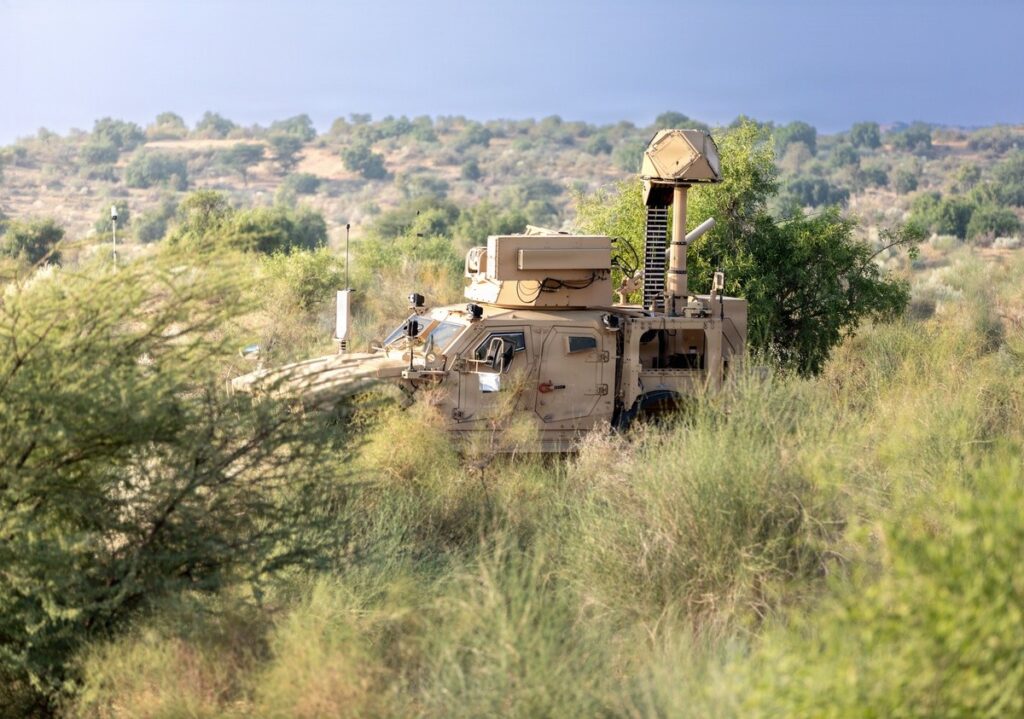
M-LIDS is not a single weapon. The U.S. Army describes it as an integrated suite combining detection, command and control, and kinetic and non-kinetic defeat capabilities on mobile tactical vehicles.
The system incorporates the Forward Area Air Defense Command and Control system to integrate sensor information. The Army also says M-LIDS uses Ku-band radar together with electro-optical and infrared sensors for detection, tracking and visual identification. Its defeat options include electronic warfare and kinetic capabilities.
That combination is important because modern counter-UAS operations rarely begin with the question of which interceptor or effect should be used. The first challenge is establishing a reliable picture of what is in the air, identifying the threat and connecting the information to an appropriate response.
For readers following India’s expanding counter-drone ecosystem, this architecture is particularly relevant. Indian systems are also increasingly being designed around multiple layers of detection, identification, command and control and mitigation. DroneUnzip previously examined how RF and radar can complement each other in airspace security.
Why the Rajasthan exercise matters
The significance of the M-LIDS activity goes beyond the hardware itself. The U.S. Army said the system was trained alongside other capabilities during Yudh Abhyas, allowing participants to consider counter-UAS protection as part of a larger force rather than an isolated mission.
The September 26 culmination of the exercise brought together Indian systems including the Pinaka multi-barrel rocket launcher, M777 ultra-light howitzer, Dhanush artillery system, L70 air-defence guns and Swathi weapon-locating radar. U.S. capabilities included HIMARS and M-LIDS.
That combination illustrates an important shift in military thinking: drones and counter-drone systems increasingly have to operate within the same battlefield network as artillery, air defence, aviation and surveillance assets.
The U.S. Army also highlighted the environmental challenge. M-LIDS was operated in Rajasthan’s heat, dust and open terrain. A mobile counter-UAS capability can reposition with a formation, which the Army identifies as an advantage when forces are operating across changing battlefield conditions.
What it means for India’s drone ecosystem
The exercise does not mean India has selected or adopted M-LIDS. That distinction matters. The publicly available U.S. Army material describes training, familiarisation and interoperability activities. It does not announce an Indian procurement or acquisition decision for M-LIDS.
What the event does demonstrate is the growing importance of counter-UAS interoperability between the two countries. India is building its own domestic counter-drone capabilities while also conducting military exercises that expose its forces to systems and operating concepts used by partner nations.
That exchange could become increasingly relevant as the Indian military evaluates how to protect mobile formations and critical assets from small unmanned aircraft. The challenge is no longer simply detecting a drone. It is connecting detection, identification, command and control and response quickly enough to preserve the force’s ability to operate.
The bigger counter-drone lesson
Yudh Abhyas 2026 offers a useful snapshot of where counter-UAS technology is heading. The emphasis is moving toward layered systems that can operate alongside conventional military capabilities and remain mobile with the force.
For India, the lesson is especially relevant as the country develops its indigenous drone and counter-drone industrial base. Exposure to international systems such as M-LIDS can provide another reference point for thinking about mobility, sensor integration, command and control and the relationship between electronic and kinetic countermeasures.
There is no evidence from the exercise itself that India has chosen M-LIDS for procurement. The more immediate takeaway is simpler: counter-drone capability is becoming a routine part of combined military training, and interoperability is becoming almost as important as the individual system.
Sources
- U.S. Army: M-LIDS strengthens counter-UAS interoperability during Yudh Abhyas 2026, September 25, 2026
- U.S. Army: U.S., Indian armies complete bilateral live-fire exercise during Yudh Abhyas 2026, September 26, 2026
- Press Information Bureau: India-US Joint Military Exercise Yudh Abhyas 2026 commences, September 15, 2026