
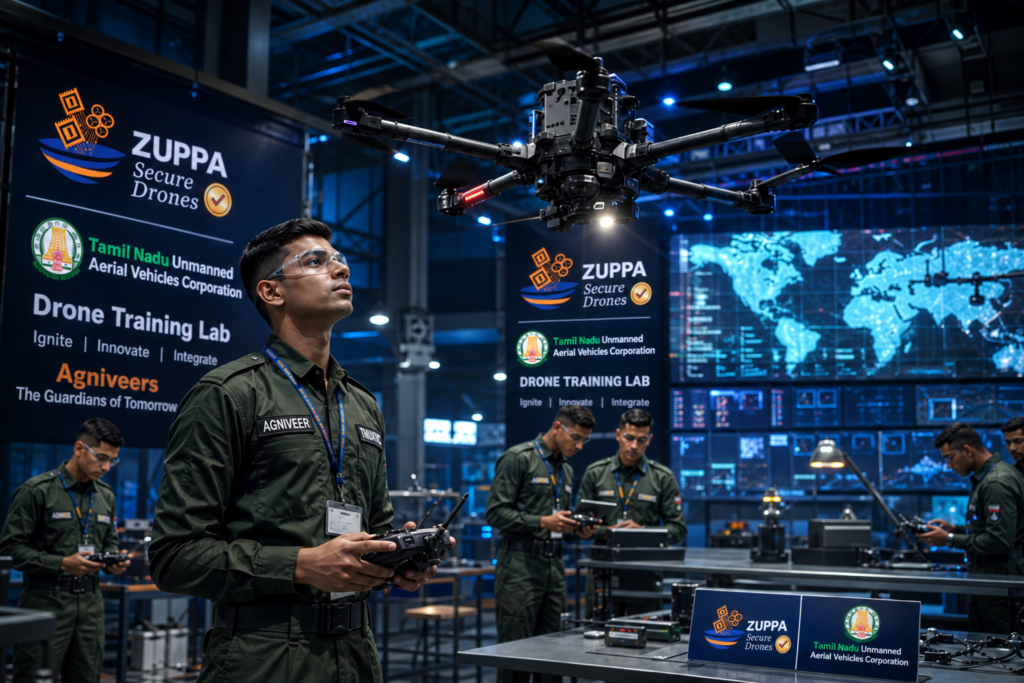
Indian defence drone company Zuppa Geo Navigation Technologies has signed a memorandum of understanding (MoU) with the Tamil Nadu Unmanned Aerial Vehicles Corporation (TNUAVC) to establish drone-training laboratories at Army Regimental Centres and develop a structured pilot-training programme for Agniveers and serving defence personnel. The initiative is also intended to support personnel transitioning out of the armed forces.
Announced on September 29, 2026, the programme is planned to begin at the Madras Regimental Centre in Wellington, Coonoor. The first phase is expected to train 200 personnel in its initial batch, with capacity planned for about 1,000 trainees annually. The four-week course is expected to combine classroom instruction, simulator work and practical flying.
What the Zuppa-TNUAVC agreement includes
Under the MoU, Zuppa will establish indigenous drone laboratories and provide equipment and training infrastructure. The facilities are expected to include micro- and small-category drones, mission flight simulators, learning management systems and related training resources.
TNUAVC will deploy qualified instructors to conduct the training in line with applicable Directorate General of Civil Aviation (DGCA) requirements. The two organisations will jointly develop the curriculum, conduct assessments and facilitate certification.
The planned four-week programme covers several areas of UAV operations, including rotorcraft principles and aerodynamics, hybrid operations, drone equipment maintenance, risk assessment, safety management, basic assembly, practical flying, mission planning and relevant regulations. The combination is designed to cover more than piloting alone, with maintenance and operational safety included in the course outline.
Training targets and certification pathway
Zuppa founder and managing director Sai Pattabiram said the partnership aims to train and certify more than 2,000 Agniveers and defence personnel over three years. That figure is a stated programme target; it should not be read as the number of personnel already trained or certified.
Eligible participants may pursue the DGCA-approved Small Category Remote Pilot Certificate (RPC) for drones weighing above 2 kg and up to 25 kg, subject to the applicable eligibility, training and assessment requirements. The announcement does not indicate that every participant will automatically receive a certificate on completing the course.
The initial plan combines a first batch of 200 with an intended annual training capacity of around 1,000. The reported three-year target of more than 2,000 certifications is a separate programme goal, and the organisations have not publicly detailed a year-by-year enrolment or certification schedule.
Why drone skills are becoming relevant to defence
Unmanned aircraft are used across a widening range of defence tasks, including surveillance, reconnaissance, communications support and logistics. Their usefulness depends not only on the aircraft, but also on personnel who can plan missions, operate equipment safely, maintain systems and understand operating restrictions.
For military users, training must account for mission context, equipment reliability, risk and coordination with other activities. A structured course can provide a common foundation, although the announcement does not specify how the programme will be integrated into particular Army units or operational roles.
Drone training can also have relevance beyond uniformed service. Personnel leaving the armed forces may be able to apply transferable skills in civilian UAV operations, subject to the requirements of the role and any licences or permissions needed. The partners have positioned the programme as a way to build a wider pool of skilled UAV professionals, but have not announced job-placement commitments or employment outcomes.
How the initiative fits India’s drone ecosystem
The agreement adds a training and workforce-development element to India’s expanding drone ecosystem. Much of the public conversation around the sector focuses on aircraft, payloads, autonomy and procurement. Training infrastructure addresses a different part of the value chain: the people who operate, inspect, maintain and manage unmanned systems.
DroneUnzip has previously covered counter-UAS developments, including the M-LIDS counter-drone system demonstrated during Yudh Abhyas 2026 and Indra’s DRIZZLE interceptor drone. Those systems address detection or interception, whereas the Zuppa-TNUAVC programme focuses on building operational skills. Together, these areas illustrate the breadth of capabilities involved in unmanned aviation, without implying that the initiatives are connected.
The training labs are described as indigenous, but the public announcement does not provide a detailed bill of materials, investment value, number of laboratories, equipment suppliers or a schedule for expansion beyond the initial location. Those details will be important in assessing the programme’s eventual scale.
What remains to be confirmed
The MoU establishes a framework for cooperation, while several implementation details remain open. These include the final course calendar, the number of trainees who will complete each batch, the certification outcomes, the cost of the programme and whether additional Army Regimental Centres will be included.
There is also a distinction between creating training capacity and demonstrating long-term results. Actual enrolment, course completion, certification and post-service employment figures will provide a clearer measure of the programme’s reach once training begins.
For now, the agreement marks a planned collaboration between a private Indian drone technology company and a state-linked UAV corporation to establish structured training for defence personnel. Its significance will depend on how quickly the labs become operational and whether the announced training targets translate into sustained, measurable outcomes.