

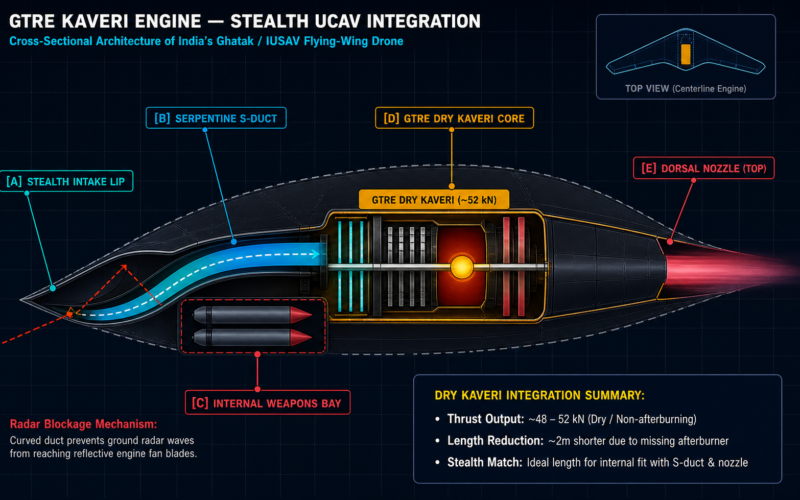
The propulsion system planned for India’s Ghatak unmanned combat aerial vehicle (UCAV) is one of the programme’s most important and least publicly documented elements. Public reporting has associated Ghatak with a non-afterburning derivative of the indigenous Kaveri engine, developed by the Defence Research and Development Organisation’s Gas Turbine Research Establishment (GTRE). But the connection needs careful explanation: an engine programme, an engine test milestone and a flying combat aircraft are three different stages of development.
This guide explains the Kaveri connection, why a dry-engine derivative is being discussed for an unmanned aircraft, what the available sources establish, and which important details remain undisclosed. It draws on official DRDO/Ministry of Defence material and clearly attributed reporting rather than treating every reported specification as an officially confirmed Ghatak capability.
What engine is associated with the Ghatak UCAV?
Public reporting has linked the planned Ghatak UCAV with the Kaveri Derivative Engine (KDE), a non-afterburning derivative of India’s Kaveri aero-engine programme. The Kaveri family was developed by GTRE, a DRDO laboratory responsible for gas-turbine propulsion research.
The Ministry of Defence’s Aero India 2025 release lists a “Kaveri Derivate Aero Engine without afterburner” among the technologies displayed. This confirms the derivative was showcased, not that it has been integrated into Ghatak or that its final performance is publicly established.
The distinction matters because Ghatak’s final propulsion arrangement and its integration milestones should be described only to the extent supported by public evidence. The available sources associate the dry Kaveri derivative with Ghatak, but do not provide a complete, officially released propulsion specification for the full-scale aircraft.
What is the Kaveri dry engine?
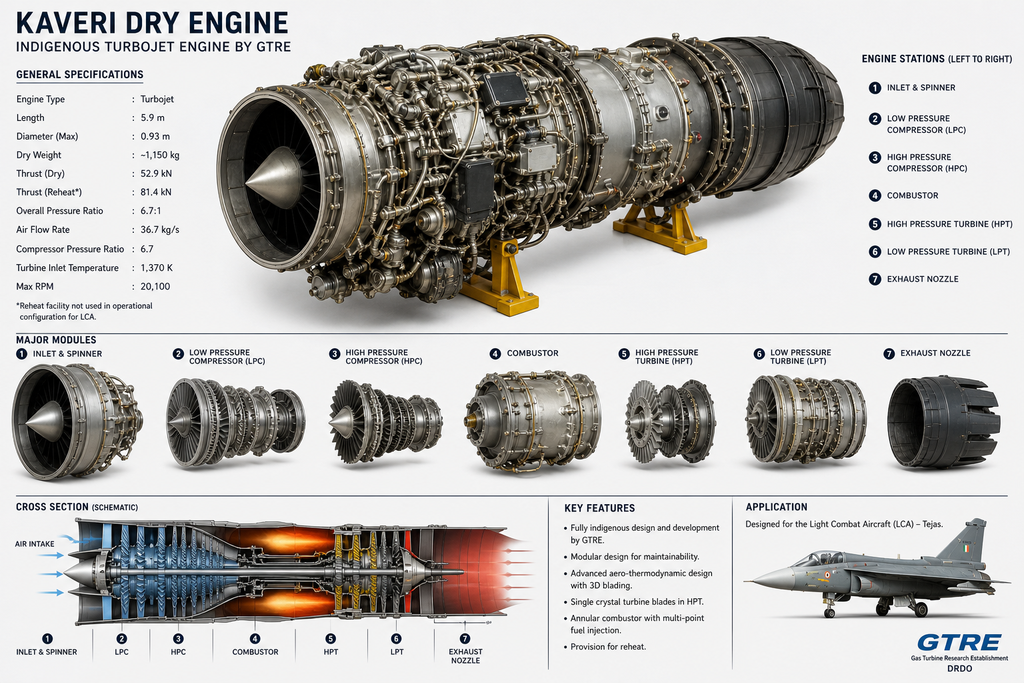
A dry engine is a gas-turbine engine that operates without an afterburner. An afterburner injects additional fuel into the exhaust stream to produce a temporary increase in thrust. It is useful for some high-performance fighter missions, but adds complexity, heat and fuel demand.
The Kaveri programme originally aimed to produce an indigenous engine for the Light Combat Aircraft (LCA) Tejas. The original afterburning engine did not meet the requirements needed for the production Tejas, and the fighter moved ahead with a different powerplant. The wider Kaveri effort nevertheless built experience in aero-engine design, component development and testing.
A non-afterburning derivative is a different application of that work, not proof that the original Kaveri engine has become suitable for Tejas. It must be assessed against the needs of its own intended platform, including thrust, weight, fuel use, reliability and operating conditions.
Why could a dry engine suit an unmanned combat aircraft?
An unmanned aircraft does not automatically need the same engine characteristics as a crewed fighter. Its propulsion requirements depend on the aircraft’s weight, aerodynamic design, mission profile, desired speed and altitude, internal fuel volume, and the balance between endurance and performance.
A dry turbofan may be appropriate when the aircraft’s mission does not require the short-duration thrust boost provided by an afterburner. That is a general engineering consideration, not a confirmed statement about every Ghatak mission requirement. Publicly available sources do not disclose enough information to calculate the final aircraft’s thrust requirement or determine its expected range and endurance from the engine alone.
Propulsion also interacts with the airframe. Intake design, exhaust treatment, thermal management and engine placement can influence an aircraft’s aerodynamic performance and its low-observable design. For a stealth-oriented flying wing, those choices must be engineered as part of the complete aircraft rather than evaluated as an engine-only problem.
What do the reported Kaveri engine trials establish?
On 30 September 2026, The Times of India reported, citing a defence source, that the Kaveri dry engine had completed high-altitude and flight trials in Russia and reached a reported peak dry thrust of 48.5 kilonewtons (kN), compared with a target of approximately 46 kN. The report identified the Central Institute of Aviation Motors and the Gromov Flight Research Institute as the Russian facilities involved.
The Economic Times also covered the development while referring to the earlier report. Because the coverage traces back to the same reporting, it should not be counted as independent confirmation of the trial results. We did not locate a corresponding public DRDO or Ministry of Defence release confirming the 48.5 kN figure during this research.
Accordingly, the thrust figure should be treated as reported, not independently confirmed by a public primary source. It is not a published Ghatak engine specification, and it does not establish that the engine has been installed in a Ghatak prototype or that Ghatak has flown with it.
Even when a test milestone is confirmed, a thrust result alone does not establish operational readiness. The full test envelope, reliability, durability, control behaviour, certification requirements and suitability for the intended aircraft all matter.
What remains before the engine can be integrated with Ghatak?
Engine development and aircraft development involve overlapping but distinct work. The following are the types of milestones that matter when evaluating whether a propulsion system is ready for use in an aircraft. The exact sequence and status for Ghatak should not be assumed unless an authoritative source confirms them.
- Test-data review: Engineers assess whether the test results meet the programme’s technical requirements and identify issues requiring further work.
- Airworthiness and qualification: The relevant authorities evaluate evidence that the engine and its intended installation satisfy applicable safety and performance requirements.
- Aircraft integration: The propulsion system must work with the airframe, intake, exhaust, fuel, electrical, control and monitoring systems.
- Integrated ground testing: The assembled system is checked for interfaces, control response, thermal behaviour and other aircraft-specific factors.
- Aircraft-level flight trials: Testing of the complete aircraft is needed to establish how the integrated system performs in flight.
The September 2026 report said certification and integration were still ahead. Without a newer official confirmation, DroneUnzip should not describe those steps as completed or give a definitive date for Ghatak’s first flight, production or induction.
How does the engine story connect to DRDO’s SWiFT demonstrator?
DRDO’s Stealth Wing Flying Testbed (SWiFT), also described by the Ministry of Defence as the Autonomous Flying Wing Technology Demonstrator, provides context for the wider Ghatak effort. DRDO reported SWiFT’s maiden flight on 1 July 2022 and a successful flight in the final tailless configuration on 15 December 2023.
The official release on the 2023 trial described autonomous landing using onboard sensor-data fusion and GAGAN-supported navigation. These are relevant technology-development achievements for autonomous flying-wing aircraft.
SWiFT is not the full-scale Ghatak UCAV, however. Its publicly reported flights do not demonstrate that Ghatak has completed engine integration, aircraft-level flight testing or operational qualification. Readers can find the wider programme background in our Ghatak UCAV overview and the specific demonstrator chronology in our SWiFT explainer.
What is confirmed, reported and still unknown?
| Question | What the available evidence supports |
|---|---|
| Who developed the Kaveri engine family? | DRDO’s Gas Turbine Research Establishment (GTRE). |
| Has DRDO publicly displayed a Kaveri derivative without an afterburner? | Yes. The Ministry of Defence listed it among DRDO technologies displayed at Aero India 2025. |
| Is the dry Kaveri derivative linked to Ghatak? | Yes in published reporting, but the public sources reviewed do not provide a complete official Ghatak propulsion specification. |
| Did the dry engine reach 48.5 kN in Russian trials? | Reported by The Times of India citing a defence source; we did not locate a corresponding public primary-source confirmation. |
| Has Ghatak flown with this engine? | Not established by the sources reviewed for this article. |
| Are final range, endurance, speed and service-entry dates confirmed? | Not established by the sources cited here. |
Why the Kaveri connection matters for India
Developing an indigenous aero-engine is a long-term technical challenge. A successful propulsion system requires more than reaching a target thrust figure: it must deliver repeatable performance, reliability, maintainability and compatibility with its intended aircraft throughout the required operating envelope.
For Ghatak, an indigenous propulsion option could support greater control over an important technology and supply chain. But the strategic value will depend on the engine completing the relevant development, qualification and integration work. A test milestone is progress, not a substitute for those later stages.
Conclusion
The Kaveri dry-engine connection is an important part of the Ghatak story, but the public evidence supports a narrower conclusion than some headlines suggest. Official material confirms that DRDO displayed a Kaveri derivative without an afterburner, while September 2026 reporting describes Russian trials and a 48.5 kN thrust result. We did not find a public primary-source confirmation of that figure or evidence in the sources reviewed that Ghatak has flown with the engine.
The next meaningful evidence will be an authoritative update on qualification, aircraft integration or integrated flight testing. Until then, the engine should be described as a reported propulsion path for Ghatak, not a fully confirmed operational capability. For programme context, see our Ghatak UCAV overview and SWiFT demonstrator explainer.
FAQs
Which engine is expected to power the Ghatak UCAV?
Public reporting associates Ghatak with the Kaveri Derivative Engine, a non-afterburning derivative developed by DRDO’s GTRE. A complete official specification for Ghatak’s final propulsion configuration has not been publicly established in the sources reviewed.
What is the difference between the Kaveri engine and the Kaveri dry engine?
The original Kaveri was developed as an afterburning engine for the Tejas programme. The dry derivative operates without an afterburner and is being pursued for a different application. The two should not be treated as interchangeable configurations.
Has the Kaveri dry engine completed its trials?
A 30 September 2026 report by The Times of India, citing a defence source, said the engine had completed high-altitude and flight trials in Russia. We did not locate a corresponding public DRDO or Ministry of Defence release confirming the reported thrust figure.
Has Ghatak flown with the Kaveri engine?
The sources reviewed for this article do not establish that Ghatak has flown with the engine. Engine testing, engine certification, aircraft integration and an integrated aircraft flight are separate milestones.
Do we know Ghatak’s engine thrust, range or service-entry date?
The 48.5 kN figure has been reported for the dry engine, not confirmed as a final Ghatak specification by a public primary source. The sources reviewed do not establish Ghatak’s final range, endurance or service-entry date.
