

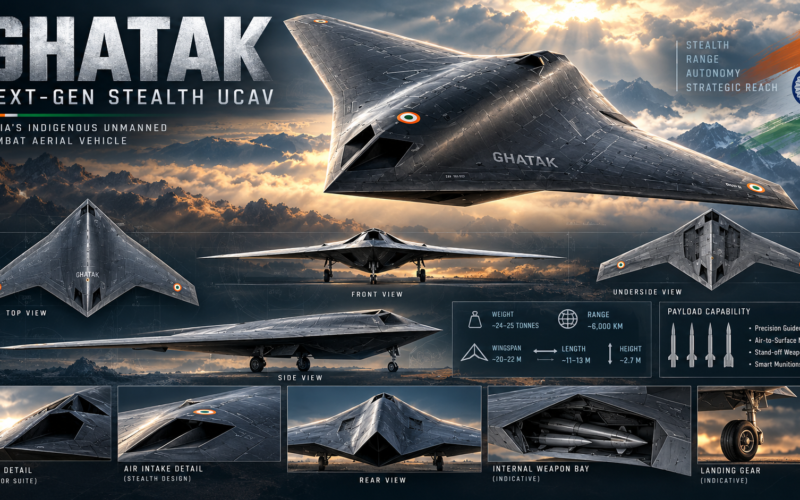
Discover India’s Ghatak UCAV, DRDO’s ambitious stealth combat drone programme. Explore its SWiFT demonstrator, indigenous engine, anticipated capabilities and production plans.
India’s pursuit of an indigenous stealth combat aircraft has extended beyond conventional fighter jets. The Defence Research and Development Organisation (DRDO) is developing the Ghatak Unmanned Combat Aerial Vehicle (UCAV), a jet-powered, flying-wing aircraft designed to undertake combat missions without an onboard pilot.
Unlike conventional surveillance drones, Ghatak is intended to combine low-observable design, autonomous flight and internal weapons carriage. Its development also represents a long-term effort to build domestic expertise in advanced unmanned aviation, including flight control, propulsion and aircraft integration.
The programme has reached an important milestone through the successful flight testing of the Stealth Wing Flying Testbed (SWiFT), a smaller technology demonstrator. However, the full-scale Ghatak remains a development project, and several of its intended performance characteristics have yet to be publicly confirmed.
What is the DRDO Ghatak UCAV?
The Ghatak UCAV is an indigenous unmanned combat aircraft being developed under DRDO’s aerospace research programmes. It is intended to be a stealth-capable, jet-powered platform with autonomous flight capabilities and an internal weapons bay.
The programme evolved from the earlier AURA (Autonomous Unmanned Research Aircraft) concept. Its central design philosophy is to combine the aerodynamic characteristics of a flying wing with the reduced radar signature and mission flexibility required for a future combat aircraft.
Unlike remotely piloted surveillance drones, Ghatak is intended to perform more demanding combat missions. Its proposed applications include precision strike and intelligence, surveillance and reconnaissance (ISR). The precise operational capabilities and final weapons configuration have not been publicly established.
Ghatak drone manufacturing company: Who is developing it?
The Ghatak programme is being developed by DRDO, India’s principal defence research organisation. Two important establishments associated with the programme are the Aeronautical Development Establishment (ADE) and the Aeronautical Development Agency (ADA), both based in Bengaluru.
| Organisation | Role |
|---|---|
| DRDO | Overall defence research and development organisation |
| ADE | Development of unmanned aircraft and the SWiFT technology demonstrator |
| ADA | Aircraft design expertise associated with the Ghatak programme |
| GTRE | Development of the Kaveri engine family and related propulsion technologies |
ADE’s involvement is particularly evident in SWiFT, which DRDO identifies as designed and developed by the establishment. ADA has been associated with the design of the full-scale Ghatak aircraft.
The distinction between development and manufacturing is important. DRDO establishments are responsible for developing the aircraft and its technologies, but the final production arrangement should not be confused with the research organisations themselves. Publicly available information does not establish a confirmed serial-production manufacturer for Ghatak. Claims naming a private aerospace company as the selected manufacturer should be treated cautiously unless supported by an official contract or announcement.
Ghatak drone first flight: What has DRDO achieved?
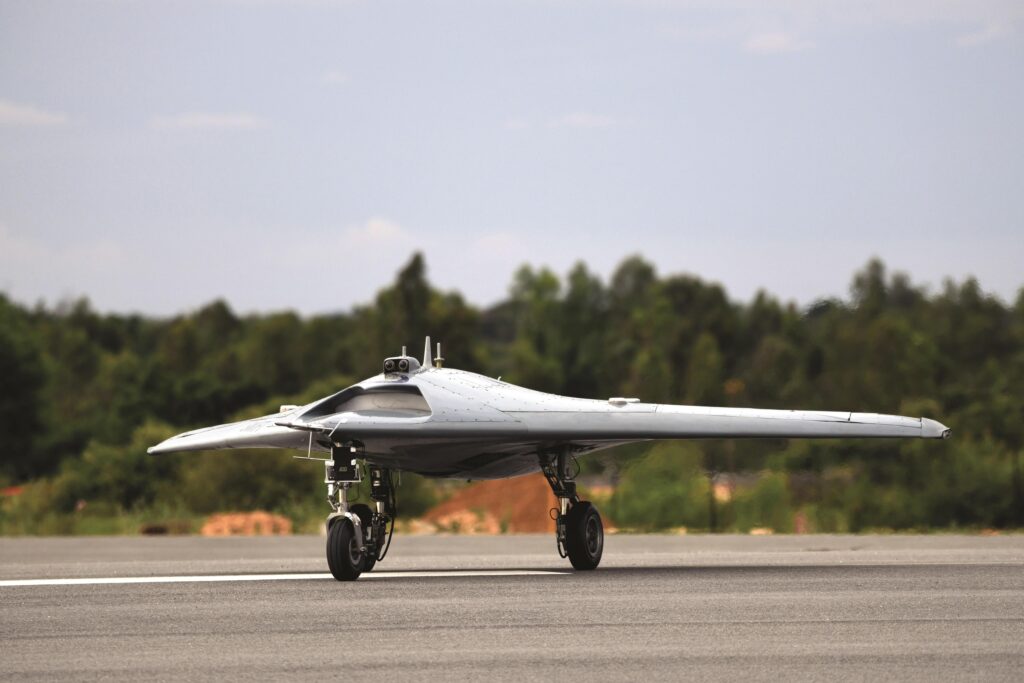
One of the most important milestones in the Ghatak programme was the first flight of its scaled technology demonstrator, SWiFT, on 1 July 2022.
DRDO successfully conducted the maiden flight at the Aeronautical Test Range in Chitradurga, Karnataka. The aircraft operated autonomously and demonstrated take-off, waypoint navigation and a controlled landing.
The Ministry of Defence described the flight as demonstrating important technologies for future unmanned aircraft. The airframe, undercarriage, flight-control systems and avionics were developed indigenously, while the demonstrator used a small turbofan engine.
The achievement was particularly relevant because a tailless flying-wing aircraft presents distinct flight-control challenges. Conventional aircraft often rely on a tail assembly for stability and control. A flying wing must achieve the required stability and manoeuvrability through its aerodynamic design and flight-control systems.
SWiFT provided DRDO with an opportunity to validate these technologies before progressing towards a much larger aircraft. The 2022 event was a milestone for SWiFT, not evidence that the full-scale Ghatak had flown.
Ghatak drone engine: The Kaveri connection
Propulsion is among the most significant technological elements of the Ghatak programme. The planned aircraft has been associated with an indigenous dry turbofan derived from the Kaveri engine family, developed by DRDO’s Gas Turbine Research Establishment (GTRE).
The original Kaveri programme was initiated to develop an indigenous engine for the Light Combat Aircraft (LCA) Tejas. Although the original engine did not meet the requirements for powering the fighter, the programme generated experience in aero-engine design and testing.
GTRE subsequently pursued a dry-engine derivative intended for unmanned aircraft applications. Unlike an afterburning fighter engine, a dry turbofan operates without an afterburner, potentially reducing fuel consumption and simplifying the propulsion system for its intended operating conditions.
The proposed Ghatak engine is important for two reasons:
- Indigenous propulsion: It could reduce dependence on foreign engine suppliers for this class of unmanned aircraft.
- Aircraft integration: A domestically developed engine would allow closer coordination between propulsion, airframe and flight-control development.
DRDO publications have reported ground and altitude testing of the dry Kaveri engine. However, engine test milestones should not automatically be interpreted as completed integration or qualification for Ghatak. The engine must also satisfy reliability, thermal management, fuel consumption and aircraft integration requirements.
Ghatak drone range: How far can it fly?
The operational range of the Ghatak UCAV is one of the most frequently discussed aspects of the programme. However, there is no sufficiently verified official figure that establishes its final combat or ferry range.
Several factors will influence the aircraft’s eventual range, including engine efficiency and available thrust, internal fuel capacity, aircraft weight and aerodynamic efficiency, flight altitude and cruising speed, payload and mission configuration, and fuel reserved for recovery and contingencies.
Ghatak’s flying-wing architecture is intended to offer aerodynamic and low-observable advantages. Nevertheless, the design alone is insufficient to calculate its operational range.
It is also important to distinguish between ferry range and combat radius. Ferry range refers to the distance an aircraft can travel under a specified transit configuration, while combat radius accounts for the distance it can travel to a mission area and return under defined operational conditions.
Until DRDO or the Ministry of Defence releases verified performance figures, specific range claims should be treated as estimates rather than confirmed specifications.
Why does Ghatak use a flying-wing design?
The flying-wing configuration is a defining feature of Ghatak. Unlike conventional aircraft, which use a distinct fuselage, wings and tail assembly, a flying wing integrates much of the aircraft’s structure into a single wing-like shape.
This architecture can offer several advantages for an aircraft designed with reduced radar visibility in mind.
- Reduced radar signature: A carefully designed flying wing can reduce radar reflections by minimising prominent vertical surfaces and managing the aircraft’s external geometry. Actual radar cross-section also depends on materials, edges, openings and engine integration.
- Aerodynamic efficiency: Flying wings can provide favourable aerodynamic characteristics, including reduced drag in suitable flight regimes. Actual efficiency depends on the specific design and mission requirements.
- Internal space: Integrating the aircraft’s structure into the wing can provide useful space for fuel, avionics and internal payloads.
- Reduced external projections: Eliminating a conventional tail and using internal payload carriage can help maintain a cleaner external configuration.
These benefits come with trade-offs. Flying wings can present stability and control challenges, particularly at low speeds and during landing. Advanced flight-control software and carefully designed aerodynamic surfaces are therefore essential.
SWiFT’s autonomous flight demonstrations were an important step towards validating some of the technologies needed for this configuration.
Ghatak drone production: When will manufacturing begin?
The transition from a technology demonstrator to a production combat aircraft involves considerably more than successful flight testing. It requires a mature design, qualification of key systems, manufacturing infrastructure and a defined acquisition programme.
In March 2026, media reporting said the Defence Procurement Board had recommended advancing a proposal for the acquisition of 60 Ghatak UCAVs. Subsequent reporting described government clearance for procurement of 60 aircraft. Procurement clearance and actual production, however, are separate stages.
A procurement decision does not necessarily mean that the final production design has been frozen, manufacturing contracts have been awarded or deliveries have begun.
For Ghatak, the remaining milestones include maturation of the full-scale design, integration of its intended propulsion system, flight testing and establishment of a production arrangement. An exact date for the beginning of serial production should not be treated as confirmed without an official schedule.
Ghatak UCAV’s intended capabilities and applications
Ghatak is being developed as a combat aircraft rather than a platform dedicated exclusively to surveillance. Its intended capabilities reflect that distinction.
| Capability | Development status |
|---|---|
| Autonomous flight | Demonstrated on SWiFT |
| Flying-wing configuration | Demonstrated on SWiFT |
| Stealth-oriented design | Intended for Ghatak |
| Internal weapons carriage | Part of the planned concept |
| Precision strike | Intended mission |
| ISR | Reported intended mission |
| Operational combat range | Not officially established |
| Operational weapons integration | Not publicly established |
| Operational deployment | Not achieved |
The combination of autonomy and low-observable design is central to Ghatak’s intended role. However, the full range of autonomous decision-making capabilities has not been publicly disclosed. Autonomous navigation, for example, is not the same as autonomous target selection or engagement. These are separate functions with different technical, operational and legal implications.
Ghatak UCAV compared with other stealth drone programmes
Ghatak is part of a wider international effort to develop advanced unmanned combat aircraft. Several other programmes provide useful context, although their maturity and intended roles differ.
| Aircraft | Country | Configuration | Development context |
|---|---|---|---|
| Ghatak | India | Flying wing | Under development; SWiFT has flown |
| X-47B | United States | Flying wing | Demonstrated autonomous carrier operations |
| nEUROn | European consortium | Flying wing | Technology demonstrator with extensive flight testing |
| GJ-11 | China | Flying wing | Publicly observed, with limited verified performance data |
| Kızılelma | Türkiye | Conventional tailless configuration | Jet-powered unmanned combat aircraft under flight testing |
The US X-47B demonstrated autonomous carrier take-off and landing, while Europe’s nEUROn programme focused on validating stealth-oriented UCAV technologies. China’s GJ-11 is another flying-wing design, although reliable public information about its capabilities remains limited.
Türkiye’s Kızılelma differs in its external configuration and development objectives, despite also targeting advanced unmanned combat operations.
These programmes provide a useful technological comparison, but they should not be treated as equivalent aircraft. Differences in size, propulsion, mission requirements and maturity make direct performance comparisons unreliable.
What lies ahead for India’s Ghatak UCAV?
The next stages of Ghatak’s development will determine how quickly the programme can move from technology validation to an operational aircraft.
Full-scale aircraft development: The transition from SWiFT to the larger Ghatak will require extensive aerodynamic, structural and systems engineering. A successful flight by the demonstrator does not eliminate the need for a separate full-scale testing programme.
Propulsion maturity: Integration of a suitable indigenous engine will be an important milestone. Engine reliability, fuel efficiency and compatibility with the final airframe will influence the programme’s progress.
Acquisition and production: The reported 60-aircraft procurement plan provides an indication of the intended scale of the programme. Actual production will depend on design maturity, acquisition procedures, contracts and manufacturing readiness.
Ghatak’s longer-term significance extends beyond the aircraft itself. Developing an indigenous UCAV could help strengthen India’s expertise in autonomous aviation, low-observable technologies, aircraft control systems and jet propulsion.
Nevertheless, the distinction between a technology demonstrator, a prototype and a production aircraft remains essential when assessing the programme’s progress.
Conclusion
The DRDO Ghatak UCAV is India’s indigenous stealth-oriented unmanned combat aircraft programme, featuring a flying-wing design, autonomous flight architecture and planned Kaveri-derived propulsion. The 2022 SWiFT flight demonstrated key foundational technologies, while 2026 procurement developments indicate progress towards larger-scale acquisition. However, its final range, full-scale flight milestones, operational performance and serial production schedule remain to be established, with its success depending on translating SWiFT’s demonstrated technologies into a reliable, production-ready combat aircraft.
FAQs
What is the Ghatak UCAV?
Ghatak is an indigenous stealth-oriented unmanned combat aerial vehicle being developed by DRDO. It is designed around a flying-wing configuration and is intended for autonomous flight and combat missions.
Who manufactures the Ghatak drone?
DRDO is responsible for its development, with ADE and ADA playing important roles. The final serial production manufacturer has not been publicly confirmed.
What is the range of the Ghatak drone?
Ghatak’s official operational range has not been publicly established. Published estimates should be treated cautiously until verified performance specifications become available.
Which engine will power the Ghatak UCAV?
The planned aircraft is associated with a dry turbofan derived from India’s Kaveri engine programme, developed by GTRE. Its final operational engine configuration should be confirmed through official programme announcements.
When did the Ghatak drone have its first flight?
The smaller SWiFT technology demonstrator completed its maiden flight on 1 July 2022. This was not the first flight of the full-scale Ghatak UCAV.
Is the Ghatak UCAV operational?
No. Ghatak remains a development programme. Procurement developments do not, by themselves, establish that the aircraft has entered operational service.
