

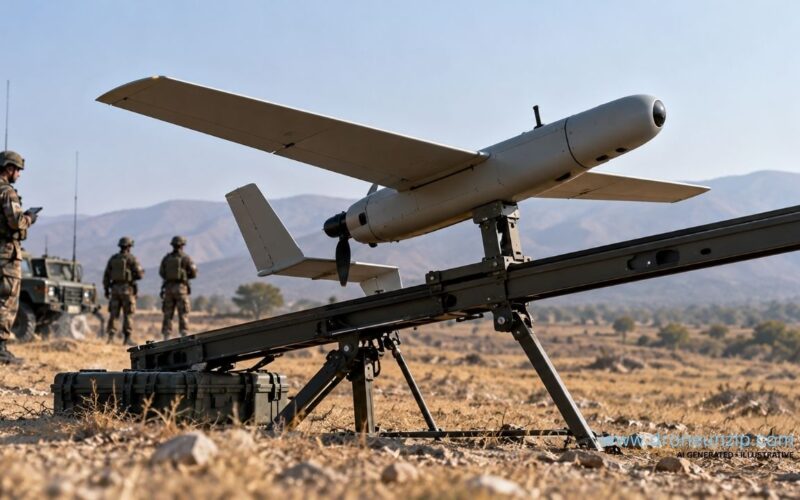
India’s Nagastra-1 is an important milestone in the country’s effort to field locally developed precision-strike systems. Developed by Economic Explosives Limited (EEL), part of Solar Industries India, the man-portable loitering munition was ordered by the Indian Army under emergency procurement powers. The programme has also moved into a follow-on phase with the reported Nagastra-1R order.
This guide separates confirmed procurement milestones from specifications reported by defence media and industry material. That distinction matters: figures for range, accuracy, endurance and indigenous content can vary by configuration and source, and not every detail has been published in an official technical datasheet.
What is Nagastra-1?
Nagastra-1 is an Indian-developed loitering munition, often described in news coverage as a kamikaze drone. Unlike a conventional surveillance UAV intended to return after a flight, a loitering munition is designed to search or wait over an area and then strike a designated target. The term “one-way attack drone” describes its strike role, although some systems can abort a mission and recover under specified conditions.
The system is intended to give ground forces a portable option for precision engagement. Public reporting describes a complete system package that includes the aerial vehicle and supporting ground equipment, rather than just the aircraft alone.
Who developed Nagastra-1?
Nagastra-1 was developed by Economic Explosives Limited, a subsidiary of Solar Industries India, headquartered in Nagpur. Reporting has also identified Bengaluru-based Z-Motion Autonomous Systems as a development partner. The programme is an example of private-sector participation in India’s defence manufacturing ecosystem.
Some reports describe the original system as having more than 75% indigenous content. That figure should be understood as a reported programme-level claim, not proof that every component is domestically sourced or that the percentage applies unchanged to later variants.
Indian Army order and delivery timeline
- June 2024: Reports said the Army had ordered 480 Nagastra-1 loitering munitions under emergency procurement. The first batch of 120 units was reported delivered after pre-delivery inspection.
- December 2024: News reports said the full consignment of 480 systems had been supplied to the Army.
- June 2025: Defence reporting described a follow-on order for 450 Nagastra-1R systems, reportedly valued at ₹158 crore, with delivery expected within 12 months.
- January 2026: The Ministry of Defence said Nagastra drones manufactured by the Solar Group had been used during Operation Sindoor. The ministry did not publish a detailed operational assessment or a technical breakdown in that statement.
Nagastra-1: publicly reported capabilities
Public reports describe Nagastra-1 as a man-portable, electrically propelled system with a low acoustic signature. Media accounts have cited a complete system weight of about 30 kg when its supporting equipment is included, and a warhead intended for soft targets. Reported range and accuracy figures differ between accounts, so they should not be treated as universally applicable performance guarantees.
| Attribute | What public sources say | How to interpret it |
|---|---|---|
| System type | Man-portable loitering munition | Established description across reporting |
| Developer | Economic Explosives Limited, Solar Industries group | Reported consistently; Z-Motion has also been identified as a partner |
| Indigenous content | More than 75% reported for Nagastra-1 | Source-specific claim; do not automatically apply to every variant |
| Range and accuracy | Various reports cite figures around 15–30 km and metre-level accuracy | Figures vary by source and control mode; no single number should be presented without qualification |
| Propulsion | Electric propulsion is reported | Associated with a lower acoustic signature than many combustion-powered designs |
| Recovery | Mission-abort and parachute recovery have been reported | Recovery is conditional and does not mean every strike mission is reusable |
These figures are drawn from public reporting and defence-industry material, not a complete, independently verified specification sheet released for every configuration. Operational performance can depend on variant, payload, communications, weather and mission profile.
What is Nagastra-1R?
Nagastra-1R is the follow-on variant associated with the reported 2025 order. A DESIDOC/DRDO press-clipping bulletin described an order for 450 systems and reported features including a thermal-camera option for night operations, encrypted video and telemetry links, a precision-targeting system and more than 80% indigenous content. These are reported details, and should not be silently transferred to the original Nagastra-1.
The reported increase in indigenous content also illustrates why articles should name the specific variant when discussing capabilities. Procurement announcements, media reports and manufacturer statements may refer to different configurations or milestones. For a broader introduction to the category, read our beginner’s guide to kamikaze drones.
Why Nagastra-1 matters for India
The programme matters for three broad reasons. First, it gives the Army an indigenous option in a category that has become more prominent in recent conflicts. Second, it creates an opportunity to build domestic expertise across airframes, guidance, communications, payload integration and ground-control equipment. Third, follow-on orders can help manufacturers improve production capacity and refine systems using user feedback.
Indigenous production does not automatically establish superiority over imported alternatives. A meaningful comparison would require transparent, like-for-like evidence on reliability, electronic-warfare resilience, target-recognition limits, lifecycle costs, training burden and performance in realistic conditions. Much of that information is not public.
What remains undisclosed?
Public information does not provide a complete picture of Nagastra-1’s operational performance. Details that should not be guessed include verified effectiveness in different weather and terrain, resistance to jamming across all mission conditions, production cost per complete system, maintenance requirements, serviceability rates and the exact performance envelope of each variant.
Statements about operational use should also be handled carefully. The Ministry of Defence’s January 2026 statement said Solar Group’s Nagastra drones were used during Operation Sindoor, but it did not provide a detailed public after-action report. That is evidence of an official statement about use, not a basis for inventing mission counts, target effects or hit rates.
FAQs
What is Nagastra-1?
Nagastra-1 is an Indian-developed, man-portable loitering munition designed for precision-strike missions.
Who manufactures Nagastra-1?
It was developed by Economic Explosives Limited, part of Solar Industries India. Public reporting has also identified Z-Motion Autonomous Systems as a development partner.
How many Nagastra-1 systems did the Indian Army order?
Reports in 2024 said the Army ordered 480 systems and that the complete consignment was delivered by December 2024.
What is the range of Nagastra-1?
Public reports cite different range figures, often depending on control mode and configuration. Until a definitive technical datasheet is available, range claims should be attributed to their source rather than treated as a single guaranteed figure.
How is Nagastra-1R different from Nagastra-1?
Nagastra-1R is a follow-on variant. A June 2025 defence press-clipping bulletin reported a 450-unit order and described upgrades including a thermal-camera option, encrypted communications and a higher indigenous-content claim.
Was Nagastra used during Operation Sindoor?
In January 2026, the Ministry of Defence stated that Nagastra drones manufactured by the Solar Group had been used during Operation Sindoor. The statement did not provide a detailed public account of specific missions or results.
Conclusion
Nagastra-1 is significant not because every performance detail is publicly settled, but because it marks a concrete Indian Army procurement of an indigenous loitering munition and has progressed into a reported follow-on variant. The strongest account of the programme keeps the 2024 Nagastra-1 delivery, the 2025 Nagastra-1R order and later official references to operational use distinct. As more official technical and procurement information becomes available, the picture of India’s loitering-munition capability can be updated without turning reported figures into unsupported certainty.
Sources: India Today’s June 2024 report; Business Standard’s December 2024 report; DESIDOC/DRDO press-clipping bulletin, June 2025; Ministry of Defence / PIB, January 2026.
