

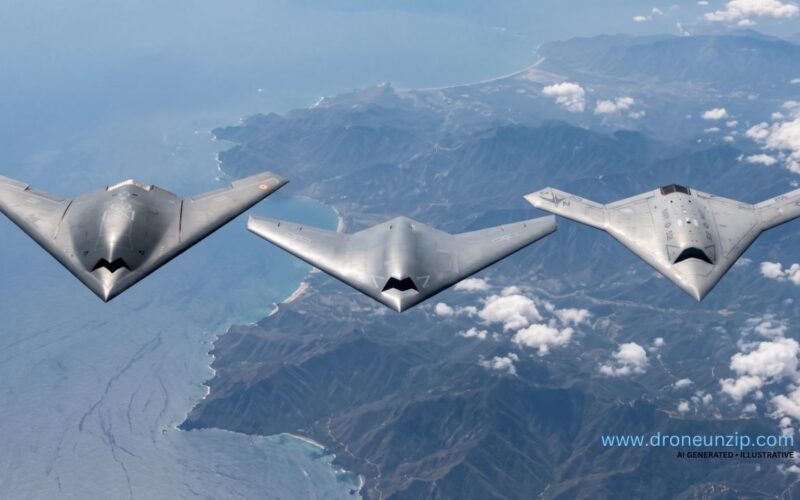
India’s Ghatak unmanned combat aerial vehicle (UCAV), China’s GJ-11 stealth attack drone and America’s X-47B are often grouped together because they use tailless flying-wing layouts. That visual similarity can be useful, but it does not make the aircraft equivalent. Their publicly documented programme stages, intended roles and demonstrated milestones differ significantly.
The fairest comparison separates three things: what each programme is intended to achieve, what has actually been demonstrated in public, and what remains undisclosed or unconfirmed. This is particularly important for Ghatak, where the full-scale aircraft’s operational specifications and flight-test status should not be inferred from the smaller SWiFT technology demonstrator.
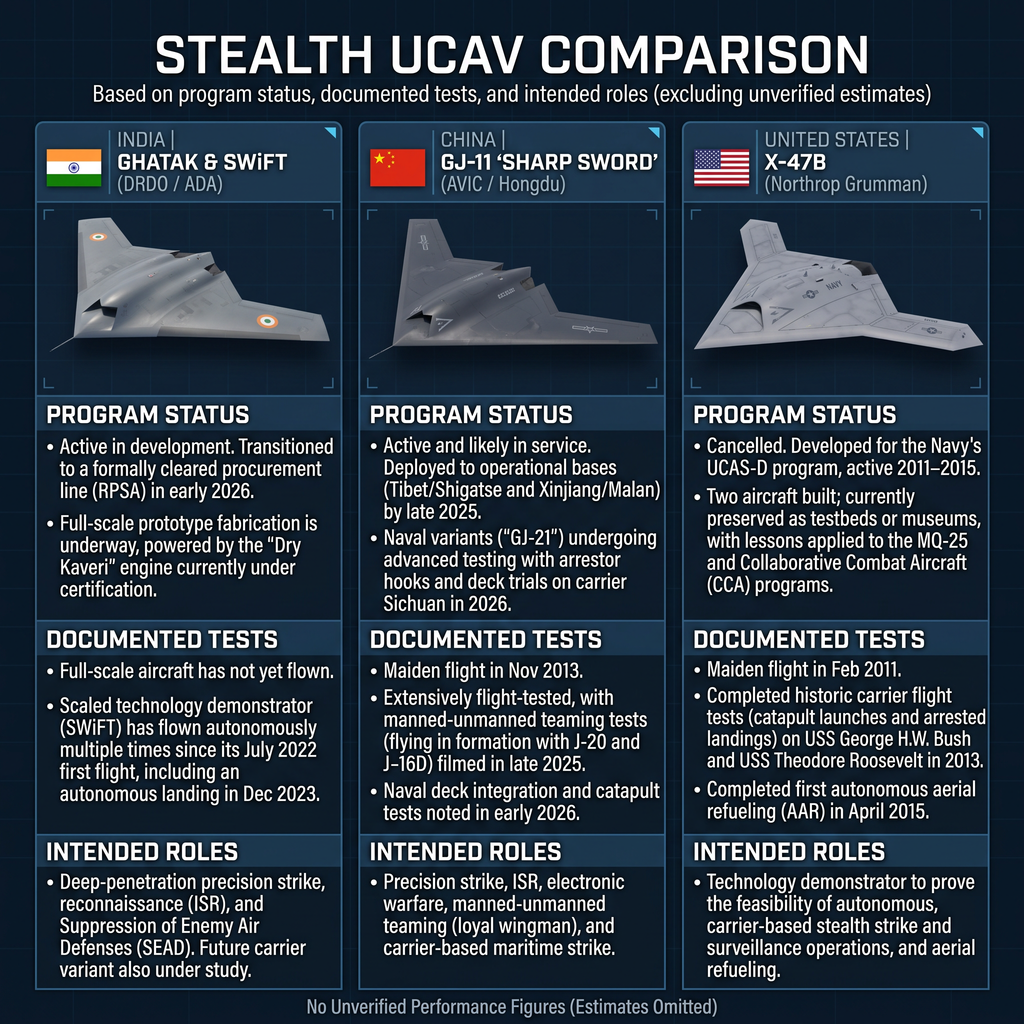
Ghatak vs GJ-11 vs X-47B: at a glance
| Category | India: Ghatak | China: GJ-11 | United States: X-47B |
|---|---|---|---|
| Programme type | Developing stealth-oriented UCAV programme | Stealth attack drone publicly displayed by China | Experimental unmanned combat air-system demonstrator |
| Flying-wing layout | Planned design; SWiFT tests related technologies | Publicly displayed flying-wing configuration | Tailless flying-wing demonstrator |
| Publicly documented milestones | SWiFT autonomous flight trials; these are not proof of a full-scale Ghatak flight | Public parade display; detailed performance data remain limited in authoritative open sources | Autonomous carrier launch/recovery demonstrations and autonomous aerial refuelling |
| Primary emphasis visible in public record | Developing India’s stealth UCAV capability | Stealth attack role, based on public presentation and reporting | Carrier aviation autonomy and technology demonstration |
| Operational status | Full-scale operational induction not confirmed in the sources reviewed | Chinese official parade reporting described it as in active service in 2019; detailed service configuration is not fully public | Demonstrator programme, not an operational strike aircraft |
| Specifications | Verified full-scale range, endurance, payload and engine details remain unconfirmed publicly | Reliable, fully official public specifications are limited | Demonstrator data exist, but should not be treated as specifications for a production combat aircraft |
1. India’s Ghatak UCAV: a developing stealth-combat programme
Ghatak is India’s planned stealth-oriented unmanned combat aircraft programme, associated with a flying-wing configuration and intended combat roles. Its development involves a combination of low-observable design, autonomous flight controls, propulsion and integration of mission systems.
The most visible related flight milestones belong to the Stealth Wing Flying Testbed (SWiFT), developed to demonstrate technologies for a future flying-wing unmanned aircraft. The Ministry of Defence reported SWiFT’s maiden autonomous flight on 1 July 2022 and a further trial in a tailless configuration on 15 December 2023. These are meaningful technology milestones, but they should not be described as the full-scale Ghatak’s first flight.
At the time of writing, the sources reviewed do not establish a confirmed full-scale Ghatak first flight, operational induction date or complete official performance specification. Claims about range, endurance, payload, engine configuration and delivery timelines should therefore be attributed to a reliable source or identified as unconfirmed.
For more detail, read our guides to the Ghatak UCAV programme, the SWiFT demonstrator, how the flying-wing layout supports stealth, the Kaveri engine connection, publicly known range and endurance details and the Ghatak development timeline.
2. China’s GJ-11: a stealth attack drone with limited public specifications
China publicly displayed the GJ-11 stealth attack drone during its National Day military parade on 1 October 2019. China’s government news service identified the GJ-11 among the unmanned systems shown at the event, while reporting at the time described it as a reconnaissance-strike or stealth attack platform.
The aircraft’s flying-wing appearance suggests a design shaped around low-observable characteristics, but appearance alone cannot establish its radar signature, sensor suite, mission radius, payload or combat effectiveness. Publicly accessible authoritative sources provide much less detail about the GJ-11’s full performance and configuration than would be needed for a reliable numerical comparison.
China’s official parade coverage in 2019 reported that the GJ-11 was in active military service. That is a meaningful difference from a technology demonstrator, but it does not make every widely circulated claim about the aircraft’s specifications independently verified. The scope of deployment, operational variants and exact capabilities remain difficult to assess from open sources alone.
3. America’s X-47B: a demonstrator that proved carrier-based autonomy
The X-47B was developed as an experimental Unmanned Combat Air System Demonstration (UCAS-D) aircraft for the US Navy. Its central public achievement was demonstrating that an unmanned, tailless aircraft could operate in demanding carrier aviation environments, rather than entering service as an operational strike platform.
In July 2013, the US Navy and Northrop Grumman reported the X-47B’s first arrested landing aboard a moving aircraft carrier. In April 2015, the US Navy reported that the aircraft completed an autonomous aerial refuelling demonstration, receiving fuel from a tanker. These milestones provided evidence of carrier operations and autonomous flight-system capabilities.
The X-47B should not be treated as an operational equivalent of the GJ-11 or as a direct measure of what Ghatak may eventually achieve. It was a demonstrator designed to test technologies and operational concepts. Its achievements are valuable reference points for unmanned aviation, but they do not establish the capabilities of a future production combat aircraft.
4. Why the flying-wing design matters, and what it cannot tell us
A flying-wing configuration can help reduce some sources of radar reflection by avoiding a conventional tail and integrating the body and wings into a continuous planform. Designers must still manage radar reflections from edges, inlets, apertures, materials and other details. A flying-wing silhouette alone is not proof of a particular stealth level.
The layout also creates aerodynamic and control challenges, especially at low speeds and during landing. The SWiFT flight trials are relevant because they demonstrate development work on autonomous flying-wing control and landing technologies. However, the final performance of a larger aircraft depends on its own design, systems integration, testing and operating requirements.
5. Which aircraft is more advanced?
There is no single defensible ranking without defining what “advanced” means. If the measure is publicly demonstrated carrier launch, recovery and aerial refuelling, the X-47B has clear documented milestones. If the measure is a publicly presented stealth attack drone described by Chinese official coverage as in service in 2019, the GJ-11 has a different programme position. Ghatak’s progress should be judged against its own development milestones, not against capabilities inferred from the other aircraft’s appearance.
A numerical comparison of range, endurance, speed, payload or radar cross-section would be misleading where specifications are not verified on a like-for-like basis. Even when figures circulate in defence media, they may refer to estimates, different variants or different test conditions. Without comparable primary-source data, a table of precise performance numbers would create false certainty.
6. What a fair comparison can conclude
- Ghatak: judge progress by verified full-scale development and flight-test milestones, keeping SWiFT results separate.
- GJ-11: acknowledge its public presentation as a Chinese stealth attack drone while treating detailed performance claims cautiously.
- X-47B: recognise its documented carrier-operation and autonomous-refuelling demonstrations, without labelling it an operational combat aircraft.
- All three: distinguish demonstrated capability, intended role, programme status and speculation instead of assuming similar shapes mean similar performance.
FAQs
Is Ghatak more advanced than China’s GJ-11?
Public evidence does not support a definitive overall ranking. Ghatak remains a developing programme with key full-scale milestones unconfirmed in the sources reviewed, while China publicly displayed the GJ-11 in 2019 and official Chinese coverage described it as in service. Reliable like-for-like performance data are not available publicly.
Is the US X-47B an operational combat drone?
No. The X-47B was an experimental US Navy demonstrator used to test unmanned carrier aviation technologies, including autonomous carrier recovery and aerial refuelling. It should not be described as an operational strike aircraft.
Have Ghatak and SWiFT both flown?
Official sources confirm SWiFT technology demonstrator flights. The sources reviewed for this article do not confirm a first flight of the full-scale Ghatak. The two should not be conflated.
Which aircraft has the longest range or endurance?
A reliable ranking cannot be made from the available verified public information. The aircraft are different programme types, and complete comparable official figures are not available for all three.
Why do all three aircraft look similar?
The flying-wing layout is one approach to reducing some radar reflections and integrating aerodynamic surfaces. Similar overall shapes do not prove identical design details, radar signatures, mission systems or performance.
Conclusion
Ghatak, GJ-11 and X-47B illustrate three different points in the development of unmanned flying-wing aircraft. India’s Ghatak programme is still best assessed through verified development milestones and the SWiFT demonstrator’s carefully bounded role. China’s GJ-11 has been publicly presented as a stealth attack drone, although its detailed specifications remain difficult to verify independently. The US X-47B, meanwhile, demonstrated important carrier-operation and autonomous-refuelling technologies but was not an operational strike aircraft. The most reliable comparison is therefore not a speculative winner’s chart: it is a clear separation of programme maturity, demonstrated milestones and unknown performance data.
