

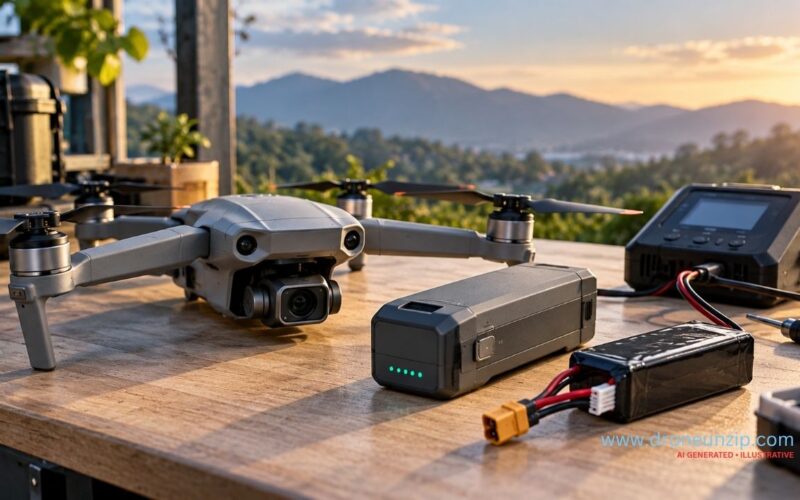
A drone’s advertised flight time is only half the story. Battery condition, temperature, payload, wind, flying style and how the pack is stored can all affect the time you actually get in the air. Understanding the battery helps you choose compatible replacements, plan flights more realistically and spot warning signs before a pack becomes a safety risk.
This guide explains common drone battery types, the meaning of mAh, volts and watt-hours, why flight time varies, and how to charge, store and inspect batteries. If you are comparing aircraft budgets, our drone price guide for India adds purchase-cost context, while our FPV drone explainer covers battery considerations for hobby quadcopters. Exact limits differ by aircraft and battery model, so the manufacturer’s manual always takes priority over general advice.
Which batteries do drones use?
Many consumer and small commercial multirotor drones use rechargeable lithium-based batteries because they can store substantial energy for their weight. Two common labels are LiPo (lithium-polymer) and Li-ion (lithium-ion). The label alone does not tell you whether a battery will fit or perform safely in a particular aircraft: voltage, connector, dimensions, discharge capability, electronics and manufacturer approval also matter.
| Battery type | Where it is commonly encountered | Potential advantages | Important limitations |
|---|---|---|---|
| LiPo (lithium-polymer) | FPV, racing, freestyle and many hobby builds | Available in a wide range of sizes and discharge ratings; can supply high current for demanding manoeuvres | Needs a compatible balance charger and careful handling; physical damage or misuse can cause fire |
| Li-ion (lithium-ion) | Some efficient long-endurance hobby designs and integrated drone packs | Can offer useful energy capacity for a given mass in suitable designs | High-current performance depends on the specific cell and pack; not a universal drop-in replacement for LiPo |
| Intelligent proprietary flight battery | Many integrated camera and enterprise drones | May include battery management, status reporting, temperature monitoring and model-specific safeguards | Compatibility and maintenance procedures are model-specific; use the approved battery and charger |
These categories overlap: an intelligent flight battery may use lithium-ion or lithium-polymer chemistry. The practical distinction is often whether the battery is a user-built pack or an integrated system with model-specific electronics and software.
mAh, voltage, cell count and watt-hours explained
Battery listings can look like a wall of numbers. Four details are especially useful when comparing packs.
| Specification | What it means | How to use it |
|---|---|---|
| Capacity (mAh or Ah) | The amount of electrical charge a battery can deliver under stated conditions | A higher mAh figure may mean more stored charge, but does not guarantee longer flight if the pack is heavier or less suitable |
| Voltage (V) | The electrical potential of the pack; it changes with chemistry, cell count and state of charge | Match the aircraft’s required battery voltage and supported cell count |
| Cell count (S) | For common hobby LiPo packs, “S” indicates how many cells are connected in series | More cells generally mean higher pack voltage; never assume a higher-S pack is compatible |
| Energy (Wh) | Watt-hours estimate stored energy and allow more meaningful comparisons across different voltages | Approximate nominal energy = voltage × amp-hours. For example, 3.5 Ah × 14.8 V ≈ 51.8 Wh |
| Discharge rating | A manufacturer rating intended to describe how quickly a battery can deliver current | Interpret ratings cautiously; labels and real performance vary. Stay within the aircraft and battery maker’s requirements |
Example: a 5,000 mAh battery is 5 Ah. If its nominal voltage is 14.8 V, its nominal energy is about 74 Wh (14.8 × 5). This calculation helps compare energy, but it does not predict exact flight time. Real usable energy is affected by load, voltage limits, battery condition and the aircraft’s reserve requirements.
What affects real-world drone flight time?
| Factor | Why it matters | Practical takeaway |
|---|---|---|
| Battery capacity and condition | Usable energy declines with ageing, damage and some storage or operating conditions | Check battery health and telemetry where available, not just the printed capacity |
| Aircraft weight and payload | Extra mass generally requires more lift and energy | Use only approved payloads and accessories; avoid unnecessary weight |
| Wind and weather | Wind can increase power demand and complicate the return leg; temperature can affect battery performance | Plan for conditions in both directions and leave a sensible reserve |
| Flying style | Hard acceleration, rapid climbs and aggressive manoeuvres can consume energy quickly | Use flight logs or controlled repeat flights to understand your own setup |
| Propellers, motors and maintenance | Damage, poor setup or mechanical problems can reduce efficiency and increase risk | Inspect the aircraft before flying and replace damaged parts |
| Battery temperature | Very hot or cold conditions can affect performance and safe charging limits | Follow the exact battery manual’s temperature limits and warnings |
Manufacturer flight-time figures are usually measured under specified test conditions. Treat them as a comparison point, not a promise that every flight will last that long. A responsible flight plan includes time to return and land before the battery reaches a critical level. Never extend a flight simply to test the advertised maximum.
How to charge a drone battery safely
Charging is one of the moments when battery condition and the right equipment matter most. DJI’s safety guidance, for example, warns against charging a hot battery immediately after flight and against using swollen, leaking or damaged packs. These are model-specific manufacturer instructions, but the core principle is broad: follow the battery maker’s manual and do not improvise a charging setup.
- Use the charger, charging hub and cable specified or approved for the exact battery.
- Charge in a dry, well-ventilated location on a stable surface, away from combustible clutter and direct heat.
- Allow a warm battery to cool to the manufacturer’s recommended temperature before charging.
- Do not charge a pack that is swollen, leaking, cracked, unusually hot, wet or otherwise damaged.
- Stay present and attentive during charging; stop if you notice unusual heat, odour, swelling, smoke or abnormal behaviour.
- Keep metal objects away from exposed terminals and prevent short circuits.
- Do not open, puncture, crush or attempt an improvised repair on a lithium battery.
If a battery begins smoking, swelling rapidly or burning, do not handle or carry it through an occupied area. Move people away, avoid inhaling fumes and contact local emergency services when there is a fire or immediate danger. Follow the battery manufacturer’s emergency guidance and local fire-safety advice.
How to store batteries between flights
Storage advice depends on the battery design. Many intelligent camera-drone batteries have their own self-discharge behaviour and specified storage level. DJI’s guidance for several intelligent flight batteries recommends a partial charge for extended storage, a cool and dry location, periodic checks and avoiding prolonged storage when fully discharged. Do not apply one manufacturer’s percentage or schedule to every battery type.
- Follow the storage charge level and temperature range specified in your exact manual.
- Keep batteries dry, away from direct sunlight, heaters and hot vehicles, especially in India’s summer conditions.
- Store packs where they cannot be crushed, punctured or short-circuited by keys, tools or loose metal items.
- Check stored batteries periodically and recharge or service them only as the manufacturer directs.
- For FPV LiPo packs, use a compatible balance charger and the storage mode specified for the pack; do not guess the voltage or leave a pack deeply discharged.
- Keep batteries away from children and dispose of damaged or end-of-life packs through an appropriate battery collection or recycling route.
Warning signs: when to stop using a battery
| Warning sign | What to do |
|---|---|
| Swelling, deformation or a split case | Stop using and charging the battery. Follow the manufacturer’s support and disposal instructions. |
| Leakage, unusual chemical smell, smoke or hissing | Keep away, avoid contact and fumes, and follow emergency guidance if there is immediate danger. |
| Damage after a crash, drop or hard impact | Do not assume the pack is safe because it still powers on; have it assessed or replaced according to the manufacturer’s guidance. |
| Unusual heating during storage or charging | Stop charging or using it if safe to do so, move people away if there are signs of failure, and contact the manufacturer or qualified service support. |
| Unexpected voltage sag, abrupt warnings or abnormal cell readings | Land safely when possible, inspect the pack and aircraft, and do not return the battery to service until the cause is understood. |
Battery cycle count can be useful, but there is no single cycle number that makes every drone battery safe or unsafe. Age, storage history, temperature, use, damage and the manufacturer’s stated service limits all matter. Replace a battery when required by its manual or when its condition is questionable.
How to choose a replacement drone battery
- Confirm the exact model. Check the aircraft’s manual or manufacturer compatibility list before ordering.
- Match voltage and cell count. A connector that fits physically does not prove electrical compatibility.
- Check dimensions and weight. A heavier pack can change handling, balance and flight time.
- Use the correct charger. Battery chemistry, cell count, charging current and balance requirements must match.
- Check authenticity and support. Prefer reputable sellers and batteries with clear model compatibility, warranty and manufacturer support.
- Compare the total cost. Include the charger, charging hub, safe storage, spare packs and replacement availability, not just the advertised battery price.
For FPV builds, do not select a battery on capacity alone. The pack must meet the build’s voltage, current, connector, dimensions and weight requirements. For integrated camera drones, a model-approved battery is usually the safer choice than an improvised substitute.
Travelling with drone batteries
Battery transport rules depend on the airline, route, battery watt-hours and whether you are carrying the battery or shipping it as cargo. Do not assume a rule from another country or airline automatically applies to an India departure. Before travelling, check the current airline instructions, airport requirements and applicable dangerous-goods rules. Protect terminals against short circuits and do not travel with damaged batteries.
The US Federal Aviation Administration’s passenger guidance illustrates why watt-hours matter for air travel, but it is not a substitute for the rules that apply to your particular airline and itinerary. Confirm requirements directly with the carrier before arriving at the airport.
FAQs
Does a higher mAh battery always give longer flight time?
No. A higher-capacity battery may also weigh more, and the aircraft may not support it. Flight time depends on usable energy, weight, conditions, flying style and battery health.
Can I use a battery with the same connector but a different voltage?
Do not do so unless the aircraft manufacturer explicitly confirms compatibility. Connector shape alone does not establish that voltage, current capability or battery electronics are suitable.
Should I charge a drone battery immediately after landing?
Not if it is still hot. Follow the battery manual’s temperature limits and allow it to cool as directed before charging.
What should I do with a swollen drone battery?
Stop using and charging it. Do not puncture, compress or attempt to repair it. Contact the manufacturer or an authorised service provider for safe handling and disposal advice.
How often should a drone battery be replaced?
There is no universal replacement interval. Follow the manufacturer’s service limits and consider battery age, cycle count, health readings, storage history, physical condition and any abnormal performance.
The takeaway
A drone battery is not just a capacity number. Voltage compatibility, battery chemistry, weight, temperature, charging equipment and storage history all affect performance and safety. Use the exact manufacturer guidance for your aircraft, plan flights with a reserve, and retire any battery that is damaged or showing warning signs. A few careful checks on the ground can prevent a much more serious problem in the air.
