

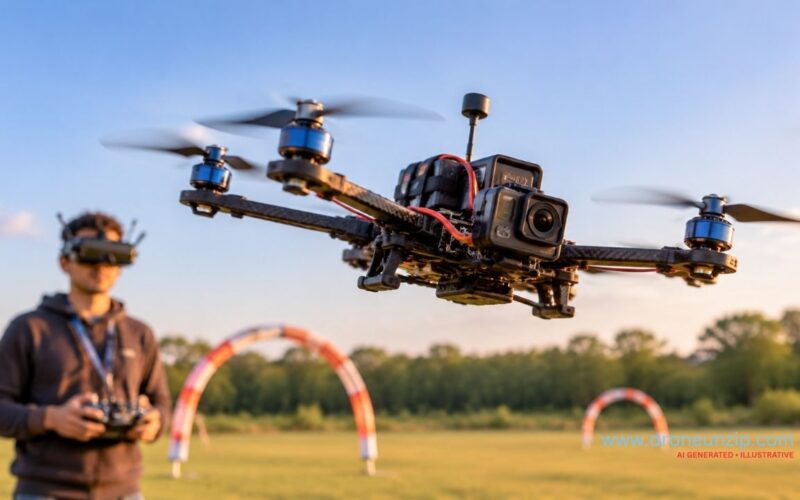
An FPV drone lets you see the flight from the aircraft’s point of view. FPV stands for first-person view: a camera on the drone sends live video to goggles or a screen, helping the pilot steer through a course, follow a moving subject or capture immersive footage. Unlike many camera drones designed to hold position and make smooth automated shots, traditional FPV quadcopters are built around responsive manual control. The result can be fast, precise and creative flying, but it also demands practice, maintenance and careful safety planning.
This guide explains how FPV drones work, the main types, the parts that matter, how beginners can start, and the India-specific checks to make before flying. It is a general hobby and civilian guide, not a guide to weaponising or modifying a drone for harm.
What is an FPV drone?
An FPV drone is an unmanned aircraft that transmits a live view from an onboard camera to the pilot. The pilot typically wears video goggles, although a monitor can also be used. The camera feed provides an immersive view, while a separate radio link carries control inputs from the transmitter to the aircraft.
FPV describes the viewing and control experience, not one specific airframe. Many FPV drones are compact quadcopters with four motors, but FPV equipment can also be fitted to other aircraft designs. Nor does FPV automatically mean autonomous flight: in conventional hobby FPV flying, the pilot remains responsible for controlling the aircraft.
FPV drone types compared
The best type depends on where and how you want to fly. Size labels such as “whoop” or “5-inch” are common hobby terms, not guarantees of flight time, range or legal classification.
| Type | Typical design | Best suited to | Main trade-off |
|---|---|---|---|
| Micro / tiny whoop | Small, lightweight frame, often with propeller guards | Indoor practice, small spaces and learning basic control | Less authority in wind; camera and video performance vary |
| Small freestyle quad | Compact, durable frame built for manoeuvrability | Learning turns, rolls and creative flight in suitable open areas | Crashes can damage motors, arms, cameras or electronics |
| 5-inch-class freestyle / racing quad | Larger frame with powerful motors and replaceable components | Organised racing, freestyle and action-camera filming | Higher energy, noise and repair costs; requires more space and skill |
| Long-range FPV build | Airframe and radio/video setup selected for efficient flight | Experienced pilots seeking longer routes where permitted | Greater planning burden; advertised range is not a safe or lawful operating distance |
| Cinewhoop | Compact ducted or guarded-prop design with a camera payload | Controlled, close-proximity cinematic shots by skilled pilots | Payload affects handling and endurance; ducts do not remove collision risk |
| Integrated digital FPV system | Aircraft, camera, video transmitter and goggles designed to work together | Pilots who prefer a more integrated setup | Compatibility, repairability and upgrade choices depend on the ecosystem |
How an FPV drone works
Think of the aircraft as two connected paths: one carries your control commands to the drone; the other returns video and, where supported, telemetry to you. The exact equipment varies between analogue and digital systems, so latency, image quality, interference handling and compatibility should be checked for the specific products being considered.
| Component | What it does | What to check |
|---|---|---|
| FPV camera | Captures the forward view used for piloting and/or recording | Field of view, low-light behaviour, durability and recording quality |
| Video transmitter (VTX) and antenna | Sends the camera feed to the goggles or receiver | Supported bands, power limits, antenna compatibility and local rules |
| Goggles or monitor | Displays the live video to the pilot | Compatibility, fit, visibility, latency and replacement cost |
| Radio transmitter and receiver | Carries the pilot’s stick inputs to the aircraft | Protocol compatibility, failsafe behaviour and reliable link setup |
| Flight controller | Reads sensors and calculates motor commands to stabilise the aircraft | Firmware support, sensor set and compatibility with other electronics |
| Electronic speed controllers (ESCs) | Regulate electrical power to the motors in response to flight-controller commands | Current rating, battery compatibility, cooling and firmware support |
| Brushless motors and propellers | Generate thrust and control the aircraft’s movement | Matching motor, propeller and battery choices; inspect for damage |
| Battery and power distribution | Supply energy to propulsion and onboard electronics | Cell count, capacity, connector, condition and safe charging/storage |
In a common hobby setup, the flight controller reads sensors such as a gyroscope, processes the pilot’s inputs and commands the ESCs, which drive the motors. Betaflight’s documentation explains this relationship and supports a wide range of racing, freestyle, micro and other hobby aircraft. It is an example of widely used open-source flight-control software, not a requirement for every FPV drone.
FPV versus a conventional camera drone
| Decision factor | Traditional FPV quadcopter | Typical GPS camera drone |
|---|---|---|
| Pilot experience | Often manual, hands-on control with goggles | Usually designed for accessible control through a handheld controller and app |
| Flight style | Fast transitions, close lines, racing and expressive movement | Stable hovering, planned aerial views and smooth camera moves |
| Camera priorities | Low-latency pilot view; separate action camera may be used for final footage | Integrated camera, stabilisation and automated shooting features are common |
| Position hold and automation | Depends on build, sensors, firmware and configuration; do not assume GPS hold or return-to-home | Often includes GPS-assisted positioning and automated safety features, depending on model |
| Maintenance | DIY builds can require frequent inspection, tuning and component replacement | Integrated systems may simplify setup, but still need maintenance and pre-flight checks |
| Learning curve | Steeper for acrobatic manual flight; simulator practice helps | Generally easier for basic hovering and framing, although safe operation still takes practice |
These are broad tendencies, not universal rules. Some FPV systems offer assisted modes, and some camera drones provide advanced manual control. Compare the actual aircraft and operating modes rather than relying on the label alone. For camera-focused buying decisions, see our drone camera types and features guide.
What are FPV drones used for?
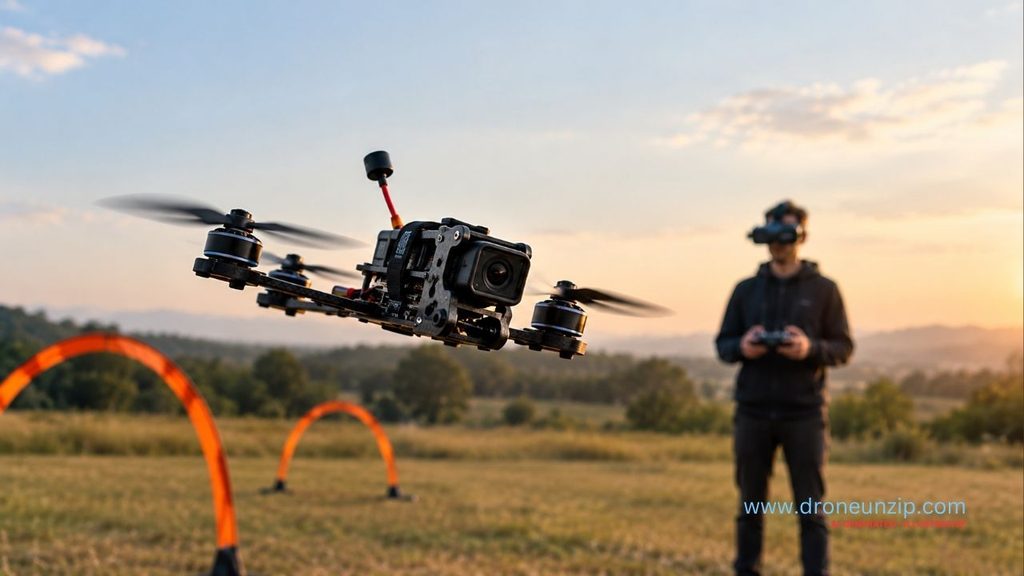
- Racing: Pilots navigate a defined course through gates and around obstacles, with performance shaped by control, course design and aircraft setup.
- Freestyle: Skilled pilots create flowing manoeuvres and lines in a suitable, controlled flying area.
- Cinematic filming: Compact FPV aircraft can capture dynamic movement through spaces that suit the aircraft and the operator’s skill. Planning, permissions and risk controls matter, especially near people or property.
- Indoor and micro flying: Small aircraft can support practice in appropriate spaces, subject to venue rules and safe separation from people.
- Training and engineering: Building and tuning an FPV quad can teach electronics, radio systems, flight control, battery care and troubleshooting.
DroneUnzip has separately covered FPV applications in our guide to what FPV drones are used for, and reported on a military procurement involving FPV drones in the Indian Army’s high-altitude FPV drone order. Those are different contexts: military systems and missions should not be treated as equivalent to recreational hobby aircraft.
How beginners should get started
- Start in a simulator. Practise orientation, throttle control, turns and landing before risking a real aircraft. DJI also recommends simulator practice as a way to build confidence.
- Choose a forgiving first setup. A small, durable aircraft with propeller guards may reduce repair costs in suitable beginner environments. Confirm the full kit’s compatibility before buying.
- Learn the controls and modes. Acro/manual mode requires more practice than stabilised modes. Understand what the selected mode does and what assistance it does not provide.
- Learn battery safety. Use a compatible charger, inspect packs for damage or swelling, and follow the battery maker’s charging, storage and transport instructions.
- Inspect before every flight. Check frame, propellers, fasteners, battery retention, antennas, radio link and failsafe behaviour. Remove propellers during bench motor tests.
- Fly in a suitable location. Keep well clear of people, roads, property and other aircraft; respect landowner and venue rules; and never assume goggles make an otherwise unsafe flight acceptable.
FPV drone rules in India: what to check
Do not assume an FPV drone is exempt from India’s drone requirements because it is small, privately built or flown using goggles. The applicable requirements can depend on the aircraft’s weight and classification, the operation, the location and the current rules. Before flying, consult the official Drone Rules, 2021 and current DGCA guidance, and check the official Digital Sky airspace resources for the intended location.
FPV goggles can limit your direct view of the aircraft. DGCA guidance for remote pilots stresses checking airspace before each flight and keeping the drone within visual line of sight. Do not interpret the video feed as automatically satisfying a visual-line-of-sight requirement. Check the current rules and any applicable permissions or conditions before each operation; this guide is general information, not legal advice.
For location planning, read our practical guide on how to check drone airspace zones in India. Airspace status and restrictions can change, so recheck the official source close to the flight.
Common FPV mistakes to avoid
- Buying goggles, a receiver and a video system that do not work together.
- Assuming a drone has GPS rescue, return-to-home or a reliable failsafe without verifying the actual hardware and configuration.
- Choosing a high-powered aircraft before learning basic orientation and throttle control.
- Ignoring battery condition, propeller damage, loose fasteners or antenna placement.
- Judging the system only by advertised video range or flight time, which depend on configuration and operating conditions.
- Flying by goggles without a safe operating plan, appropriate visual awareness or checking the rules and airspace.
FAQs
What does FPV stand for in drones?
FPV stands for first-person view. A camera on the aircraft sends a live view to goggles or a monitor, giving the pilot an onboard perspective.
Are FPV drones suitable for beginners?
They can be, if beginners choose an appropriate small setup, practise in a simulator, learn battery and propeller safety, and progress gradually. Acrobatic manual flight has a steeper learning curve than basic GPS-assisted camera-drone flying.
Do all FPV drones need goggles?
No. Goggles are common, but some pilots use a compatible monitor. The display must match the aircraft’s video system.
How long can an FPV drone fly?
There is no single flight-time figure for FPV drones. Endurance depends on the airframe, battery, payload, propellers, flying style and conditions. Check the exact model’s documented specifications and treat real-world endurance as configuration-dependent.
Can I fly an FPV drone anywhere in India?
No. Check the applicable drone requirements, airspace, location restrictions and permissions before flying. Use current official DGCA and Digital Sky information rather than relying on a generic online map or an assumption based on drone size.
The takeaway
An FPV drone is best understood as a pilot-controlled aircraft built around a live onboard view. The right setup depends on whether you want to race, practise, fly freestyle or film dynamic footage. Compare the whole system, learn its limitations, practise before flying outdoors, and treat safety and Indian airspace compliance as part of the setup rather than an afterthought.
