

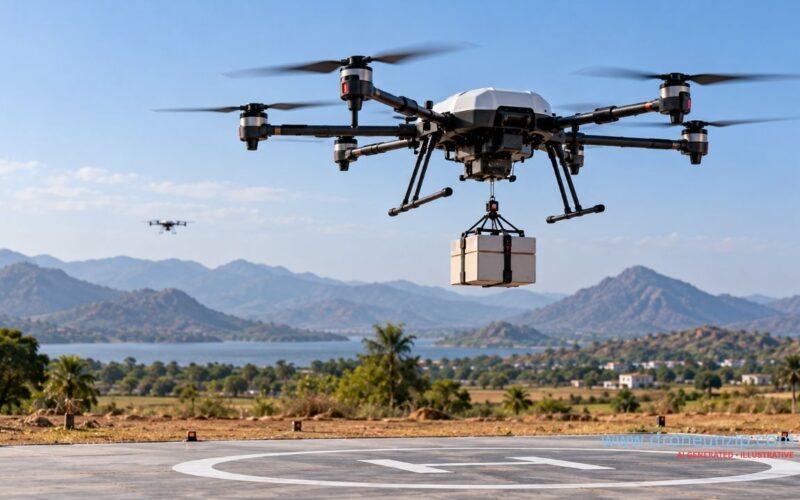
A drone drop can mean anything from lowering a medical package at a remote site to releasing a measured agricultural load. The engineering question is not simply how much a drone can carry: it is whether the aircraft can lift, control, transport and safely deliver that load under the conditions of the mission.
This guide explains drone payload capacity, common civilian delivery and release-system concepts, the trade-offs that affect flight performance, and the safety and regulatory checks relevant to India. It focuses on lawful civilian and industrial uses, not instructions for dropping hazardous or harmful items.
What does “drone drop” mean?
In civilian operations, the phrase can refer to a drone delivering a parcel, lowering a load by tether, releasing a small item at a designated point, or applying material during an agricultural operation. These are different tasks and may require different aircraft, equipment, procedures and permissions.
A delivery drone may land or place a package in a controlled handover area. A tethered system can lower a load without requiring the aircraft to touch the ground. Agricultural drones are designed around application equipment and a specific liquid or granular payload. The term “drone drop” alone does not tell you which system or mission a searcher has in mind.
What is drone payload capacity?
Payload capacity is the mass of the useful equipment or material an aircraft can carry in addition to the items counted as part of its own operating configuration. Manufacturers may define payload figures differently, so compare specifications only after checking what is included, such as the battery, mounting hardware, delivery mechanism and other accessories.
Maximum take-off mass is not the same as payload capacity. It refers to the permitted total mass of the aircraft and everything it carries. A drone that weighs more after adding a battery, guard, camera or release mechanism has less remaining mass allowance for the actual load.
How payload changes flight performance
Adding a load changes the aircraft’s weight and may change its centre of gravity, drag and control response. A heavier multirotor generally needs more thrust to hover, which can increase power demand and reduce endurance. The actual effect depends on the airframe, propulsion system, battery, weather and how the load is mounted.
Payload also affects stability. A load that swings, shifts or hangs away from the aircraft’s centre can make control more difficult. A release mechanism adds mass and electrical or mechanical complexity even before a package is attached. For a broader explanation of energy and endurance, see our drone battery guide.
Common civilian payload and delivery approaches
The right arrangement depends on the delivery environment and the item being carried. These categories describe broad approaches, not a recommendation to retrofit a particular drone.
| Approach | Typical context | Main consideration |
|---|---|---|
| Land-and-handover delivery | Small parcels or supplies at a designated landing area | Needs a safe, accessible landing and handover zone |
| Tethered lowering | Moving a load to a point where landing is unsuitable | Swing, snagging, clearance and load-control risks |
| Purpose-built cargo drone | Repeated delivery routes or heavier logistics tasks | Aircraft, route, operating procedures and ground infrastructure must be designed together |
| Agricultural application system | Controlled application of approved agricultural material | Calibration, drift control, operator training and product-label requirements matter |
What to check before selecting a payload drone
- Documented payload limit: use the exact aircraft manual and configuration, not a generic figure for a similar-looking model.
- All-up mass: account for the battery, mount, tether or release hardware, packaging and the load itself.
- Endurance with load: seek manufacturer data for the relevant configuration and leave a suitable reserve; an unloaded flight-time claim is not a reliable loaded-flight estimate.
- Centre of gravity and secure attachment: the load must remain secured and within the manufacturer’s permitted configuration.
- Environment: wind, temperature, obstacles, people, animals and landing or handover space can change the risk.
- Operating and maintenance support: assess inspection procedures, spare parts, battery management, training and recovery plans.
Drone delivery and release systems in India: rules and safety
India’s Ministry of Civil Aviation has stated that private players may use drones for delivery subject to compliance with the Drone Rules, 2021. That is not blanket permission for every aircraft, route, payload or drop location. The applicable requirements depend on the operation and current rules, permissions and airspace conditions.
Before an operation, consult the official Digital Sky platform and current guidance from the Ministry of Civil Aviation’s Drone Rules page. Check the aircraft’s applicable certification and registration requirements, airspace zone, pilot or operator requirements, local restrictions and any conditions that apply to the material being carried. Requirements can change, so verify them for the actual mission rather than relying on a general article.
Operational planning should also address people on the ground, property, emergency procedures, loss of control, battery failure, load detachment and the possibility that a delivery site is no longer safe on arrival. Never release a load over people or an uncontrolled area merely because the aircraft is capable of carrying it.
Why advertised payload figures need context
A headline payload number rarely describes the whole mission. It may be a maximum under specific test conditions rather than a practical payload for a route with wind, a return leg, a safety reserve and a delivery mechanism. Payload, endurance and range are connected: a configuration that can lift a load briefly may not be suitable for a long, repeatable delivery route.
For procurement or professional use, request the manufacturer’s definition of payload, the permitted centre-of-gravity range, documented endurance with the intended load, operating limits, maintenance instructions and evidence supporting performance claims. If those details are not published, treat the capability as unverified rather than filling the gap with an estimate.
FAQs
Is payload capacity the same as maximum take-off mass?
No. Maximum take-off mass refers to the total aircraft mass at take-off, while payload capacity refers to the useful load it can carry under the manufacturer’s stated configuration and limits. Always check the manufacturer’s definitions.
Does carrying more weight reduce drone flight time?
It often does, particularly for multirotors, because additional mass generally requires more lift and energy. The size of the effect varies by aircraft and conditions, so use documented loaded-flight data where available.
Can private companies use drones for delivery in India?
Yes, subject to compliance with the applicable Drone Rules and other relevant requirements. Operators should check current official rules and the airspace status for the intended route and location.
Can any camera drone be fitted with a release mechanism?
Do not assume so. Added hardware can affect mass, balance, control, warranty and compliance. Use only manufacturer-approved configurations and obtain the relevant technical and operational guidance for the aircraft.
The takeaway
A useful drone payload decision starts with the mission, not the biggest advertised number. Verify the payload definition, assess endurance with the actual load, account for release hardware and ground risks, and confirm current Indian requirements before operating. The phrase “drone drop” is broad; the safest and most effective solution depends on the specific civilian task and a documented, approved aircraft configuration.
