

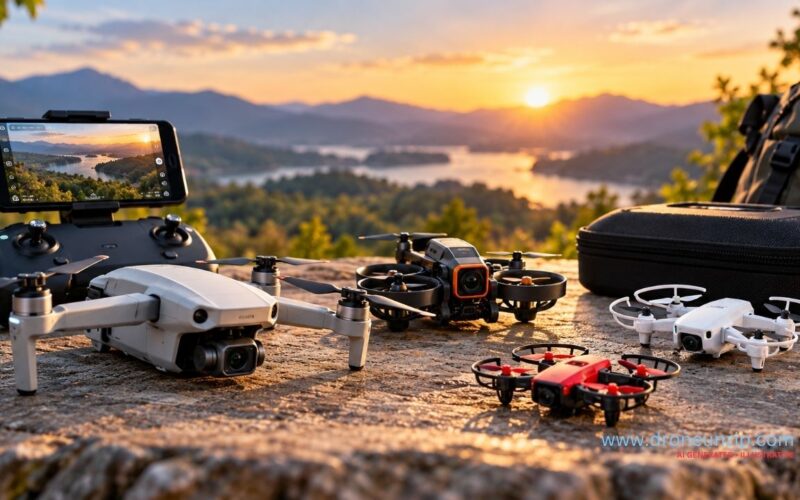
A mini drone can be a low-cost way to learn the controls, practise indoors, or carry a small camera on a trip. But “mini drone” is a loose market label, not a promise of good video, long flight time, stable outdoor flying or a particular legal status. Before buying, decide whether you want a tiny practice quadcopter, a compact camera drone, or a small FPV aircraft. They solve different problems.
This mini drone buying guide explains the trade-offs that matter, what to check in product listings, how to avoid misleading specifications, and which India-specific safety and airspace checks to make before your first flight.
What is a mini drone?
A mini drone is generally a compact, lightweight unmanned aircraft designed to be easier to carry, store or learn on than larger platforms. There is no single universal product definition used by every seller. Some listings describe palm-sized toy quadcopters as mini drones; others use the term for foldable camera drones intended for travel.
That difference matters. A tiny drone built for indoor practice may have basic sensors, a short flight time and no usable camera. A foldable camera drone may include satellite navigation, a stabilised camera and automated flight features, but cost much more. A small FPV drone prioritises a live pilot view and responsive control. Compare the actual aircraft and its intended use, not just the word “mini” in the product name.
Mini drone types compared
| Type | Best suited to | Typical strengths | Main limitations |
|---|---|---|---|
| Indoor micro or toy drone | First-time practice, supervised play and learning basic controls | Small, simple, often inexpensive; propeller guards may be included | Short flights, limited wind tolerance and basic or absent cameras |
| Mini camera drone | Travel photos, casual aerial video and outdoor hobby flying | Compact body, camera features and often a stabilised gimbal on capable models | Price, battery cost, wind limits and camera performance vary widely |
| Mini FPV drone | Immersive flying, indoor courses or freestyle practice depending on build | Responsive controls, live video and compact frames | Requires practice; repairs, video equipment and batteries add cost |
| Selfie or follow-me drone | Personal travel clips and hands-free creator shots | Designed around quick launch and subject-oriented recording | Tracking and obstacle-avoidance capabilities vary; do not assume it can safely avoid every hazard |
These categories overlap, and “mini” does not mean a drone is suitable for every age, location or weather condition. Check the specific model’s manual and operating limits.
What to check before buying a mini drone
1. Flight time, battery count and charging
Manufacturers usually quote flight time under stated test conditions. Actual time can be lower because of wind, temperature, battery age, manoeuvres, camera use and how much reserve you keep for landing. Treat the advertised figure as a comparison point, not a guaranteed session length.
Check how many batteries are included, whether spare batteries are actually available, how long charging takes, and whether the package includes a charger or only a cable. A second battery can be more useful than a headline feature if you want longer practice sessions. Follow the manufacturer’s charging and storage instructions, and do not leave lithium batteries charging unattended.
2. Wind resistance and outdoor stability
Lightweight aircraft are easier to carry but can be more affected by gusts. A drone that feels controllable in a living room may drift outdoors, and a compact camera drone can still be pushed off course by wind. Look for a manufacturer-stated wind-resistance figure where available, then read the conditions and testing notes attached to it.
Do not treat a wind-resistance rating as permission to fly in that wind. Buildings, trees and rooftops can create turbulent airflow, while gusts can differ from the average wind speed. For beginners, calm conditions and a wide, permitted area are safer than testing the aircraft at its limits.
3. Camera quality and stabilisation
If photography matters, find out whether the camera records video or only sends a low-resolution live view to a phone. Those are different functions. Also check whether the camera is fixed, electronically stabilised or mounted on a mechanical gimbal. A “4K” label alone does not tell you sensor size, low-light quality, lens sharpness, bitrate or how smooth footage will look.
For casual play, a camera may be unnecessary. For travel video, prioritise stabilisation, usable sample footage, camera tilt range, storage requirements and the ease of transferring files. For mapping or inspection, a toy-grade mini drone is unlikely to provide the repeatability or image quality required for professional work.
4. Control method, range and return features
Mini drones may use a dedicated controller, a phone app or both. A phone-only setup can be convenient, but screen controls may be less precise than physical sticks. Check phone compatibility, controller inclusion, the type of video link, and what happens if the control or video signal is lost.
Advertised control or transmission range is often measured in open conditions and may depend on the regulatory region. It is not a recommended distance to fly. Buildings, trees, radio interference, antenna orientation and local restrictions can reduce the usable link. Features such as GPS positioning or Return to Home are useful only when correctly configured and supported by the aircraft.
5. Propeller guards, durability and repairability
Propeller guards can reduce some contact risks, but they do not make a drone harmless. Check whether guards are included, whether they are replaceable, and whether spare propellers, motors and batteries are sold separately. For an indoor learner, low replacement cost and accessible parts can matter more than a long feature list.
Inspect the return policy, warranty terms, service contact and availability of replacement parts before purchase. An inexpensive drone that cannot be repaired may cost more over time than a slightly better-supported option.
6. Weight, dimensions and the complete kit
Compare the aircraft’s take-off weight, including the battery and any accessories that will be fitted. Do not rely only on the box weight or the weight printed in a product title. Added guards, batteries or payloads can change the operating weight and sometimes affect performance.
Also compare the folded dimensions, case, controller, spare propellers, memory card, cables and battery count. A low headline price may refer to the aircraft alone, while a ready-to-fly kit can cost more.
Which mini drone is right for you?
| Your main goal | What to prioritise | What not to overpay for |
|---|---|---|
| First flight or indoor practice | Simple controls, propeller guards, replaceable parts, low repair cost and short setup time | High-resolution camera or long advertised range |
| Buying for a child | Age guidance, adult supervision, protected propellers, battery safety and a suitable flying space | Claims that the drone is “completely safe” |
| Travel photography | Camera stabilisation, real sample footage, battery availability, portability and local flying rules | Megapixels or 4K labels without evidence of image quality |
| FPV learning | Durable frame, compatible controller/video system, simulator support where appropriate and accessible spare parts | Maximum speed before you have control skills |
| Outdoor flying in breezy places | Documented wind limits, stable control, clear operating guidance and a conservative safety margin | Assuming a small aircraft will be stable simply because it has GPS |
Mini drone prices: compare the whole cost
Prices vary by aircraft type, camera system, controller, battery bundle, seller, warranty and availability. Instead of relying on a single price copied from an old listing, compare current offers for the same model and the same kit contents. Check whether taxes, shipping, memory cards, spare batteries and replacement propellers are included.
For a broader India-focused breakdown of price bands and ownership costs, see our drone price in India guide. If camera quality is the priority, our drone camera buying guide explains sensors, stabilisation and the limits of headline resolution claims.
Mini drone rules in India: size does not automatically mean exempt
Before flying, check the current DigitalSky portal and airspace map, and consult the official DGCA drone rules and guidance. DigitalSky identifies green, yellow and red airspace zones and explains that permission requirements differ by zone.
Do not assume that a mini drone is automatically exempt from every rule because it is small, inexpensive, sold as a toy or weighs under a particular threshold. The applicable requirements depend on the aircraft’s classification and the current rules, as well as the airspace and circumstances of the flight. Verify the actual take-off weight and classification, check location restrictions, and follow the manufacturer’s safety guidance. If you cannot establish that a flight is permitted, do not launch until you have checked with the relevant official source.
For a practical location check, read our guide on how to check India’s drone airspace map. Rules and maps can change, so revisit the official source before each flight rather than relying on a saved screenshot or an old article.
Common mini drone buying mistakes
- Buying based on “4K” alone: ask for genuine sample footage and check stabilisation and sensor details.
- Trusting maximum flight time as normal: check the test conditions and plan to land with reserve battery.
- Ignoring spare parts: a broken propeller or battery should not make the whole aircraft unusable.
- Confusing live video with recorded quality: the phone feed and onboard recording may have different resolution and latency.
- Assuming GPS prevents crashes: positioning assistance does not replace obstacle awareness or pilot control.
- Assuming lightweight means unrestricted: check the current Indian rules and the exact flight location.
- Buying a camera drone for indoor play: a small, guarded practice drone may be more appropriate for learning basic control.
FAQs
Is a mini drone good for beginners?
It can be, if the type matches the setting and the learner. A simple guarded micro drone is often easier to practise with indoors, while a camera drone or FPV aircraft may require more setup, skill and budget. Start in a suitable, permitted area and follow the manual.
How long does a mini drone fly?
There is no single flight-time figure for all mini drones. Tiny practice drones, camera drones and FPV models have different batteries and power demands. Compare the manufacturer’s test conditions, then allow for wind, manoeuvres and a safe landing reserve.
Can I fly a mini drone indoors?
Only if the aircraft and space are suitable. Remove people, pets and fragile objects from the flight area, keep away from fans and windows, and use propeller guards where appropriate. Larger camera drones need substantially more space and may not be suitable for indoor practice.
Does a mini drone need a camera?
No. A camera is useful for recording or FPV navigation, but it adds cost and may not improve basic flight practice. Choose features around the intended use rather than treating a camera as essential.
Can I fly a mini drone anywhere in India?
No. Check the current DigitalSky airspace map, the applicable rules and any local restrictions before flying. A small aircraft is not automatically allowed in restricted or prohibited airspace.
Is a mini drone the same as a DJI Mini drone?
No. “Mini drone” is a broad category label. “DJI Mini” refers to a specific product family. A generic mini drone may be a toy, an FPV model or another compact aircraft with very different features and capabilities.
Final checklist before you buy
- Choose the type that matches your goal: indoor practice, outdoor camera flying, FPV or selfie filming.
- Compare actual battery bundle, charging time, spare-part availability and full kit price.
- Read the manual and check weight, wind limits, camera recording details and failsafe behaviour.
- Confirm warranty, return terms and service support in India.
- Check DigitalSky and current official guidance before flying.
The best mini drone is not necessarily the smallest or the one with the longest specification sheet. It is the aircraft whose controls, camera, durability, support and operating limits fit the way you genuinely plan to use it.
