

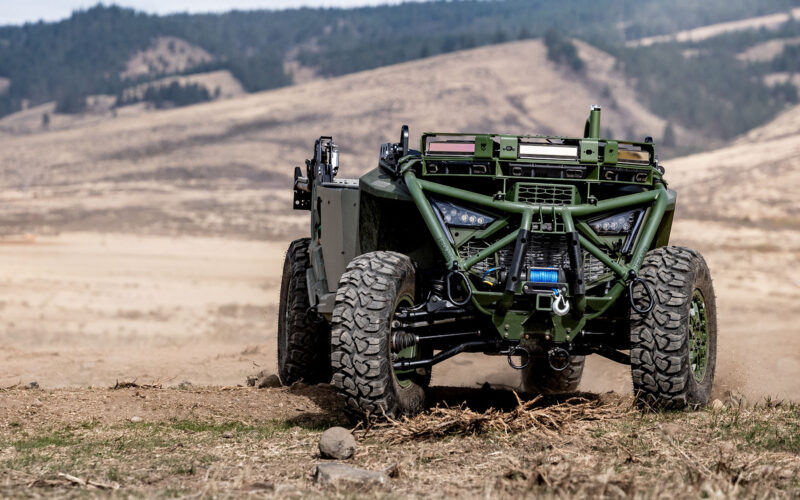
US robotics company Overland AI has unveiled IBEX, an autonomous off-road ground vehicle designed to transport heavy payloads and support military systems in environments where continuous remote control may be unreliable.
Announced on 7 October 2026, IBEX is built on the Polaris MRZR platform and uses Overland AI’s autonomy software to perceive terrain and navigate without continuous teleoperation, according to the company’s announcement.
What the company says IBEX can do
- Carry a payload of up to 2,000 pounds, approximately 907 kilograms.
- Travel at speeds above 35 mph (about 56 km/h) in autonomous mode.
- Cover a stated cruising range of 250 miles at 20 mph on a tank of diesel or JP-8.
- Provide 5 kW of exportable electrical power for onboard equipment.
These are manufacturer-reported specifications, not an independent performance assessment. Overland AI says the vehicle is designed for denied, degraded, intermittent and limited-connectivity environments. The company also says IBEX is intended to be transportable aboard a V-22 Osprey and shares parts and fuel compatibility with the MRZR platform already used by military units.
Selected for counter-drone system integration
Overland AI says the US Marine Corps selected IBEX for integration into its Marine Air Defense Integrated System (MADIS), a counter-uncrewed-aircraft and air-defence platform. A ground vehicle that can move supplies and provide power could help sustain equipment closer to the operational edge.
Reporting by Axios said prototypes were undergoing testing and that production deliveries were expected later, highlighting the difference between a selected platform and a widely fielded capability.
Why it matters
IBEX illustrates a shift in how autonomous ground vehicles are being positioned. Rather than acting only as robotic cargo carriers, they can potentially serve as mobile power sources and hosts for sensors, communications equipment or mission payloads. That combination may be valuable where resupply is difficult and human-operated vehicles face risk.
The same general design logic could eventually have civilian applications in remote industrial sites, disaster response and other off-road operations. Those applications would still require suitable safety, reliability and regulatory validation.
What to watch next
- Production and delivery milestones for the Marine Corps programme.
- Independent evidence of autonomous performance in difficult terrain and disrupted communications.
- How IBEX is integrated with MADIS and whether the vehicle performs logistics, power-support or other roles in practice.
- Whether the platform attracts additional military or non-military customers.
The near-term story is a military-selected autonomous vehicle with substantial stated payload and power capacity. Its longer-term significance will depend on field reliability, integration results and the ability to manufacture and maintain it at scale.
Sources
Editorial note: Performance figures are attributed to Overland AI; operational outcomes and production status should be updated only when independently confirmed.
