

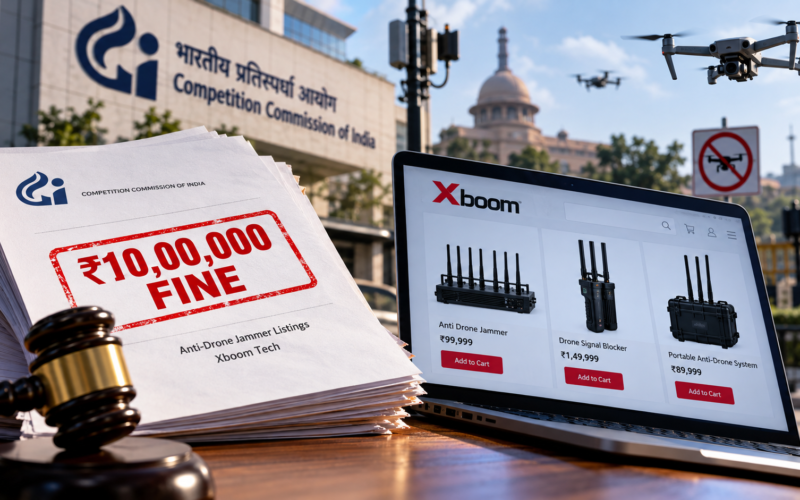
India’s consumer regulator has imposed a ₹10 lakh penalty on Bengaluru-based e-commerce company Xboom over the listing and advertising of anti-drone systems, drone jammers and GPS jammers without the regulatory disclosures the authority said were required. The Central Consumer Protection Authority (CCPA) issued its order on September 17, 2026, and the action has broader implications for how sensitive counter-drone equipment is marketed online.
According to the CCPA proceedings reported by PTI, the regulator’s investigation found six products listed under an “Anti-Drone” category on Xboom’s website. The products identified were X-Mini, X-Radar XK2, X-Eye, X-Gun XK4, RF-Patrol XK2 and XGaurd. Their listings included technical descriptions and claims relating to jamming or disruption capabilities, but did not, according to the authority, clearly disclose licensing requirements, the restricted nature of the equipment or the consequences of unauthorised possession or use.
Why the CCPA acted against Xboom
The case began with a suo motu inquiry by the CCPA after the authority identified the online listings. The regulator had already issued notices to six e-commerce entities in February 2026 over listings involving anti-drone systems, drone jammers and GPS jammers. Xboom was among those entities. The earlier government action is documented in a CCPA press release published through the Ministry of Consumer Affairs.
Xboom told the authority that its model was enquiry-based and that the products were intended for government agencies, armed forces and other authorised institutional users rather than ordinary consumers. The CCPA did not accept that explanation as sufficient. It held that publishing the product representations on a website could itself fall within the statutory concept of advertising, even where the platform used an enquiry mechanism rather than a conventional checkout.
The authority also pointed to inconsistencies in how Xboom’s website operated. According to the order, some other drone products on the platform were available through an “Add to Cart” option, raising questions about whether adequate screening and end-user verification were actually in place.
Six restricted products were at the centre of the case
The six products named by the CCPA were presented as anti-drone equipment capable of functions such as detecting, disrupting or neutralising drone-related communications. The regulator said the listings did not adequately communicate the licensing and regulatory restrictions associated with such equipment.
This distinction matters because a counter-drone system is not automatically equivalent to a conventional consumer electronics product. Systems that use radio-frequency interference or other forms of jamming can affect communications and navigation signals beyond the intended drone target. Their possession, import, manufacture and use can therefore be subject to government authorisation and other regulatory controls.
The CCPA found that failing to disclose those restrictions could leave a visitor with the impression that the products were freely and lawfully procurable. It cited provisions of the Consumer Protection Act, 2019 and the Consumer Protection (E-Commerce) Rules, 2020 in reaching its findings.
₹10 lakh penalty and new compliance requirements
The ₹10 lakh penalty represents the maximum penalty available for a first contravention under the provision cited by the authority. In addition to the financial penalty, the CCPA directed Xboom to stop listing, hosting, advertising, promoting or offering anti-drone systems, drone jammers, GPS jammers and other wireless jamming equipment unless specified compliance conditions are met.
The authority also directed the company to implement a verifiable KYC and end-use authorisation mechanism so that restricted equipment is supplied only to authenticated government, defence or law-enforcement end users. Product listings must also prominently disclose applicable licensing requirements and the consequences of unauthorised possession or use. Xboom was given 15 days from the order to submit a compliance report.
What the decision means for India’s counter-drone market
The decision arrives as India is rapidly expanding its counter-drone capabilities. Recent military exercises and procurement initiatives have placed greater emphasis on detecting, tracking and defeating unmanned aircraft, while Indian defence companies are developing systems ranging from radar and electronic warfare to directed-energy and interceptor technologies.
That expansion creates a growing commercial market, but the Xboom case highlights an important boundary: demand for counter-UAS technology does not remove the regulatory obligations attached to equipment that can interfere with radio-frequency communications.
For legitimate manufacturers and integrators, the ruling could encourage more rigorous product documentation, end-user verification and compliance checks. DroneUnzip has also covered developments in Indra’s DRIZZLE interceptor drone and the M-LIDS counter-drone system demonstrated during Yudh Abhyas 2026, illustrating the range of technologies in this sector. For online marketplaces, the Xboom order is a reminder that simply labelling a transaction as an “enquiry” may not be enough when the underlying product is subject to specific government controls.
The decision also fits into a wider regulatory push that began earlier this year. In February, the CCPA said it had identified restricted wireless transmitting devices being offered online without adequate disclosure of licensing requirements and regulatory clearances. The latest order turns that broader warning into a concrete enforcement action against one platform.
The bigger lesson for counter-UAS technology
India’s drone ecosystem is moving quickly, and counter-UAS technology is becoming an increasingly important part of that ecosystem. But as these systems become more capable, the line between a defence product and a regulated communications device becomes increasingly important.
The Xboom case does not mean anti-drone technology cannot be marketed commercially. Instead, it underlines the need for the right approvals, transparent disclosures and a verifiable end-user process where the equipment falls under restricted categories. For India’s rapidly growing drone and counter-drone industry, compliance is becoming part of the technology story itself.
Sources: Central Consumer Protection Authority/Ministry of Consumer Affairs; PTI reporting published by The Economic Times; Times of India reporting on the CCPA order.
