

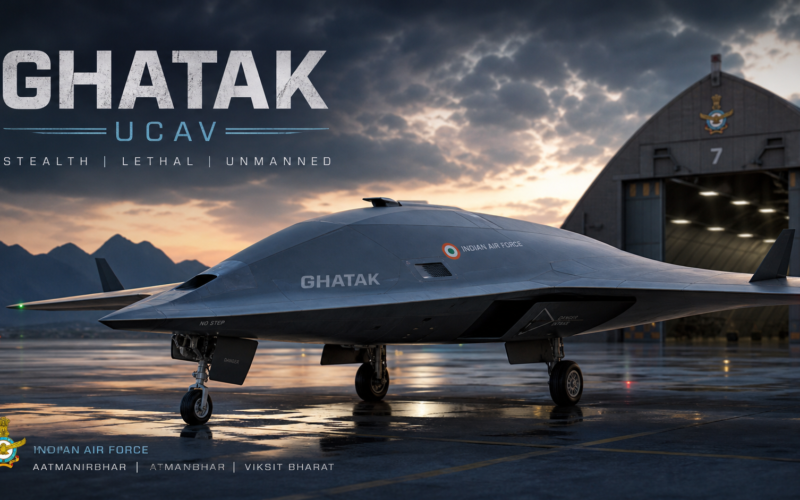
How far can India’s Ghatak unmanned combat aerial vehicle (UCAV) fly, and how long could it remain airborne? The public record does not establish a verified operational range or endurance figure for the full-scale Ghatak. Numbers repeated online often trace back to early AURA-era requirements or secondary reporting, not a current, officially confirmed specification.
The distinction is important. Ghatak is the planned full-scale stealth UCAV programme, while the Stealth Wing Flying Testbed (SWiFT) is a smaller technology demonstrator that has flown. SWiFT provides evidence of progress in autonomous flying-wing technology, but its flights do not establish the full-size aircraft’s range, endurance or combat radius.
What is publicly confirmed about Ghatak UCAV range?
No current official DRDO or Ministry of Defence source located for this article publishes a confirmed operational range, ferry range, endurance or combat radius for the full-scale Ghatak. The Ministry of Defence’s announcement of SWiFT’s maiden flight on 1 July 2022 describes the autonomous flying-wing technology demonstrator and its flight, but does not provide a performance specification for the operational UCAV.
A figure of around 500 nautical miles (approximately 926 kilometres) appears in reporting associated with an early Indian Air Force requirement for the AURA concept around 2010. That historical figure should not be presented as Ghatak’s confirmed range today. A preliminary requirement is not the same as a final design specification, and neither is proof of tested performance.
Repeated publication does not independently validate a number. Unless a figure can be traced to an authoritative specification, an official statement or a clearly identified test, it should remain labelled as historical reporting or an estimate, not a confirmed capability.
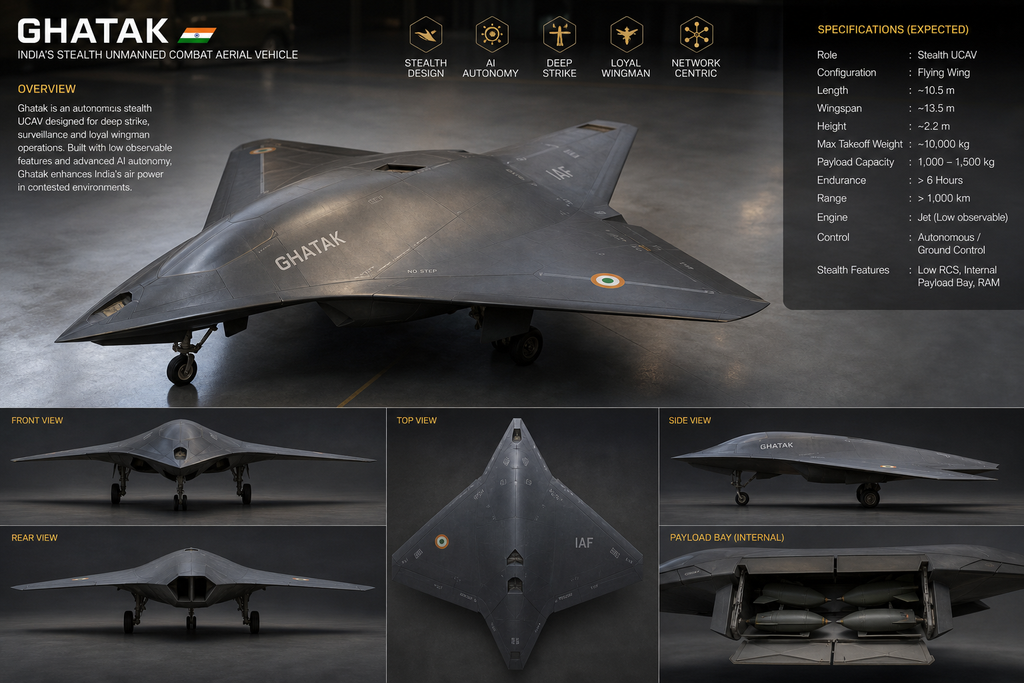
Range, combat radius and endurance are different measures
Range describes distance travelled, but the exact meaning depends on the context. Ferry range generally refers to a transfer flight under a specified configuration, often with minimal payload. Maximum range may use ideal conditions that do not represent an operational mission. Neither number automatically tells us how far an aircraft can travel to a target and return.
Combat radius is more mission-specific. It normally describes how far an aircraft can operate from its base and return after carrying out a defined mission, with the calculation affected by payload, route, reserve fuel and mission profile. Endurance is the time an aircraft can remain airborne. It depends on factors such as fuel capacity, engine efficiency, aircraft weight, altitude, speed and the time spent in different phases of flight.
These measures cannot be substituted for one another. A stated range without its configuration and mission assumptions tells us little about useful combat radius. Likewise, an endurance figure cannot be reliably inferred from a range estimate without knowing how the aircraft is intended to fly.
What SWiFT has demonstrated, and what it has not
SWiFT is a technology demonstrator associated with the larger Ghatak effort. Its maiden flight provided evidence that India had advanced a tailless flying-wing demonstrator into flight testing. The Ministry of Defence later described the programme’s progress in its official update on indigenous defence technology.
That progress matters because flying-wing aircraft bring demanding design and control challenges. A demonstrator can help validate aerodynamic behaviour, flight-control approaches and aspects of autonomous operation before technologies are developed further. It does not, however, provide a direct performance sheet for a larger aircraft with different dimensions, propulsion, fuel volume, payload and mission systems.
SWiFT’s flight duration or flight distance should therefore not be used as a proxy for Ghatak’s endurance or range. The programmes are related, but their roles and configurations are not identical. For background, see DroneUnzip’s coverage of the Ghatak UCAV programme and the SWiFT stealth demonstrator.
How propulsion and mission design affect performance
Range and endurance depend on the complete aircraft, not just its engine. Fuel fraction, aerodynamic efficiency, structural weight, payload, electrical demand and the flight profile all affect how far and how long a UCAV can operate. A stealth aircraft’s shape and internal arrangement also impose design trade-offs that cannot be assessed from a headline figure alone.
Propulsion is one part of that picture. Public discussion has linked Ghatak’s development to India’s work on indigenous propulsion, including the Kaveri programme, but a programme association is not confirmation of the final aircraft’s engine configuration or performance. DroneUnzip has covered the context in its explainer on the Ghatak and Kaveri connection. Until an authoritative update identifies the selected configuration and publishes tested data, specific range or endurance claims remain premature.
Ghatak range and endurance: confirmed versus unknown
| Item | Publicly supportable position |
|---|---|
| Full-scale Ghatak operational range | Not publicly confirmed in the official sources reviewed |
| Full-scale Ghatak endurance | Not publicly confirmed in the official sources reviewed |
| Ghatak combat radius | No verified public figure identified |
| Early AURA-era range figure around 500 nautical miles | Historical reported requirement; not a confirmed current Ghatak specification |
| SWiFT flight testing | Demonstrator flight progress confirmed; does not establish full-scale Ghatak performance |
What would count as confirmation?
A reliable figure should identify what is being measured and the configuration to which it applies. For range, that means distinguishing ferry range from mission range or combat radius. For endurance, it means clarifying whether the number is a design target, a claimed capability or a demonstrated flight result. Payload, test conditions and the status of the aircraft also matter.
The strongest evidence would be a specific statement or technical release from DRDO, the Ministry of Defence or another directly responsible authority. Credible reporting can provide context, but it should not turn an old requirement or an unattributed estimate into a confirmed specification.
FAQs
Has DRDO confirmed Ghatak UCAV’s range?
No verified public figure for the full-scale Ghatak’s operational range was identified in the official sources reviewed. Early AURA-era figures should not be treated as a current specification.
How long can Ghatak stay airborne?
A confirmed endurance figure has not been publicly established in the sources reviewed. Endurance depends on the aircraft’s final design, propulsion, fuel capacity, payload and mission profile.
Does SWiFT prove Ghatak’s range or endurance?
No. SWiFT is a smaller technology demonstrator. Its flights demonstrate progress in flying-wing technology, but they do not establish the performance of the full-scale Ghatak UCAV.
Is the reported 500-nautical-mile figure confirmed?
No. The figure appears in reporting associated with an early AURA-era requirement. It should not be described as Ghatak’s confirmed current range.
Conclusion
Ghatak’s range and endurance remain unconfirmed in the public record. SWiFT has demonstrated progress in tailless flying-wing technology, but its flights cannot establish the full-scale UCAV’s operational performance. Until DRDO or the Ministry of Defence releases a defined figure, early AURA-era estimates should not be presented as Ghatak specifications.
