

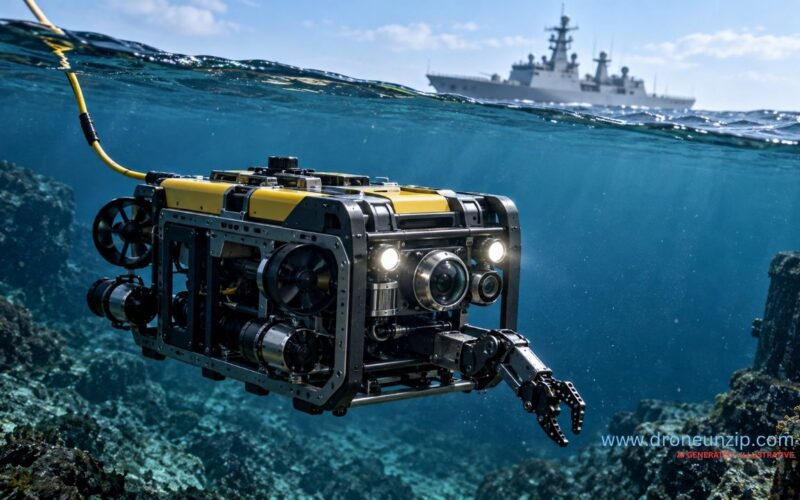
Kochi-based marine robotics company EyeROV has delivered two TROUT military-grade remotely operated underwater vehicle (ROV) systems to the Indian Navy, according to reporting published on 7 October 2026. The delivery is part of a five-system order and advances an indigenous underwater robotics programme developed through the iDEX defence innovation ecosystem.
The New Indian Express reported that the systems were designed, developed, manufactured and qualified in India for naval operations. Malayala Manorama separately reported the delivery of the initial systems. The available reports attribute the programme to the iDEX DISC 7 SPRINT Challenge, which supports the development of strategically important technologies for the armed forces.
What is the EyeROV TROUT?
TROUT is a remotely operated underwater vehicle, meaning it is controlled by an operator rather than functioning as a fully autonomous underwater drone. According to the reporting, its intended tasks include underwater inspection, surveillance and reconnaissance, search and recovery, detection, and robotic intervention.
Those roles can be useful in environments where visibility is poor, currents are strong or access is difficult. Underwater robots can also help crews inspect submerged structures and investigate objects without immediately placing divers in potentially hazardous conditions. The precise equipment fitted to the delivered systems and the Navy’s operational deployment plans have not been detailed in the cited reports.
How was the system qualified?
The New Indian Express reported that TROUT underwent field trials and system-level validation covering manoeuvrability, deep-dive capability, performance in strong underwater currents, detection, navigation, endurance and operator control. The report also said the platform went through the Directorate of Quality Assurance (Naval) quality-assurance framework and completed type testing.
These are reported qualification milestones, not a public independent performance assessment. Publicly available information reviewed for this draft does not establish the full operational specifications, mission performance or the date on which the remaining systems will be delivered.
Why does the delivery matter for India?
The delivery is a concrete example of an Indian-developed underwater robotic system moving from development and testing into supply to the Navy. Indigenous systems may help build domestic expertise in marine robotics, electronics, control software and subsea engineering. The practical significance will depend on reliability in service, maintainability, operator training and how the vehicles are integrated into naval workflows.
Underwater ROVs should not be confused with autonomous underwater vehicles (AUVs). An ROV is generally operated remotely, often through a tether, while an AUV is designed to carry out missions autonomously. The distinction matters when comparing endurance, communications and the types of tasks each platform can perform.
What happens next?
The delivery reported on 7 October covers two systems within the Indian Navy’s order for five TROUT vehicles. The sources reviewed for this draft do not independently confirm a firm delivery schedule for the remaining three systems. DroneUnzip will update this report if an official release or further verifiable procurement information becomes available.
Sources
The New Indian Express, 7 October 2026: EyeROV delivery report Malayala Manorama, 7 October 2026: TROUT delivery report The Week, 8 October 2026: TROUT background and reported qualification
