

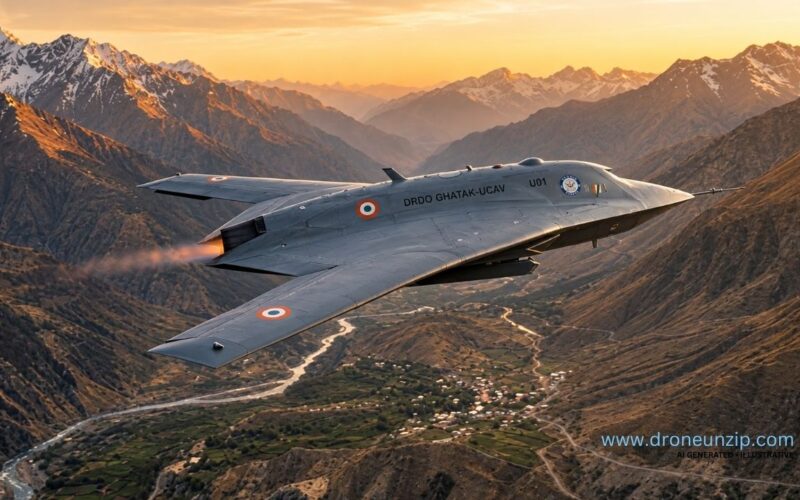
India’s Ghatak unmanned combat aerial vehicle (UCAV) is being developed around a tailless flying-wing configuration intended to support low-observable flight. The shape is more than a visual signature: it affects how the aircraft generates lift, how flight control is managed, and how designers balance radar signature, internal volume and aerodynamic efficiency. But public information does not reveal Ghatak’s full stealth design or measured radar cross-section, so its capabilities must be discussed with care.
This explainer looks at what the official record of DRDO’s SWiFT demonstrator establishes, how flying-wing layouts can support low observability in general, and what remains unknown about the full-scale Ghatak aircraft.
Key takeaways
- Ghatak is publicly described as a stealth-oriented, jet-powered UCAV with a flying-wing configuration and an internal weapons bay.
- DRDO’s SWiFT is a technology demonstrator related to the programme, not the full-scale operational Ghatak aircraft.
- A flying wing can reduce some sources of radar reflection by avoiding a conventional tail, but shape alone does not make an aircraft invisible to radar.
- Public sources do not establish Ghatak’s measured radar cross-section, complete materials recipe or final production configuration.
What is the flying-wing design used for Ghatak?
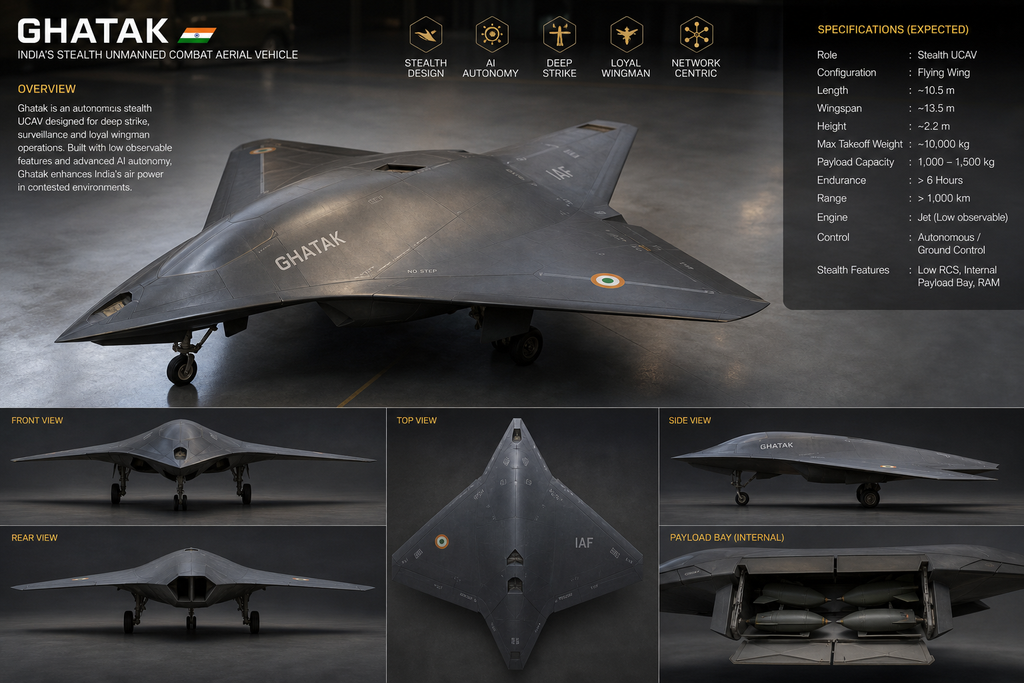
A flying wing is an aircraft layout in which the main lifting surface forms most of the aircraft’s body, with no conventional tail assembly. The configuration can provide internal volume and reduce the number of distinct surfaces and junctions that designers must manage. It also presents engineering challenges: stability and control have to be achieved without relying on the tail surfaces found on many conventional aircraft.
DRDO’s public descriptions of its Autonomous Flying Wing Technology Demonstrator identify it as a precursor technology effort for a future stealth unmanned combat aircraft. Official material has described the demonstrator as a scaled-down version of Ghatak, but it should not be treated as a one-to-one representation of the full-scale aircraft’s dimensions, systems or performance.
How can a flying wing support stealth?
Radar stealth, more accurately called low observability, is about reducing the strength and usefulness of signals returned to a radar. Aircraft designers consider the shape and alignment of surfaces, the treatment of edges and openings, the placement of antennas, and how the engine intake and exhaust are integrated into the airframe.
A flying-wing layout can help designers manage radar-reflecting features because it avoids a conventional vertical tail and can align major edges. Internal weapons carriage can also avoid the extra radar-reflecting shapes created by external stores. These are general design principles, not proof of a particular detection range or radar cross-section for Ghatak.
Stealth is not invisibility. Detection depends on factors including radar frequency, viewing angle, distance, sensor capability and the aircraft’s configuration. Publicly available information does not provide enough data to quantify Ghatak’s radar signature or compare it numerically with another aircraft.
What has SWiFT demonstrated?
The Stealth Wing Flying Testbed (SWiFT), also referred to in official releases as the Autonomous Flying Wing Technology Demonstrator, provides evidence of progress in autonomous flying-wing technology. The Ministry of Defence reported its maiden flight on 1 July 2022. A later official release described a successful flight in the final tailless configuration on 15 December 2023 and highlighted autonomous landing using onboard sensor-data fusion and GAGAN-supported navigation.
These milestones are relevant because a tailless aircraft requires carefully developed flight-control laws and reliable onboard systems. However, SWiFT’s flights do not by themselves establish that the full-scale Ghatak has completed its own flight testing, weapons integration, engine qualification or operational evaluation. Read our SWiFT demonstrator explainer for the dedicated development timeline.
Why do the intake, exhaust and internal weapons bay matter?
The airframe cannot be designed for low observability in isolation. An engine intake must deliver suitable airflow to the engine, while its geometry can also influence how radar energy interacts with internal surfaces. Exhaust treatment presents a different challenge because hot gases and engine components can contribute to an aircraft’s infrared signature. These trade-offs must be balanced with engine performance, cooling, maintenance and weight.
An internal weapons bay can preserve a cleaner outer shape than carrying weapons on external pylons. It introduces its own integration demands, including door mechanisms, safe separation of stores and space competition with fuel and other systems. Ghatak is publicly associated with internal weapons carriage, but detailed bay geometry, weapon combinations and verified signature measurements are not available in the sources used here.
What is known about Ghatak’s design, and what remains undisclosed?
Official descriptions establish the broad concept: an autonomous, jet-powered stealth UCAV using a flying-wing configuration and intended to carry weapons internally. Public reporting adds context on the programme’s development and possible dimensions or payload, but reported estimates should not be mistaken for a complete official specification.
The sources reviewed do not provide a verified radar cross-section, complete structural-material breakdown, detailed intake and exhaust geometry, final dimensions or a full-scale aircraft test record. Nor should images of models, demonstrators or artist’s concepts be assumed to show the final production configuration.
Why the design matters for India’s UCAV programme
A stealth-oriented flying wing brings together aerodynamics, autonomous control, propulsion, materials and mission-system integration. Progress in a demonstrator can reduce technical uncertainty, but scaling up introduces new challenges in structural loads, engine installation, flight-control behaviour, internal volume and maintainability.
For readers following the programme, the most useful milestones to watch are official updates on the full-scale airframe, integrated propulsion, aircraft-level trials and qualification. Our Ghatak UCAV overview explains the wider programme, while the Kaveri engine article examines the reported propulsion path and its unresolved questions.
FAQs
Is Ghatak a flying-wing drone?
Public DRDO descriptions identify Ghatak as a stealth-oriented UCAV based on a flying-wing configuration. The final full-scale configuration should be confirmed through official programme updates.
Does a flying-wing design make an aircraft invisible to radar?
No. It can help reduce certain radar reflections, but stealth depends on the aircraft’s complete shape, materials, openings, stores and operating conditions. No public source reviewed here establishes Ghatak’s measured radar cross-section.
Is SWiFT the same aircraft as Ghatak?
No. SWiFT is a technology demonstrator associated with the wider flying-wing programme. Its test results should not be presented as proof that the full-scale Ghatak has completed the same milestones.
What has DRDO confirmed about SWiFT testing?
The Ministry of Defence reported SWiFT’s maiden flight on 1 July 2022 and a successful flight in the final tailless configuration on 15 December 2023, including autonomous landing capabilities.
Are Ghatak’s stealth materials and radar signature public?
The sources reviewed do not establish a complete materials specification or a verified radar cross-section for Ghatak. Specific numerical claims should be attributed and treated cautiously unless supported by an authoritative source.
Conclusion
The Ghatak UCAV remains an important part of India’s ambition to develop advanced unmanned combat aircraft, but its actual performance must be separated from projections and assumptions. While the SWiFT demonstrator has provided evidence of progress in autonomous flying-wing technology, its achievements should not be treated as confirmed specifications for the full-scale Ghatak. The aircraft’s operational range, endurance, payload capacity and final mission profile remain details to watch for in future official disclosures. Until those figures are confirmed, the most reliable assessment is based on demonstrated milestones rather than unverified performance claims.
