

The Royal Navy’s experimental uncrewed underwater vessel XV Excalibur has successfully launched a US Navy Mk 48 heavyweight torpedo during a trial in Scotland, the Royal Navy announced on 30 September 2026. The test was conducted at the British Underwater Test and Evaluation Centre (BUTEC) near Kyle of Lochalsh as part of UK-US work under AUKUS Pillar 2.
The Royal Navy said the three-week experiment involved an inert, recoverable version of the torpedo. USNI News had reported the trial on 22 September, citing a US Navy announcement and identifying 13 September as the launch date. QinetiQ, which operates the test range, also confirmed its support for the exercise.
What happened during the trial?
XV Excalibur, an extra-large uncrewed underwater vessel (XLUUV), was adapted with a specialist management system to fire and control the Mk 48. According to the Royal Navy, the trial demonstrated that a weapon payload could be integrated onto an uncrewed underwater platform without designing a dedicated crewed vessel for that specific role.
QinetiQ said the trial involved the Royal Navy’s XV Excalibur firing an inert Mk 48 and that QinetiQ Hammerhead uncrewed surface vessels acted as targets. The test took place at BUTEC in north-west Scotland, a facility used for underwater testing.
Why is the XV Excalibur trial significant?
The test is an important integration milestone because it brings together an uncrewed underwater vehicle, a weapon developed for naval use and supporting command and control systems. The stated objective was to demonstrate a proof of concept, not to announce that a fully operational autonomous torpedo-attack capability has entered service.
The distinction is important: the Royal Navy described the weapon used in the experiment as inert and recoverable. The announcement does not establish that the trial involved a live warhead or that the platform has been cleared for operational deployments with torpedoes.
How does it connect to AUKUS?
The UK, US and Australia are working through AUKUS to accelerate advanced defence capabilities. The Royal Navy described the experiment as part of AUKUS Pillar 2, which focuses on advanced capabilities and technology cooperation. The USNI report said the work was conducted under Project Broadsword and Trial Iron.
The trial also tested interoperability: integrating a US weapon system with a British uncrewed vessel. QinetiQ’s account confirms that the test involved the Royal Navy, US Navy and industry partners at the Scottish test facility.
What remains unproven?
The announcement marks a successful demonstration, but it does not provide a full operational specification for XV Excalibur or a timetable for deploying torpedo-capable uncrewed underwater vessels. Further trials would be needed to establish the maturity, reliability, command arrangements and operational limits of such a capability. The Royal Navy said the launch was the first in a series of trials expected to increase in scope and complexity.
For naval forces, uncrewed underwater platforms may offer additional options for missions that expose crews to risk. Their real-world value will depend on dependable navigation, secure control, payload integration, safety procedures and the ability to operate alongside crewed ships and submarines.
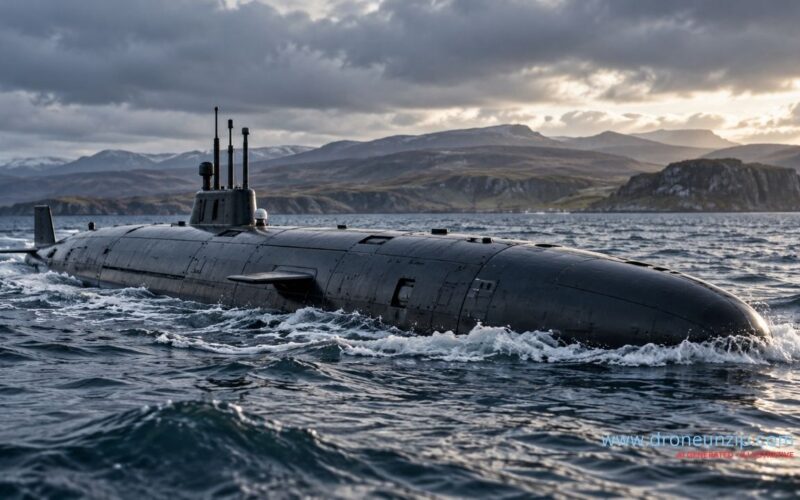
Image note: The featured image for this draft is intended as an AI-generated illustrative depiction of an uncrewed submarine at sea. It is not a photograph of XV Excalibur or the actual trial.
