

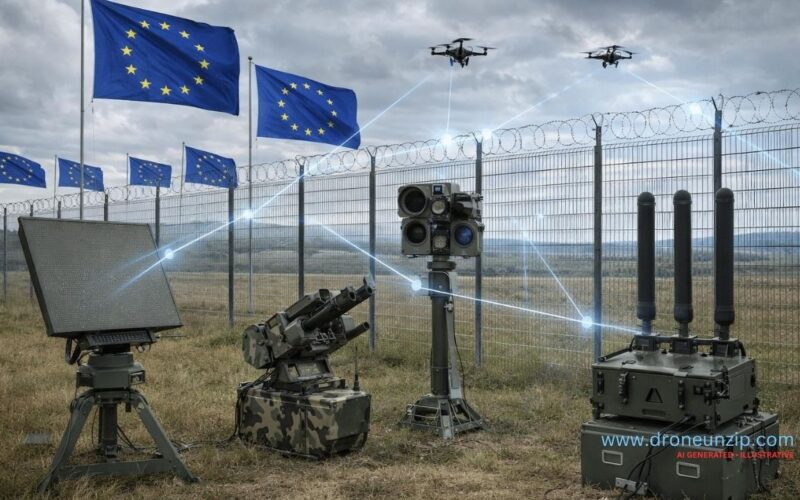
Latvia is developing an increasingly automated anti-drone defence network along its eastern border with Russia, combining acoustic sensors, radar surveillance, command-and-control systems and interceptor drones to detect and counter aerial threats while reducing the number of soldiers needed to operate the system.
In an interview published by Business Insider on October 15, 2026, Latvian Defence Minister Raivis Melnis described plans to automate the detection, tracking and launch stages of interception, with human personnel retaining the final decision to engage a target. The initiative builds on Latvia’s existing drone-detection infrastructure and its efforts to introduce locally developed counter-drone technologies.
The programme reflects a wider European defence challenge: protecting national airspace against increasingly accessible unmanned aircraft without relying exclusively on expensive missiles or fighter aircraft.
Key Takeaways
- Automation is the goal: Latvia wants to automate key stages of drone detection and interception while retaining human authorisation for engagement.
- The detection network is already developing: Latvia’s Defence Ministry reported acoustic detection along the entire eastern border and the integration of Giraffe 1X surveillance radars in December 2025.
- Interceptor drones are part of the response: Latvia has tested domestic interceptor systems and announced plans to deploy mobile interception teams.
- Ukraine is an important source of battlefield lessons: Latvia is drawing on experience gained from the Russia-Ukraine war to inform its counter-drone capabilities.
- Full deployment remains a work in progress: The proposed automated architecture should not be confused with a fully operational, autonomous defence system covering every section of the border.
Who Is Building Latvia’s Anti-Drone Defences?
Latvia’s National Armed Forces and Ministry of Defence are leading the country’s military counter-drone development, working with domestic defence companies and international partners.
The country established its Autonomous Systems Competence Center in September 2025. The centre supports the armed forces in adopting, testing and maintaining unmanned and counter-unmanned systems, while also providing a platform for Latvia’s domestic drone industry.
Local industry is central to the programme. Origin Robotics, a Latvian company developing autonomous defence systems, produces the BLAZE interceptor drone. Eraser is another Latvian manufacturer identified in reporting on the country’s mobile interceptor teams.
The objective is not simply to purchase more equipment. Latvia is working towards a connected system in which surveillance sensors identify a potential threat, command systems process the information and an appropriate counter-drone asset can respond.
What Will the Automated Anti-Drone System Do?
The proposed architecture brings together several capabilities that serve different functions.
Acoustic sensors and radar: Acoustic detection can help identify the sound signatures of approaching drones, while radar provides additional information about aerial objects. Combining sensor types can improve detection, although performance varies with the target, environment and operating conditions.
Command-and-control systems: These systems are intended to connect detection, tracking and interception. Effective integration is critical because identifying a drone is only the first step. Defenders must also assess its trajectory, identity and potential threat before deciding how to respond.
Interceptor drones: Rather than using a conventional missile against every aerial threat, Latvia is developing and testing interceptor drones designed to engage hostile unmanned aircraft.
Human-supervised engagement: According to Melnis, the intended system would automate detection, tracking and launching processes while leaving the final decision to neutralise a target to a human operator. This distinction is important: automation of the engagement sequence does not necessarily mean that a machine independently decides whether a target should be attacked.
Latvia has also explored electronic warfare and other counter-drone technologies as part of its broader air-defence development.
When Did Latvia Begin Building Its Drone Wall?
The programme has developed through several stages.
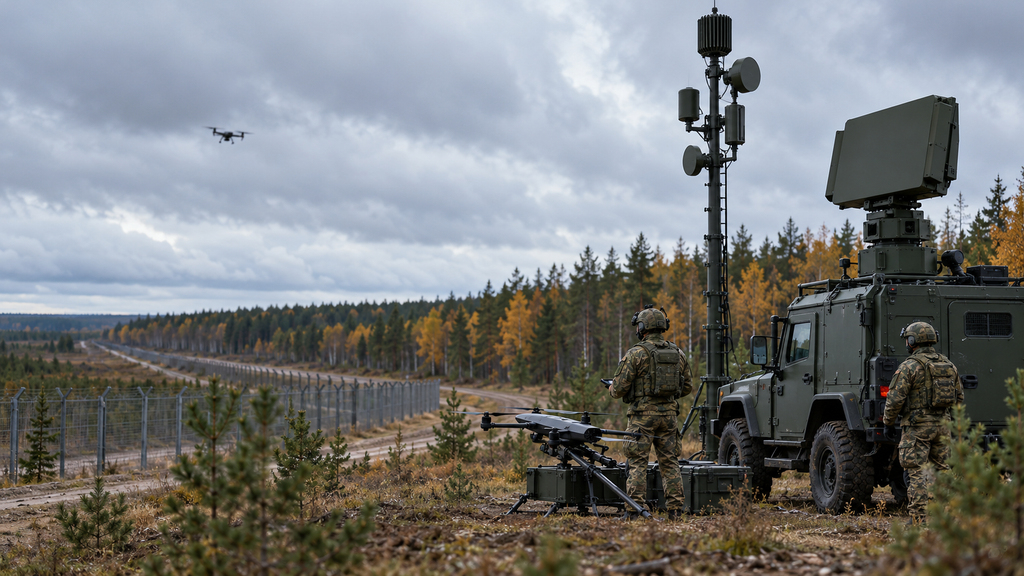
In December 2025, Latvia’s Defence Ministry announced that acoustic drone detection had been introduced along the entire eastern border. It also reported the integration of Giraffe 1X radars and the testing of domestically produced interceptor drones at the Selonia military training area.
The ministry said that €50 million was planned for unmanned aerial system capabilities in 2026, alongside €200.54 million planned for strengthening air defence. These were announced budget allocations, not evidence that the entire automated system had been delivered or that all funds had already been spent.
In May 2026, Latvia announced plans to deploy mobile interceptor teams in response to drone incursions. Defence News reported that the proposed teams would use interceptor drones from Origin Robotics and Eraser. Officials described the deployment as an initial capability and acknowledged that substantially more resources would be needed for comprehensive coverage.
The next step is to increase integration and automation so that the country can respond to aerial threats with less dependence on personnel stationed along the border.
Where Will the Defences Be Deployed?
The programme focuses on Latvia’s eastern frontier, particularly the border with Russia, within a broader effort to strengthen the country’s eastern border with both Russia and Belarus.
The distinction matters because Latvia’s wider eastern-border security programme covers more than counter-drone warfare. It also includes border surveillance, physical fortifications, air defence and other security measures.
The automated anti-drone concept is intended to strengthen protection against low-flying unmanned aircraft that may cross into Latvian airspace. However, the available reporting does not establish that a fully automated interception network is already deployed continuously along the entire Russian border.
Why Is Latvia Investing in Automated Counter-Drone Technology?
Drone incursions have exposed gaps in airspace protection
Latvia and neighbouring Baltic states have faced incidents involving drones entering their airspace. On May 7, 2026, Latvia’s armed forces reported that three foreign unmanned aircraft entered Latvian airspace: two crashed inside the country, while another subsequently left its airspace.
Latvian officials attributed the incident to drones arriving from Russia, while subsequent reporting discussed Ukrainian drones that may have been diverted by Russian electronic warfare. The precise circumstances and origins of individual incidents should be distinguished from the broader, documented problem of unwanted drone incursions.
The incidents highlighted the difficulty of detecting, identifying and responding to small unmanned aircraft before they reach sensitive areas.
Conventional air defence can be expensive
Using fighter aircraft or high-cost missile interceptors against relatively inexpensive drones can create an unfavourable cost exchange, particularly when attacks involve large numbers of targets.
Interceptor drones offer another potential layer of defence. Their effectiveness will depend on acquisition costs, reliability, detection performance, operating conditions and the ability to integrate them into a wider air-defence network.
Latvia is therefore pursuing a more varied approach rather than treating conventional air defence and low-cost counter-drone systems as mutually exclusive.
A smaller military needs to make better use of personnel
Automation could reduce the number of operators required to monitor sensors, track targets and coordinate responses. That is particularly relevant for a country seeking to protect a long border with limited military manpower.
However, the benefits depend on reliable sensor data, robust communications, effective command systems and safeguards against misidentification. Human supervision remains important because a drone detected near a border is not automatically a hostile aircraft.
What Latvia’s Programme Reveals About the Future of Counter-Drone Warfare
Latvia’s plans point to three developments worth watching.
First, counter-drone defence is becoming a network problem. Individual radars, acoustic sensors and interceptor drones are useful, but their combined value depends on how effectively they share information and support decisions.
Second, interception is moving towards lower-cost, layered options. Dedicated interceptor drones could complement electronic warfare, short-range air defence and conventional missile systems. No single method is likely to address every drone type or operating environment.
Third, human-machine coordination is becoming a defining design question. Latvia’s stated approach seeks to automate routine processes without transferring the final engagement decision entirely to a machine. How quickly that approach can be implemented reliably in real-world conditions remains to be demonstrated.
The programme also has implications beyond Latvia. As a NATO member bordering Russia, Latvia is addressing a problem relevant to other countries concerned about low-cost unmanned aircraft, electronic warfare and the strain that repeated incursions can place on air-defence resources.
For India, the development offers a useful point of comparison in the broader evolution of counter-unmanned aircraft systems. The relevant lesson is not that Latvia’s architecture can simply be replicated, but that sensor integration, affordable interception, domestic industrial capacity and clear human-authorisation procedures are becoming increasingly important components of modern airspace security.
What Happens Next?
The key milestones to watch are the transition from mobile interceptor teams to more automated deployments, the operational performance of Latvian-made interceptor drones, and the integration of surveillance data with command-and-control systems.
Further evidence will be needed to determine the scale of deployment, the degree of autonomy achieved in practice, and whether the system can maintain reliable detection and interception under electronic-warfare conditions.
Latvia’s planned anti-drone network represents a significant direction of travel in European defence: moving from isolated counter-drone assets towards a more integrated, automated and human-supervised system. Its success will ultimately depend not on the promise of autonomy alone, but on whether the technology can reliably identify genuine threats and respond without endangering civilian aircraft or people.
Sources
- Latvia’s Ministry of Defence, “Latvia Strengthens the ‘Drone Wall’ on the Eastern Border,” December 10, 2025. Read the official announcement.
- Defence News, “Latvia sends mobile intercept units to Russian border in wake of drone incursions,” May 27, 2026. Read the report.
- Latvia’s Ministry of Defence, “Allied fighters shoot down foreign drone in Latvian airspace,” June 8, 2026. Read the official statement.
- Business Insider, “A NATO ally is building automated defenses against Russia’s drones to let fewer soldiers do more,” October 15, 2026. Read the report.
