

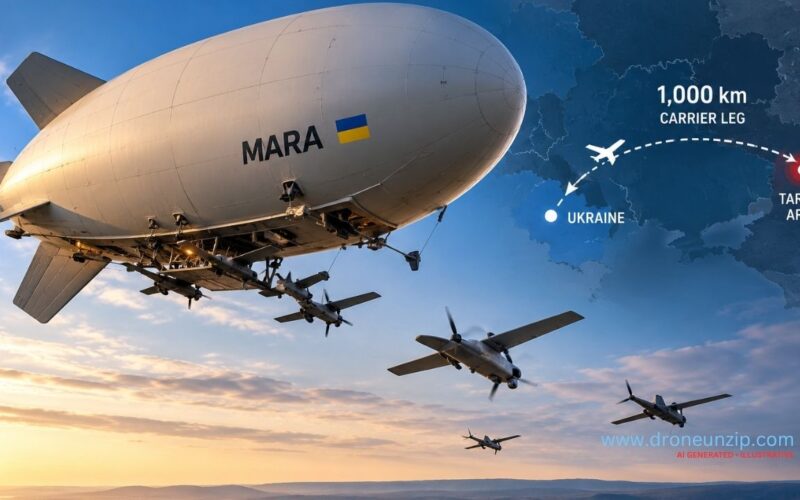
Ukraine’s Mariupol design bureau says its Mara fixed-wing strike drone can be carried toward a target area by a Balun aerostat before being released for its own final flight. Public reporting describes a claimed aerostat transport leg of up to 1,000 kilometres at an altitude above 10 kilometres, followed by a reported drone leg of about 60 kilometres. These figures have not been independently verified in public flight-test data.
Key Takeaways
- The reported 1,000-kilometre figure refers to the aerostat-assisted carrier leg, not a verified standalone range for Mara.
- The developer’s reported description gives an altitude above 10 kilometres and an additional post-release flight of about 60 kilometres.
- Independent data on test conditions, reliability, payload and operational results are not available in the sources reviewed.
Who Is Involved?
The system is attributed to the Ukrainian design bureau known as Ukrainian Mariupol. AIN reported on 8 October that the bureau described Mara as a fixed-wing strike drone used with the Balun aerostat. Subsequent coverage by TechRadar discussed the same concept and highlighted the lack of independent verification for its performance claims.
What Is the Mara-Balun Concept?
According to the developer’s description reported by AIN, the aerostat carries the drone beneath a release mechanism. Once the carrier reaches the intended area, Mara separates and continues toward its target. The approach is intended to shift part of the journey to the aerostat rather than relying entirely on the drone’s own powered flight.
The reported numbers need careful interpretation. The claimed transport leg is up to 1,000 kilometres, while the drone is said to travel a further approximately 60 kilometres after release. Adding these distances produces a theoretical combined route of around 1,060 kilometres, but that arithmetic is not evidence of a demonstrated, repeatable mission range.
When and Where?
AIN published its report on 8 October 2026 after receiving information from the design bureau. TechRadar published further coverage in October. The reports describe a Ukrainian-developed system, but the available material does not provide independently audited flight logs or a complete test record.
Why Does It Matter?
The concept illustrates an alternative way to extend the reach of a small unmanned aircraft by using a separate carrier platform. If the reported figures can be demonstrated reliably, the approach could affect how analysts assess the range and launch profile of some low-cost unmanned systems. Its practical value, however, depends on factors not established in the public reports, including weather tolerance, navigation, communications, launch reliability and exposure to air defences.
What Remains Unverified?
The developer has reportedly claimed combat testing and successful strikes, but the sources reviewed do not provide independent confirmation of those outcomes. Public reporting also does not establish Mara’s normal ground-launched range, payload, speed or the operating conditions behind the quoted distances. Those gaps mean the system’s claims should be attributed to the developer rather than presented as independently proven capability.
Sources
AIN: report based on information from the design bureau TechRadar TechYorker
