
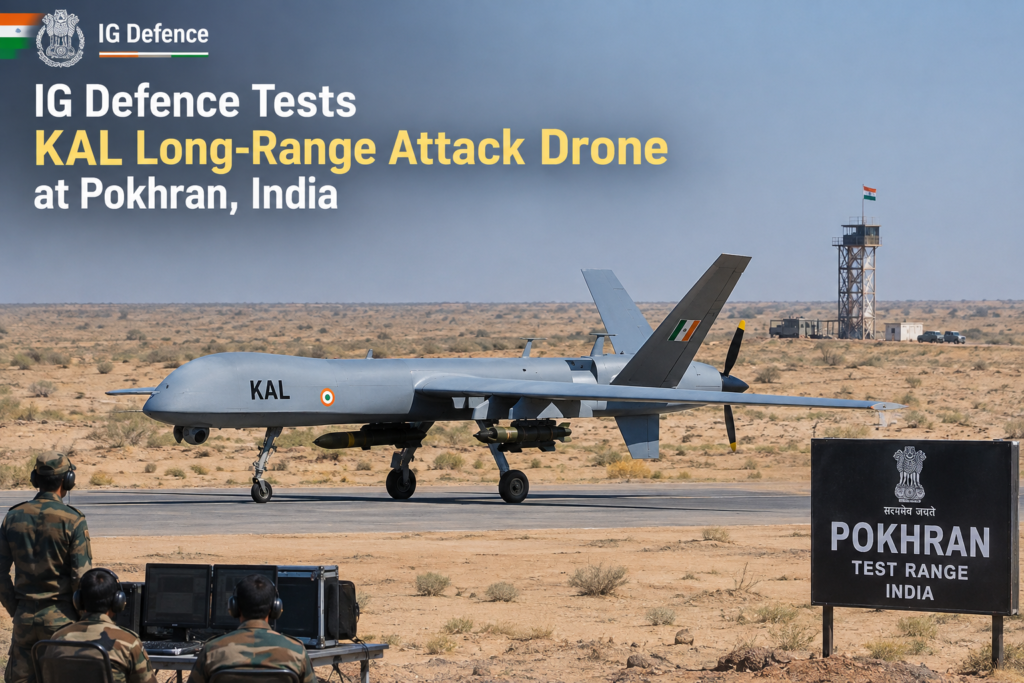
India’s long-range unmanned strike programme gained a new test milestone after Noida-based defence technology company IG Defence said its KAL one-way attack drone completed a flight trial at the Pokhran Field Firing Range in Rajasthan on September 20, 2026. The aircraft was launched from a vehicle-mounted platform, according to reports citing the company.
IG Defence describes KAL as a long-range system designed for one-way missions. The company lists a range of up to 1,000 kilometres, endurance of seven to eight hours and payload capacity of up to 50 kilograms. Those are manufacturer-reported specifications; the company and media reports have not disclosed the distance or duration achieved during the Pokhran flight.
What the KAL trial established
The trial was reported as a test of KAL’s integrated airframe, propulsion, avionics, navigation and mission architecture. A vehicle-mounted launch platform was used, indicating that the system has been developed around a mobile launch configuration rather than a fixed runway-based operation.
However, the public information available about the test remains limited. IG Defence has not disclosed the flight profile, the actual distance flown, the test’s duration, or whether a payload was carried. There has also been no public confirmation that the trial included a terminal engagement against a target. These distinctions matter: completing a flight test is a meaningful development milestone, but it does not by itself establish that every advertised mission capability has been demonstrated.
The company says KAL uses multi-band satellite navigation alongside an inertial navigation system. In broad terms, satellite navigation can provide position information, while inertial navigation estimates movement using onboard sensors. Combining the two can help an aircraft maintain a navigation solution, although performance in a contested or disrupted environment depends on implementation and test conditions that have not been publicly detailed.
Range, payload and launch configuration
IG Defence’s published figures place KAL in the long-range one-way attack drone category. The stated maximum range of 1,000 km and endurance of seven to eight hours describe the company’s intended performance envelope, not necessarily the outcome of the latest test. The reported payload capacity is up to 50 kg, while the stated operating altitude is up to 5,000 metres above mean sea level.
These figures should be read as separate specifications rather than guarantees that the aircraft can achieve maximum range, maximum payload and maximum endurance simultaneously. Actual performance for any aircraft can vary with payload, route, weather, launch conditions and mission profile. IG Defence has not released enough test data to assess those trade-offs for KAL.
The vehicle-mounted launcher is another notable element. A road-mobile launch arrangement may offer deployment flexibility compared with systems that depend on prepared runways. But mobility alone does not establish how quickly a system can be prepared, how it is sustained in the field, or how it would perform under operational conditions. Those details have not been made public.

Why the development matters to India’s drone sector
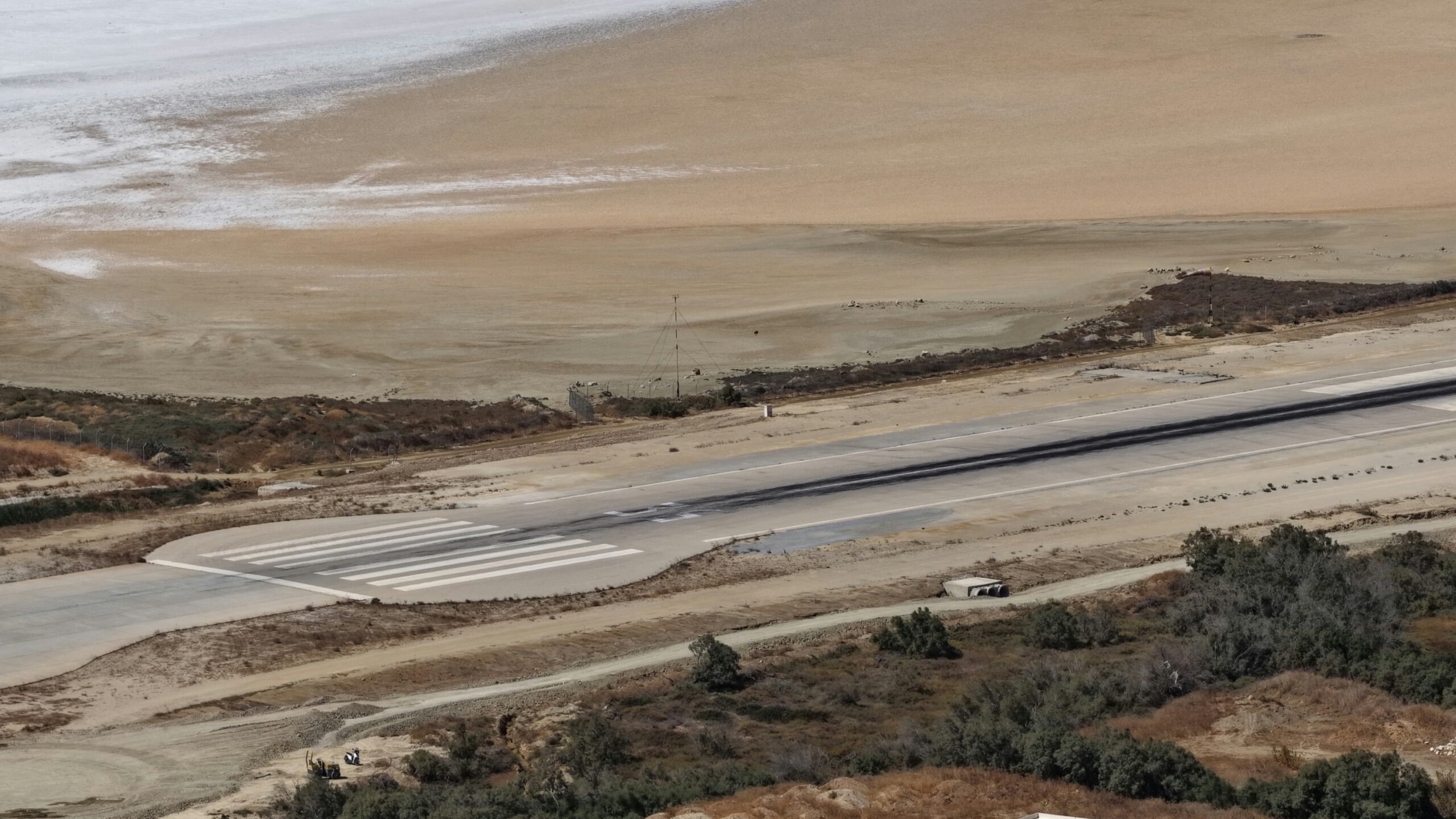
KAL’s trial comes as India’s defence establishment and domestic industry expand their engagement on unmanned aircraft and counter-drone systems. The Indian Air Force held its first Dronathon at Pokhran from September 14 to 16, 2026, bringing companies and technology developers together for demonstrations of unmanned and counter-unmanned systems. The KAL trial was reported separately; no public information reviewed for this article establishes that it was part of Dronathon.
The wider significance is the range of capabilities being pursued by Indian manufacturers. The sector includes surveillance aircraft, logistics platforms, loitering systems and counter-UAS technologies. Recent DroneUnzip coverage has also examined the M-LIDS counter-drone system demonstrated during Yudh Abhyas 2026 and the DRIZZLE interceptor drone introduced for counter-UAS operations. These systems serve different roles, but their development illustrates the breadth of India’s unmanned and anti-drone technology landscape.
For manufacturers, moving from a prototype to a dependable product involves more than demonstrating flight. Repeatable testing, reliability, production capacity, supply-chain control, maintainability and user evaluation all influence whether a system can move towards operational use. Public reporting has not established that KAL has entered serial production or secured an order from India’s armed forces.
What remains unconfirmed
Several questions remain open following the reported trial. There is no publicly disclosed test distance or endurance figure, no detailed independent assessment of the claimed performance envelope, and no confirmed Indian military procurement announcement for KAL. The company has also not publicly detailed a production schedule or an operational induction timeline.
These gaps do not negate the reported flight test, but they limit what can be concluded from it. For now, the defensible description is that IG Defence has reported a successful Pokhran flight trial of KAL and has stated a set of intended performance specifications. Further test disclosures, independent evaluation or an official procurement announcement would provide a clearer picture of the system’s maturity.
Sources: Moneycontrol, September 21, 2026; The Times of India, September 22, 2026.