

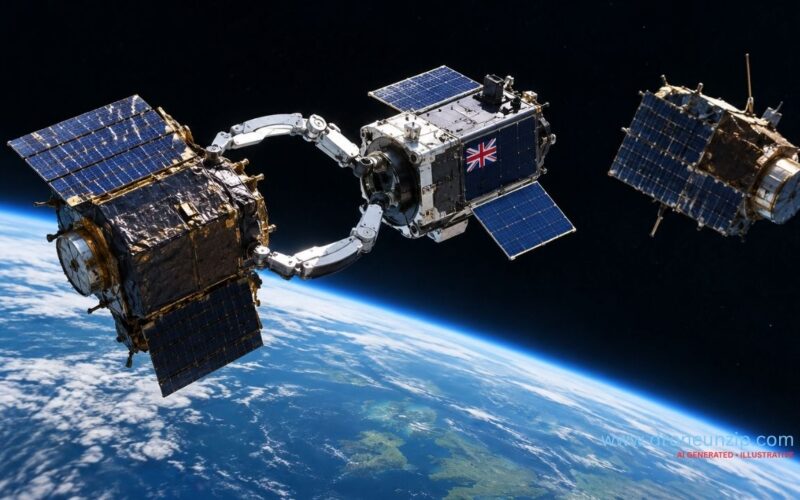
The UK Space Agency has selected ClearSpace to lead a national mission designed to remove two defunct UK-registered satellites from low Earth orbit. Announced on 15 October 2026, the programme is intended to demonstrate the difficult robotics and navigation technologies needed to approach, capture and safely remove satellites that were not designed to be serviced.
Key Takeaways
- ClearSpace has been appointed prime contractor for the UK’s first national active debris-removal mission under a contract worth more than £60 million.
- The spacecraft is planned to launch in 2029, with removal of two defunct satellites targeted by 2032.
- The mission’s future milestones include non-cooperative rendezvous, proximity operations, capture and controlled disposal; these are objectives, not completed results.
Who Is Leading the Mission?
ClearSpace, an in-orbit servicing company with operations across Europe, has been selected as prime contractor by the UK Space Agency. The UK government says the mission is backed by more than £60 million and will involve partners across the country’s space supply chain. It is intended to establish national capability in active debris removal and technologies that may also support future in-orbit servicing.
What Will the Spacecraft Do?
The mission is designed to remove two defunct UK-registered satellites from low Earth orbit. The spacecraft will need to approach objects that are not actively cooperating with the servicing vehicle, carry out proximity operations, capture them and alter their orbit so that they re-enter Earth’s atmosphere and burn up. The UK government has described the project as a step toward a more sustainable approach to operating in space.
When and Where Is the Mission Planned?
The UK Space Agency announced the selection on 15 October 2026. The spacecraft is planned to launch in 2029 from SaxaVord Spaceport in Scotland, while the government release targets removal of the two satellites by 2032. These dates are programme targets and may change as design, testing and launch planning progress.
Why Active Debris Removal Matters
Low Earth orbit hosts satellites used for communications, navigation, weather services, Earth observation and national security. Defunct satellites and fragments can pose collision risks to active spacecraft. Tracking debris is important, but removing selected objects requires an additional capability: a spacecraft must navigate close to an uncooperative target and make physical contact without creating further hazards.
Those requirements make active debris removal a demanding autonomous-systems problem. Relative navigation, machine vision, guidance and control, capture mechanisms and ground-based mission planning all have to work together. The same broad engineering areas are relevant to satellite inspection, life extension, refuelling and assembly, although each application has its own technical and commercial challenges.
The commercial opportunity is still developing. A successful demonstration could help build confidence in in-orbit servicing, but it would not by itself prove that debris removal is commercially routine or economical. Customers, insurance requirements, licensing, target selection and the cost of repeated missions will all influence adoption.
What Happens Next?
Important milestones include spacecraft design and qualification, launch readiness, safe rendezvous with each target, successful capture and controlled disposal. The mission’s eventual results will show how much of the technology can be reused for commercial servicing and future debris-removal projects.
Sources: UK Government and UK Space Agency, “World-first mission puts UK expertise to work to help clean up space”; ClearSpace, UK Active Debris Removal mission contract announcement.
