

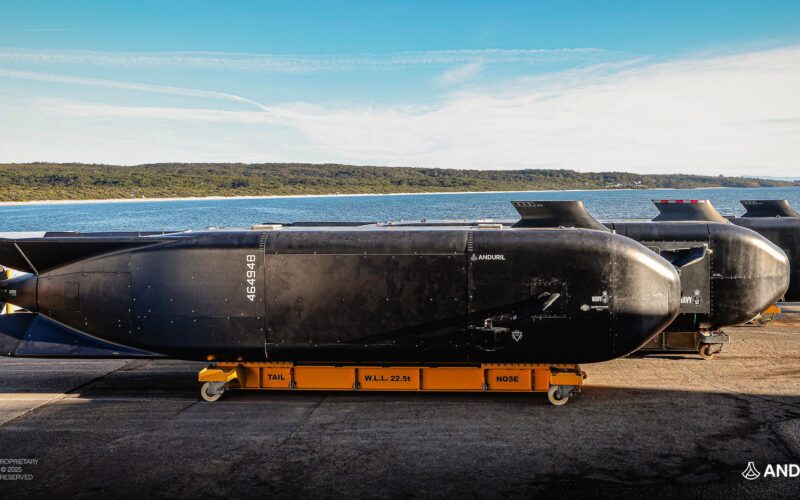
Australia has disclosed three payloads planned for its Ghost Shark extra-large autonomous underwater vehicle: sea mines, logistics caches and tube-launched Altius uncrewed aerial vehicles. Defence Industry Minister Pat Conroy announced the capabilities on 19 October 2026, describing a design that can extend a mission from underwater into the air.
Key Takeaways
- Australia says Ghost Shark is designed to carry sea mines, logistics caches and Altius uncrewed aerial vehicles.
- The minister said the vehicle could carry up to 12 sea mines at a time and deploy swarms of tube-launched Altius systems.
- The announcement describes planned capabilities; it does not establish that all payloads have completed operational trials or been used in combat.
Who Announced the Ghost Shark Payloads?
The announcement came from Australian Defence Industry Minister Pat Conroy during a press conference in Sydney. Ghost Shark is an extra-large autonomous underwater vehicle being developed by Anduril Australia for the Royal Australian Navy. The Australian government has described the programme as part of a wider effort to field autonomous maritime platforms alongside crewed naval vessels.
What Payloads Are Being Added?
The first disclosed payload is a sea-mine deployment capability. Conroy said Ghost Shark would be able to carry up to 12 mines at a time. The second is a logistics-cache payload, designed to place equipment and supplies underwater for later recovery. The third is the ability to deploy tube-launched Altius uncrewed aerial vehicles, which the minister said could perform intelligence, surveillance and reconnaissance as well as strike missions.
These are Australian government descriptions of the intended capabilities. The public announcement did not provide independent trial data for each payload, nor a detailed schedule for when each capability would enter operational service.
When and Where Was the Announcement Made?
The payloads were announced on 19 October 2026 at a press conference in Sydney. The Australian government said the systems would be taken to the AUKUS Pillar II Maritime Big Play exercise in San Diego later that week. Participation in an exercise should not be interpreted as proof that every announced payload has already completed operational qualification.
Why the Cross-Domain Design Matters
Ghost Shark’s payload approach highlights a wider trend in unmanned systems: one platform can act as a carrier or delivery vehicle for another. In this case, an underwater vehicle could deploy aerial systems, while also supporting logistics or mine-related missions. Such flexibility could allow a common vehicle architecture to serve different roles, although each payload adds integration, safety, testing and mission-planning requirements.
The announcement also included a separate payload for the Ocius Bluebottle uncrewed surface vessel: a thin-line towed-array sonar intended to detect submarines. That is a distinct platform and capability from Ghost Shark, but it reinforces the Australian programme’s focus on payload-enabled maritime autonomy.
For Indian readers, the development offers a useful comparison with India’s own unmanned maritime ecosystem. DroneUnzip has covered INS Samarthak’s support for unmanned-systems trials and the Indian Navy’s underwater ROV delivery. Those are different technologies and programmes, but all depend on integrating autonomous or remotely operated systems into maritime operations.
What Remains to Be Verified?
Important milestones to watch include public evidence of payload integration and testing, operational evaluation, production numbers and the timing of service entry. Until those details emerge, the newly disclosed payloads should be described as announced capabilities rather than proven combat performance.
Sources: Australian Department of Defence, “Australia advances undersea warfare capabilities” (19 October 2026); Minister for Defence Industry, press conference transcript (19 October 2026).
