

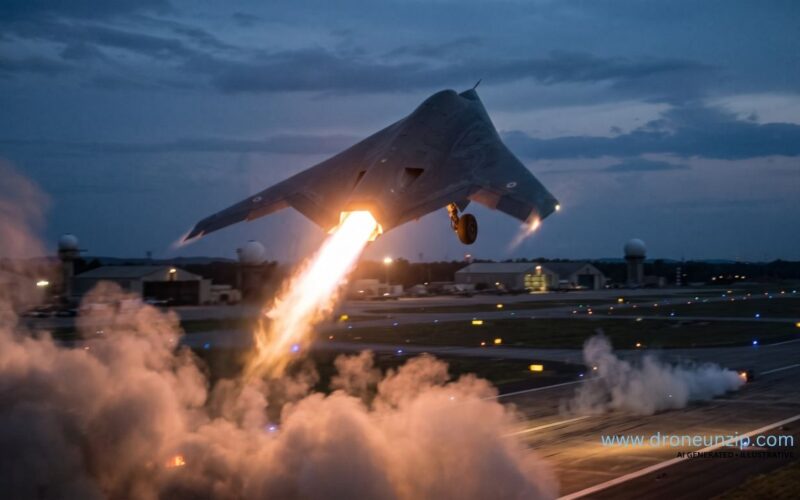
India’s Ghatak unmanned combat aerial vehicle (UCAV) programme is moving through a long development path that combines flying-wing research, autonomous flight testing, propulsion work and defence acquisition planning. The key to understanding its progress is to separate what has been demonstrated, what the government has formally approved, and what remains based on reporting or expectation.
The most visible flight milestones so far belong to the smaller Stealth Wing Flying Testbed (SWiFT), not the full-scale Ghatak aircraft. In 2026, reporting about a related Remotely Piloted Strike Aircraft (RPSA) acquisition added a new procurement dimension. But procurement approval is not the same as a completed prototype, production contract or operational induction.
Ghatak UCAV development timeline at a glance
| Period | Milestone | What it establishes |
|---|---|---|
| May 2016 | Lead-in project for Ghatak and critical technologies recorded in a government project list | Official evidence of an early development effort, not a completed aircraft |
| 1 July 2022 | SWiFT / Autonomous Flying Wing Technology Demonstrator makes its maiden flight | Autonomous take-off, waypoint navigation and landing were demonstrated on the testbed |
| 15 December 2023 | DRDO reports a successful flight trial in tailless configuration after earlier developmental flights | Further validation of flying-wing control and autonomous landing technologies |
| March 2026 | Defence media report procurement progress for a remotely piloted strike aircraft requirement associated with Ghatak | A reported acquisition milestone; the exact relationship and scope must be read against official wording |
| Current public picture | No primary-source confirmation located for a full-scale Ghatak first flight or operational induction | The full-scale aircraft’s flight, production and service dates remain unconfirmed publicly |
What is Ghatak, and how does SWiFT fit into the programme?
Ghatak is India’s planned stealth-oriented unmanned combat aircraft programme, associated with a flying-wing configuration and intended combat roles. Its development draws on several complex technologies, including autonomous flight controls, low-observable design, propulsion and integration of aircraft systems.
SWiFT is a smaller technology demonstrator developed by DRDO’s Aeronautical Development Establishment (ADE). In its 1 July 2022 announcement, the Ministry of Defence said the aircraft flew autonomously from the Aeronautical Test Range in Chitradurga, Karnataka, and demonstrated take-off, waypoint navigation and touchdown. The release described the flight as a milestone in proving critical technologies for future unmanned aircraft.
On 15 December 2023, the Ministry of Defence reported another flight trial of the Autonomous Flying Wing Technology Demonstrator in a tailless configuration. It said the programme had completed six developmental flight trials following the maiden flight, using two in-house manufactured prototypes, and that the seventh flight was conducted in the final configuration. The release highlighted aerodynamic and control-system development, simulation, avionics and autonomous landing.
These are meaningful engineering milestones, but they should not be described as the full-scale Ghatak’s maiden flight. A demonstrator can validate selected technologies without proving that a larger combat aircraft has completed design, integration or qualification.
The 2026 procurement development: what has been reported?
In March 2026, Business Standard reported that the Defence Procurement Board had recommended taking forward a proposal to procure 60 Ghatak UCAVs, citing a defence source. The report said the proposal was awaiting Defence Acquisition Council consideration. Economic Times reporting in early April described a Remotely Piloted Strike Aircraft (RPSA) programme as the next procurement framework and reported a Development-cum-Production Partner model with prototype development and a larger production ambition.
These reports indicate a potentially important transition from technology development towards acquisition planning. However, figures, costs, prototype counts, schedules and the precise naming relationship between RPSA and Ghatak should remain attributed to the reporting unless confirmed in an official document using the same terms.
An Acceptance of Necessity (AoN), where officially granted, is an in-principle acquisition approval. It does not by itself mean that a production contract has been signed, a selected company has begun manufacturing, a full-scale prototype has flown or aircraft have entered service. Those are separate milestones and should be tracked separately.
Who is developing the aircraft, and what role could industry play?
DRDO is India’s defence research and development organisation. ADE developed the SWiFT technology demonstrator, while the Ghatak programme has also been associated with the Aeronautical Development Agency (ADA) for aircraft design. DRDO’s Gas Turbine Research Establishment (GTRE) is separately involved in the Kaveri engine family, whose dry derivative has been discussed in connection with unmanned aircraft.
Recent defence reporting has described a Development-cum-Production Partner (DcPP) approach for the RPSA effort, under which private industry would participate in developing and producing prototypes. This model could bring design and research work closer to industrial manufacturing, but the identity and contractual role of a selected partner should not be treated as confirmed until an official selection or contract announcement is available.
For the wider context, see our guides to the Ghatak UCAV programme, the SWiFT demonstrator, the Kaveri engine connection, the flying-wing design and stealth considerations, and what is publicly known about Ghatak’s range and endurance.
What milestones still need to happen?
- Full-scale prototype clarity: an official update confirming the configuration and status of the full-scale aircraft.
- Prototype first flight: a publicly documented flight milestone for the full-scale aircraft, distinct from SWiFT.
- Propulsion integration: evidence that the selected engine has been integrated and tested with the full aircraft, rather than only tested separately.
- Flight-test campaign: progressive testing of flight characteristics, flight-control systems and aircraft reliability.
- Mission-system and payload testing: verified milestones for sensors, communications and intended payloads, where publicly disclosed.
- Industry partner and contract: an official announcement identifying the selected development or production partner and the scope of its work.
- User evaluation and production decisions: evidence of formal evaluation, production approval and a defined delivery schedule.
What remains unknown about Ghatak’s development?
Several details remain unavailable in sufficiently clear public primary sources: the full-scale aircraft’s first-flight date, a verified production schedule, confirmed operational range and endurance, final engine configuration, weapons and sensor integration, and a service-entry date. Estimates repeated across websites do not become official specifications simply through repetition.
It is also important not to conflate the Ghatak development programme, SWiFT’s technology demonstrations and procurement terminology used in recent reporting. These strands are related, but each has a different evidentiary status. A careful timeline should show those distinctions instead of presenting every reported target as a completed milestone.
FAQs
When did the Ghatak UCAV first fly?
The full-scale Ghatak’s first flight has not been confirmed in the primary sources reviewed for this article. DRDO’s SWiFT technology demonstrator first flew on 1 July 2022.
What did SWiFT prove?
Official releases describe autonomous flight, waypoint navigation, landing and development of technologies for a tailless flying-wing aircraft. These milestones do not establish that the full-scale Ghatak has flown.
Has Ghatak been approved for procurement?
March 2026 media reports described progress towards procurement of a remotely piloted strike aircraft requirement associated with Ghatak. The exact programme terminology, approved scope and financial details should be checked against the wording of official acquisition documents.
Has a production partner been selected?
Reports have discussed a Development-cum-Production Partner model, but this article does not treat any specific company as the selected Ghatak/RPSA partner without an official award or contract announcement.
When will Ghatak enter service?
No verified official service-entry date was located in the sources reviewed. Prototype development, flight testing, user evaluation and production decisions must precede any reliable induction timeline.
Conclusion
The Ghatak UCAV programme has progressed through important foundational work, most visibly the SWiFT demonstrator’s autonomous flying-wing flight trials. Reporting about the 2026 RPSA procurement effort suggests that acquisition planning may be advancing, but it should not be confused with a completed full-scale aircraft or a signed production contract. The next decisive evidence will be official updates on prototype development, propulsion integration, flight testing, industry-partner selection and user evaluation. Until those milestones are documented, the most accurate timeline is one that separates demonstrated technology, reported procurement progress and the work still ahead.
