

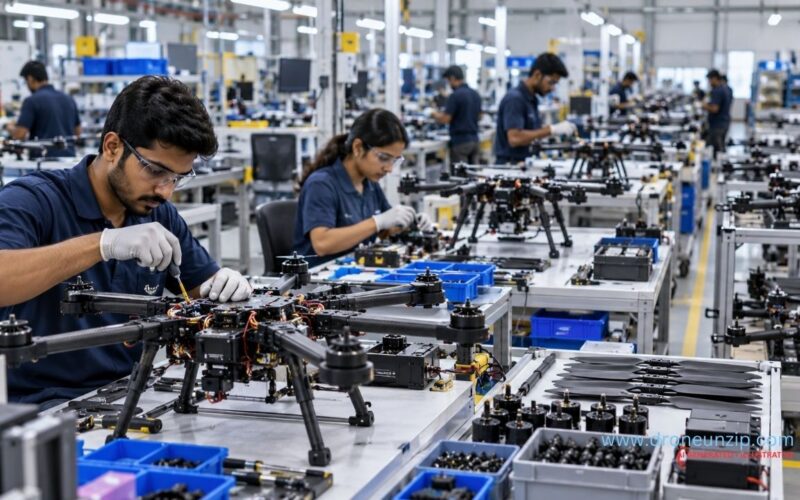
India’s drone manufacturing industry is entering a new phase as companies expand production capacity, defence orders create demand for larger batches and the government pushes for greater domestic manufacturing of drones and critical components.
Recent developments illustrate both sides of this transition. Gopalan Aerospace India plans to increase its production from around 25 drones a month to 500 within a year, while Solar Defence and Aerospace Limited has reportedly delivered 450 Nagastra-1R loitering munitions to the Indian Army under a ₹158-crore contract.
The developments point towards a shift from manufacturing relatively small quantities of specialised unmanned aircraft to building the production systems needed to fulfil larger orders. However, announced capacity, actual output and the proportion of domestically manufactured components remain separate measures of industrial progress.
Key Takeaways
- A major planned capacity increase: Gopalan Aerospace India aims to expand monthly production from approximately 25 drones to 500 within a year.
- Large defence deliveries are becoming a key indicator: Solar Defence and Aerospace has reportedly completed a delivery of 450 Nagastra-1R loitering munitions to the Indian Army.
- Government policy is pushing localisation: India’s defence leadership has called for domestic production to extend beyond final assembly to critical components, software and propulsion systems.
- Manufacturing capacity is only one part of the challenge: Quality control, component supply, testing, repeat orders and delivery reliability will determine whether capacity expansion translates into sustained production.
- The next test is industrial depth: India’s ability to manufacture key components domestically will influence the resilience and competitiveness of its drone industry.
Who Is Expanding Drone Manufacturing in India?
Several developments illustrate the different paths through which Indian drone manufacturing is scaling up.
Gopalan Aerospace India targets 500 drones per month
According to The Economic Times, Gopalan Aerospace India, the aerospace division of Gopalan Enterprises, plans to raise production from approximately 25 drones per month to 500 within a year.
The company has reportedly invested ₹75 crore out of a planned ₹100-crore investment programme and launched a new production line at its Hoskote facility in Karnataka.
If achieved, the target would represent a 20-fold increase in monthly production capacity. The company’s expansion is intended to support growing demand across unmanned aircraft and loitering-munition categories.
The important qualification is that 500 units per month is a target, not a verified current production rate. Actual output, product mix and sustained utilisation will determine how quickly the planned capacity becomes commercially meaningful.
Solar Defence demonstrates the importance of large defence orders
A different indicator of scale comes from Solar Defence and Aerospace Limited, a subsidiary of Solar Industries India.
Financial Express reported on October 15, 2026, that the company had delivered 450 Nagastra-1R loitering munitions to the Indian Army under a ₹158-crore emergency procurement contract.
The reported delivery demonstrates the importance of defence procurement in creating demand for production batches larger than those typically associated with early-stage development and limited trials.
It also highlights a distinction between two kinds of scale. A manufacturer can increase the number of units it is capable of producing, while a completed delivery demonstrates that a specific order has moved through manufacturing and supply. Neither measure, on its own, establishes the industry’s total annual production capacity.
What Is Driving the Shift Towards Larger Production Runs?
Defence demand is changing manufacturing priorities
Modern military operations have increased interest in unmanned systems for surveillance, reconnaissance, logistics and tactical missions. Loitering munitions and other specialised military drones have also become more prominent in procurement discussions.
For manufacturers, larger orders can justify investment in production tooling, dedicated assembly lines, component inventories, testing infrastructure and trained personnel.
However, military drones are not interchangeable products. Different systems may require different airframes, propulsion arrangements, payloads, communication links and testing procedures. Scaling production therefore requires more than assembling additional units on an existing workbench.
Government policy is encouraging domestic manufacturing
India introduced a Production-Linked Incentive scheme for drones and drone components in 2021, with a total allocation of ₹120 crore across its approved three-year implementation period.
The scheme was designed to reward eligible domestic value addition and support manufacturing capabilities. According to a written parliamentary answer in July 2025, ₹98.32 crore had been disbursed under the programme, and its approved period had concluded.
The scheme formed part of the wider policy effort to strengthen the domestic drone industry. Its historical allocation should not be confused with a new, ongoing funding commitment.
More recently, Defence Minister Rajnath Singh used the National Defence Industries Conclave on March 19, 2026, to call for India to become a global hub for indigenous drone manufacturing. He emphasised that self-reliance must extend to critical components, including motors, batteries, software and other elements of the supply chain.
That emphasis is significant because assembling a drone in India does not necessarily mean every critical component originates in India.
Commercial demand can support production beyond defence
Agriculture, surveying, mapping, infrastructure inspection and industrial monitoring create additional markets for unmanned aircraft.
These applications can help manufacturers build repeatable production processes and develop service and maintenance networks. Yet commercial and military markets have different requirements: a platform designed for agricultural spraying cannot automatically satisfy the endurance, reliability, payload or security requirements of a military customer.
The industry’s long-term opportunity will depend on whether manufacturers can serve different markets without compromising product quality or spreading production resources too thinly.
What Does Mass Production Actually Mean for Drone Manufacturers?
Moving from small batches to larger output involves several operational changes.
Standardised designs: Stable product architectures and documented assembly procedures reduce avoidable variation between units.
Reliable component supply: Motors, batteries, flight controllers, sensors, communication systems and other components must arrive in sufficient quantities and meet consistent specifications.
Repeatable testing: Each production run needs appropriate inspection and acceptance procedures. A higher assembly rate is not useful if defects, rework or failed tests increase at the same time.
Production planning: Manufacturers need to coordinate suppliers, labour, inventory, tooling and delivery schedules to avoid bottlenecks.
After-sales support: Larger fleets require spare parts, repairs, software support and maintenance processes. These requirements are particularly important when drones are deployed in remote areas or demanding operational environments.
The distinction is crucial: a facility may be equipped to produce hundreds of drones monthly, but dependable mass production requires the entire supply chain and quality system to operate at a comparable level.
The Component Localisation Challenge
One of the most important questions for India’s drone industry is how much of each platform’s value and technology is genuinely produced domestically.
Airframes and final assembly are visible parts of manufacturing, but critical dependencies can remain in propulsion systems, batteries, electronic components, flight controllers, navigation equipment and sensors.
The Ministry of Civil Aviation’s drone PLI framework explicitly covered a range of components, including airframes, propulsion and power systems, batteries, flight-control modules, communications equipment and payload-related technologies.
This is relevant because local assembly alone does not guarantee supply-chain resilience. Dependence on imported components can expose manufacturers to price changes, supply disruptions, export restrictions and geopolitical uncertainty.
Developing domestic component suppliers may take longer than expanding assembly capacity, particularly for specialised electronics and high-performance systems. Nevertheless, deeper localisation could help Indian manufacturers improve control over product development, repairability, production schedules and long-term support.
What This Means for India’s Drone Industry
The emerging production trend could have three important consequences.
First, larger production runs may improve manufacturing economics by spreading tooling, engineering and factory costs across more units. Whether this results in lower prices will depend on component costs, yields, utilisation and the terms of customer contracts.
Second, repeat orders could encourage investment in industrial infrastructure. Manufacturers with clearer demand visibility are better positioned to invest in production lines, workforce training, quality systems and supplier development.
Third, manufacturing depth could become a competitive differentiator. Companies that combine reliable delivery with domestic component capabilities and strong after-sales support may be better positioned to win repeat business and compete in export markets.
These outcomes are opportunities, not automatic consequences of a capacity announcement. Sustained demand, working capital, technical reliability and commercially viable production costs will remain decisive.
What to Watch Next
The next phase of India’s drone manufacturing story should be assessed against measurable indicators:
- Whether Gopalan Aerospace reaches its announced target of 500 drones per month.
- Whether additional defence contracts translate into repeat deliveries and sustained production.
- Whether manufacturers disclose actual output, factory utilisation and delivery performance rather than capacity alone.
- Whether domestic suppliers expand production of motors, batteries, flight controllers and other critical components.
- Whether Indian drone companies develop export markets while meeting the certification and support requirements of overseas customers.
India’s drone industry is showing signs of moving beyond development-led manufacturing towards larger production programmes. The strongest evidence of progress will come not from ambitious capacity targets alone, but from repeated deliveries, dependable quality, competitive costs and a deeper domestic supply chain.
The industrial challenge is clear: building a successful drone prototype is an engineering achievement. Building hundreds of reliable systems, delivering them on schedule and supporting them throughout their service life is a manufacturing achievement.
Sources
- The Economic Times, October 14, 2026, for Gopalan Aerospace’s planned capacity expansion.
- Financial Express, October 15, 2026, for the reported Nagastra-1R delivery.
- Press Information Bureau, March 19, 2026, for the government’s manufacturing ambition and emphasis on localisation.
- Ministry of Civil Aviation, PLI scheme, for the policy framework supporting domestic drone and component manufacturing.
- Rajya Sabha written answer, July 28, 2025, for the status of the drone PLI scheme.
