

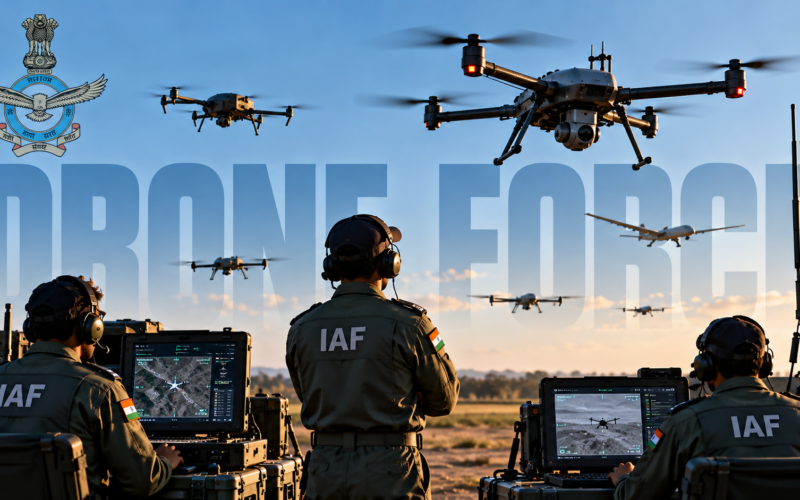
The Indian Air Force does not plan to create a separate drone force, but it is expanding the number and types of unmanned aerial systems and loitering munitions it operates. Air Chief Marshal AP Singh said on October 3 that drones should remain integrated with the IAF’s existing weapons and platforms rather than operate as an independent arm.
Speaking at the IAF’s annual press conference in New Delhi ahead of Air Force Day, Singh described drones as an “evolutionary” capability for the service. He said the IAF has used drone capabilities for decades and is now increasing their numbers, types and operational capabilities.
IAF chooses an integrated drone force structure
Singh was asked whether the IAF was considering a dedicated drone force. His answer was that such a separate structure is not currently planned. Instead, unmanned systems and loitering munitions are expected to work alongside other weapons and platforms.
The reasoning is operational integration. Singh said different weapon systems should not operate in isolation if the objective is to create a combined battlefield effect. In this model, drones are treated as another capability within a wider force structure rather than as a standalone service.
That distinction matters as military drones have expanded from traditional intelligence, surveillance and reconnaissance roles into a much wider set of missions. Depending on the platform, unmanned systems can provide persistent observation, communications support, targeting information, electronic effects or strike capabilities.
More drones and loitering munitions are being added
The IAF chief said the service is increasing both the number of drones and loitering munitions, while also expanding the variety of systems available. He indicated that specialised units already handle these capabilities and that their numbers can be increased if required.
Loitering munitions received particular attention during the briefing. Singh said they had helped create disruption and target some air-defence assets. His comments point to a growing emphasis on using relatively expendable unmanned systems as part of a broader combination of sensors, aircraft, air-defence systems and other weapons.
The approach is different from building an isolated “drone arm” whose operations would be separated from conventional aviation. Instead, the IAF appears to be placing greater emphasis on connecting unmanned systems with the rest of its operational network.
Why integration matters for military drones
Modern military drone operations increasingly depend on what happens around the aircraft, not only on the drone itself. A reconnaissance UAV can feed information to other platforms, while a loitering munition may be used against a target identified by another sensor. Communications, command-and-control, electronic warfare and air-defence systems can also influence whether an unmanned mission succeeds.
This makes interoperability an important requirement. A drone operating independently may provide useful information or effects, but its value can change significantly when its sensors and communications are connected to other parts of the force.
The IAF’s approach also fits into a broader shift toward networked operations. Rather than treating manned aircraft, unmanned aircraft and other weapon systems as separate categories, the emphasis is increasingly on how they can contribute to the same mission.
Drone endurance is another factor. Long-duration unmanned aircraft can maintain surveillance over an area without placing a pilot in the aircraft, while smaller systems can be deployed in larger numbers for more distributed operations. Technologies aimed at extending endurance are also being explored across the industry, including wireless power beaming for drones.
What the IAF statement means for India’s drone strategy
The October 3 comments do not announce a new drone procurement programme or identify specific aircraft that will be inducted. They instead provide a clear indication of how the IAF currently views the organisational role of unmanned systems.
The immediate direction is expansion within the existing force structure. The IAF intends to increase drone and loitering-munition capabilities while integrating them with other weapons and platforms. That leaves future questions around fleet size, platform categories, command arrangements and specific procurement programmes open.
For India’s wider drone industry, the comments also highlight the importance of interoperability. Systems developed for military use may need to work within larger networks rather than being designed only as standalone aircraft. That can influence requirements for communications, sensors, navigation, autonomy, electronic resilience and mission systems.
Drones are becoming part of the wider air-power network
The IAF’s position is therefore less about creating a separate drone branch and more about expanding unmanned capability throughout the existing operational structure. Singh’s comments indicate that drones and loitering munitions will continue to grow in numbers and variety, but their employment is expected to remain tied to the wider force.
The statement is significant because it comes as military organisations around the world are reassessing how unmanned systems fit alongside conventional aircraft and other battlefield capabilities. For the IAF, the direction outlined on October 3 is integration rather than separation.
Sources
ANI report carried by Public TV The Economic Times India Defence Wire
