

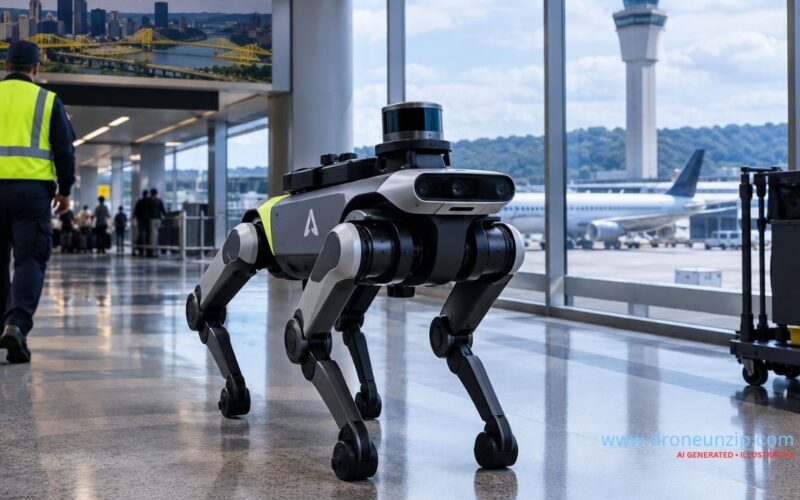
Pittsburgh International Airport plans to test up to four quadruped robots powered by Skild AI technology for air-quality monitoring and selected terminal operations. The airport announced the pilot through its xBridge innovation programme in October 2026, positioning the project as a practical test of robotics in a busy public facility.
Key Takeaways
- Pittsburgh International Airport says it plans to test up to four quadruped robots as part of its xBridge innovation programme.
- Proposed tasks include monitoring air quality and supporting terminal operations; the airport’s announcement describes a pilot, not a full-scale deployment.
- The wider trend is robots being evaluated for routine facility monitoring, where safety, reliability and integration with human staff matter as much as mobility.
Who Is Involved in the Airport Robotics Pilot?
The pilot is being run by Pittsburgh International Airport through its xBridge innovation programme, which evaluates emerging technologies for airport operations. Skild AI provides the robotics AI technology associated with the quadruped platforms. The airport’s announcement is the primary source for the proposed use cases and the planned scope of the test.
What Will the Robots Do?
The airport has described air-quality monitoring and terminal operations as focus areas. Reporting around the pilot has also mentioned possible tasks such as identifying spills, overflowing bins or congestion. These should be understood as intended or potential applications of the trial, rather than a claim that the robots already perform every task autonomously in routine service.
When and Where Is the Trial Taking Place?
The airport announced the project in October 2026, with its official newsroom publishing details on 9 October. The trial is based at Pittsburgh International Airport in Pennsylvania, United States. The public announcement describes a planned deployment of up to four robots; it does not establish that all four are already operating.
Why Airport Robotics Is Worth Watching
Airports are challenging environments for autonomous machines. Robots must navigate around passengers, luggage, staff and vehicles while operating under strict safety procedures. Routine inspection tasks can be attractive early use cases because they may be repetitive and measurable, but successful deployment still depends on dependable perception, safe navigation, reliable data collection and clear escalation to human staff.
The commercial model may be as important as the robot itself. A facility operator needs a system that can be mapped, supervised, maintained and integrated with existing workflows. This creates potential demand for robotics-as-a-service, fleet monitoring, mapping, computer vision and operational analytics rather than only for the physical machine.
The technology also connects with advances in spatial data and machine perception. DroneUnzip recently covered Hesai’s Kosmo spatial-intelligence platform, another example of the data and perception infrastructure being developed to help autonomous systems interpret real environments. The airport pilot and Kosmo are separate initiatives, but both illustrate the importance of translating sensor inputs into useful operational decisions.
What Happens Next?
The key indicators will be whether the pilot expands, which tasks are actually completed by the robots, how often human intervention is needed, and whether the airport reports measurable improvements in safety or operating efficiency. Until those results are published, the project is best treated as an operational test rather than proof that quadruped robots are ready for widespread airport adoption.
Sources: Pittsburgh International Airport, xBridge quadruped-robot pilot announcement (9 October 2026).
