

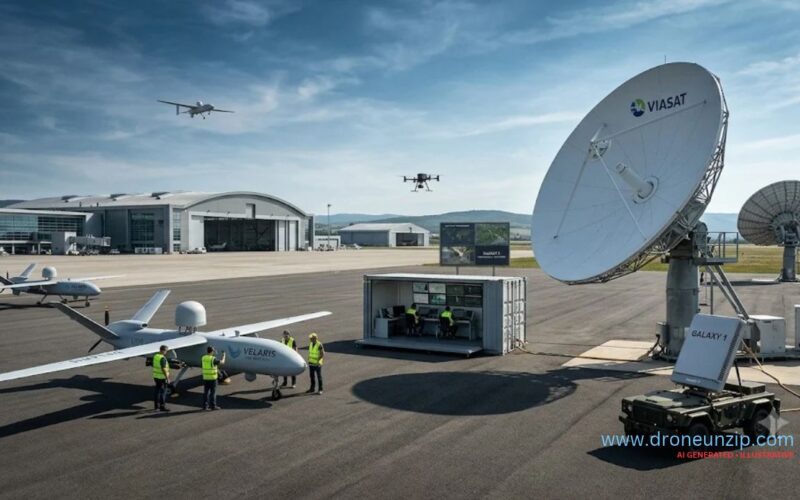
Viasat and Galaxy 1 Communications announced on 2 November 2026 a production agreement to expand the commercial rollout of Velaris, Viasat’s satellite communications service for uncrewed aircraft and advanced air mobility. The announcement, published on Viasat’s website on 3 November, follows two years of joint development, integration and proof-of-concept activity.
Key Takeaways
- Galaxy 1 will provide commercial and operational infrastructure supporting Viasat’s Velaris partner ecosystem.
- Velaris uses L-band satellite connectivity for uncrewed and advanced air mobility applications.
- The agreement covers customer onboarding, service management, remote terminal monitoring and API integrations.
- The announcement concerns commercial infrastructure; it is not proof of regulatory approval for any particular BVLOS operation.
What Viasat and Galaxy 1 Announced
Viasat said the production agreement will help service providers, aircraft operators and technology partners access Velaris connectivity through a more scalable commercial platform. Galaxy 1 will manage functions including provisioning, billing, reporting, network infrastructure, terminal configuration, incident management and service restoration.
The partners said their two years of joint development and proof-of-concept testing validated capabilities needed for production service delivery. They did not disclose a new satellite launch, an aircraft procurement order or a count of paying commercial operators.
Why Satellite Connectivity Matters for Autonomous Aircraft
Beyond-visual-line-of-sight flights may travel outside conventional terrestrial communications coverage. Satellite links can support command, monitoring and operational data services, particularly in remote regions. Connectivity alone does not make an aircraft autonomous, and safe BVLOS operations also require suitable aircraft systems, operational procedures and regulatory permissions.
What Galaxy 1 Adds to Velaris
Galaxy 1’s role extends beyond supplying a connection. Its platform is intended to handle remote terminal management, integration with third-party applications and commercial operations for multiple customers. This infrastructure could make it easier for aircraft operators to manage satellite-connected fleets without building every service-management function themselves.
Potential Applications and Limits
Viasat identifies delivery aircraft for logistics and medicine, advanced air mobility and inspection missions in remote locations among potential uses. Those examples describe intended markets, not evidence that each application has reached large-scale commercial deployment.
Why It Matters for India’s Drone Ecosystem
Long-distance logistics, offshore inspection and remote-area monitoring can face communications challenges. Satellite-backed UAV services may become relevant to these use cases, but the agreement does not announce an Indian customer, Indian regulatory clearance or a domestic launch.
What Comes Next?
Key milestones include operator adoption, integration of aircraft terminals, service-level performance and regulatory approvals for specific routes. The wider trend is a shift toward managed communications infrastructure for autonomous aviation, beyond the sale of satellite bandwidth alone.
