
Drone registration in India is governed by the Drone Rules, 2021, as amended, but the application portal has changed. Since 15 July 2025, DGCA’s Form D-2 service for issuing a Unique Identification Number (UIN) has been on eGCA, rather than the older Digital Sky registration workflow. Before buying or flying a drone, check whether the aircraft qualifies for an exemption, whether it has the required certification and whether its registration service is currently available.
Important October 2026 update: DGCA’s website displays a notice that registration of non-type-certified (non-TC) unmanned aircraft systems is temporarily suspended until further notice. Do not assume an unregistered imported drone can be made legal through a routine online application.
Do you need to register a drone in India?
Rule 14 of the Drone Rules, 2021 establishes the general requirement to register an unmanned aircraft system and obtain a UIN before operating it, unless an exemption applies. A drone’s small size alone is not a reliable substitute for checking the actual exemption provisions. The rules distinguish aircraft registration from remote-pilot qualification and permission to use a particular airspace.
Digital Sky versus eGCA: which portal should you use?
DGCA’s public notice dated 3 July 2025 moved the following services from Digital Sky to eGCA: Form D-2 (UIN issuance), Form D-3 (UIN transfer or deregistration), and remote-pilot-certificate-related services. The D-2 and D-3 transition took effect on 15 July 2025. Digital Sky remains relevant for checking drone airspace zones before a flight. The two platforms serve different purposes; do not follow old guides that direct new D-2 applications to Digital Sky.
Start with the official DGCA website and its eGCA service link. For airspace, see our guide to checking India’s drone airspace zones.
What is a drone UIN?
A Unique Identification Number is the registration identifier for a UAS. Under Rule 15, a UIN application uses Form D-2 and identifies the aircraft and associated serial-numbered components. It is not the same thing as a remote pilot certificate, a type certificate or permission to enter restricted airspace.
How to prepare for registration on eGCA
- Identify the drone and its category. Record its make, model, weight, serial number and relevant component details from the manufacturer.
- Check the applicable exemption and certification status. The requirements depend on the aircraft and intended operation. Check the current rules rather than relying on seller descriptions.
- Check DGCA’s current service notices. In particular, verify whether the suspension affecting non-type-certified UAS applies to your drone.
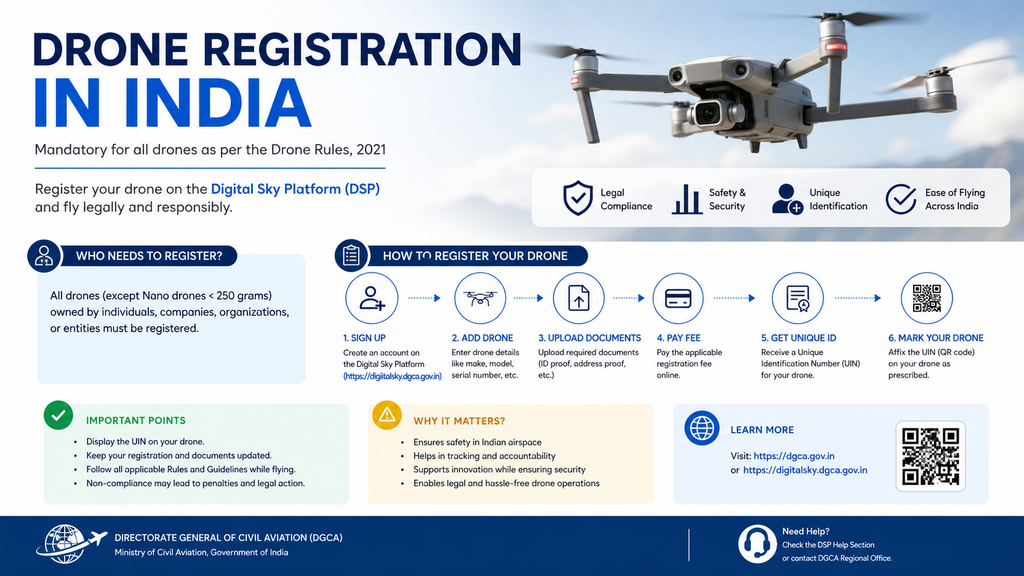
- Open the official eGCA portal through DGCA. Locate the UAS registration/UIN issuance service (Form D-2) and follow the portal’s live instructions.
- Enter the requested information and submit supporting material. Use the documents and fields actually requested by the live service; do not rely on screenshots of the old Digital Sky process.
- Confirm issuance before operating. An application or payment receipt is not a UIN. Retain the issued record and verify its details.
Editorial limitation: This is a rules-based preparation guide, not a verified screen-by-screen walkthrough of a live eGCA application. Portal screens, document requirements and payment steps must be checked in the live service before they can be described precisely.
Registration fees and documents
Rule 15 refers applicants to Form D-2 and the fee specified in Rule 46. Before paying, verify the applicable fee and payment method on the official eGCA service. Older DGCA manuals were written for superseded regulatory workflows and should not be treated as a current fee or document checklist. Keep purchase records, manufacturer serial numbers and any relevant certification information available, but follow the live official checklist.
Can you register a non-type-certified drone?
Do not assume so. DGCA currently highlights a temporary suspension of registration for non-type-certified UAS. This is particularly important for buyers of inexpensive drones sold without clear documentation. Check the notice and the aircraft’s status with DGCA before purchase or flight. A retailer’s assurance is not a substitute for a regulatory record.
Drone registration in India is not a flying licence
Aircraft registration identifies the drone; a remote pilot certificate relates to the pilot’s qualification where required. Separately, the flight location may be subject to green, yellow or red airspace restrictions and other operational rules. Our drone flying licence guide covers the pilot side, while our India flying locations guide explains why a scenic destination is not automatically an approved launch site.
What should buyers check before paying?
- Whether the seller can identify the exact aircraft model and its certification status.
- Whether registration is required and currently possible for that model.
- Whether the intended use requires a remote pilot certificate.
- Whether your intended flying area and operation are permitted.
- Whether the purchase includes traceable invoices, serial numbers and after-sales support.
For model selection, also read our DJI drone buying guide for India. Buying a capable camera drone and being allowed to operate it are separate decisions.
FAQs
Is Digital Sky still used for drone registration?
DGCA migrated Form D-2 UIN issuance to eGCA in July 2025. Digital Sky remains relevant for checking airspace; confirm any newer changes directly with DGCA.
Can I fly immediately after applying for a UIN?
Do not treat an application as an issued registration. Check the actual UIN requirement, any applicable exemptions and other operational permissions before flying.
Does a UIN replace a remote pilot certificate?
No. They concern different regulatory requirements.
What if my drone is not type-certified?
DGCA’s current homepage notice says registration of non-TC UAS is temporarily suspended. Confirm the notice and its scope with DGCA before attempting to register or operate the aircraft.
