

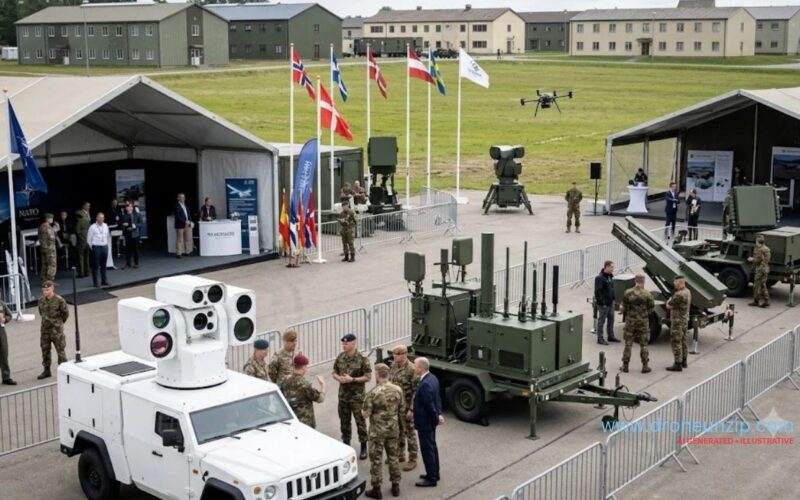
NATO has launched a counter-uncrewed aircraft systems procurement marketplace that allows member countries to purchase from a catalogue of 16 selected counter-drone solutions without running separate tenders for each acquisition. The NATO Communications and Information Agency (NCIA) announced the framework on 5 November 2026, naming five participating suppliers: Alta Ares, Axon Enterprise, Northrop Grumman, OSL UK and Quantum Systems.
What happened
The marketplace is part of NATO’s Drone Edge initiative, introduced at the alliance’s defence industry forum in Ankara in July. According to NCIA, the selected solutions draw on experience from national innovation programmes, NATO exercises and operational deployments, including in Ukraine. The agency describes a mix of fixed, transportable and mobile systems.
NCIA organised the competition around four operational scenarios. Point protection addresses high-value sites such as bases and command posts. Area protection covers a zone up to three kilometres across. Border protection covers a 20-kilometre segment, while convoy protection focuses on moving columns up to 300 metres long travelling at speeds up to 50 kilometres per hour.
The multi-award framework is valid for 18 months, with a possible extension. NATO has separately allocated €3.1 million for additional testing by nations or NATO commands. The agency says new competitions will be held to keep pace with changing drone threats.
What comes next
OSL UK, a company within the Terma group, is one of the five selected suppliers. Its inclusion is a procurement-framework decision, not proof that a particular country has ordered a specific OSL system under the new mechanism.
The marketplace could shorten the time between identifying a drone-defence requirement and placing an order. It also puts a premium on interoperability: a radar, radio-frequency sensor and command system must work within a wider national or alliance architecture, not merely as standalone equipment.
For Indian manufacturers and system integrators, NATO’s approach offers a useful reference point for how counter-drone solutions may increasingly be assessed: through clearly defined operational scenarios, integration requirements and accelerated procurement rather than isolated equipment specifications. That is an industry implication, not an announced NATO-India programme.
Related DroneUnzip reporting includes earlier autonomous-systems coverage and related technology developments.
