

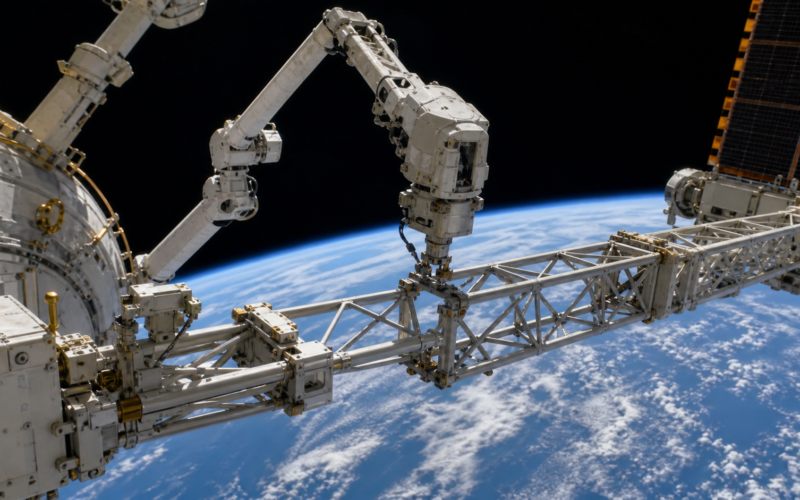
Caltech and the US Defense Advanced Research Projects Agency (DARPA) have demonstrated automated assembly of a structural truss in orbit, a step toward constructing space systems too large to launch as single folded units. DARPA announced the achievement on 5 November 2026 under its Novel Orbital and Moon Manufacturing, Materials and Mass-efficient Design programme, known as NOM4D.
What happened
The Caltech payload, called ASTRA, used a gantry-style robotic system to position composite structural members and connect them with custom joints. DARPA says the robot also deployed a thin reflective mesh during the assembly sequence, providing a proof of concept for future space-based antennas.
The achievement is significant because today’s large antennas and telescopes are constrained by launch-vehicle fairing dimensions and the complexity of deployment mechanisms. Constructing a structure from smaller parts after launch could eventually allow new designs, although scaling the technique remains a major engineering challenge.
Caltech reported that the orbital hardware carried two preassembled truss bays and built a third. The researchers had planned a more extensive demonstration involving a reflector antenna, but did not complete the full structure. The milestone therefore concerns a successful partial assembly, not a finished operational antenna.
What comes next
DARPA describes the test as the first automated assembly of a structure in space. That characterisation refers to the programme’s demonstration and should not be confused with routine autonomous construction or a commercially deployable orbital factory.
Future applications could include large communication apertures, astronomical observatories and solar-power structures. All would require further proof of precision, repeatability, reliability and operations over much larger dimensions.
For the autonomous-systems industry, the experiment expands robotics beyond Earth-based inspection and transport into construction in microgravity. The emerging opportunity is not only robotic arms but also machine-readable assembly planning, modular joints, inspection and fault recovery in orbit.
Related DroneUnzip reporting includes earlier autonomous-systems coverage and related technology developments.
