

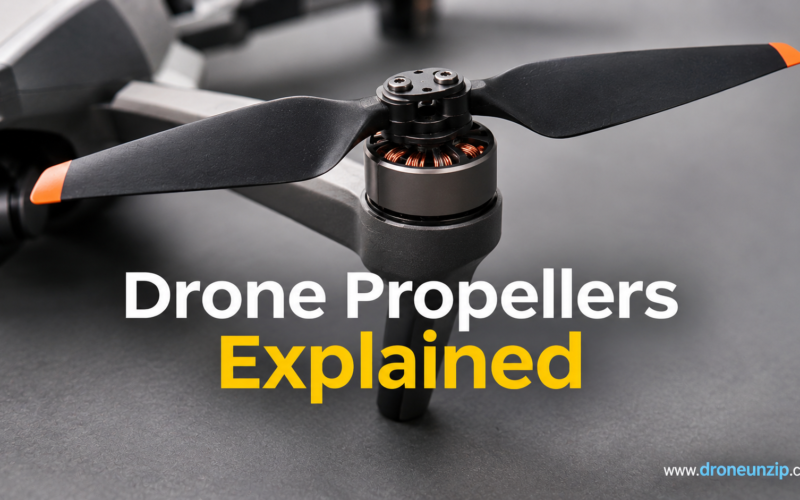
Drone propellers are rotating aerodynamic blades that generate thrust. Their diameter, pitch, blade count, shape and rotation direction affect lift, control, motor loading and battery consumption. A replacement that looks similar may still be unsafe because of its dimensions, mounting system or intended rotation. This guide explains the specifications, performance trade-offs and safe replacement process for camera drones, FPV aircraft and other multirotors.
What Are Drone Propellers and How Do They Work?
A drone propeller is a rotating aerodynamic wing. Its blades accelerate air to produce thrust. On a conventional multirotor, the propellers push air predominantly downward and generate upward thrust. The flight controller adjusts individual motor speeds to control attitude and movement. Opposing rotation directions help control reaction torque and yaw.
Propeller geometry influences thrust, vibration, motor loading, noise and power consumption. A replacement must match the aircraft, not merely look similar.
Types of Drone Propellers
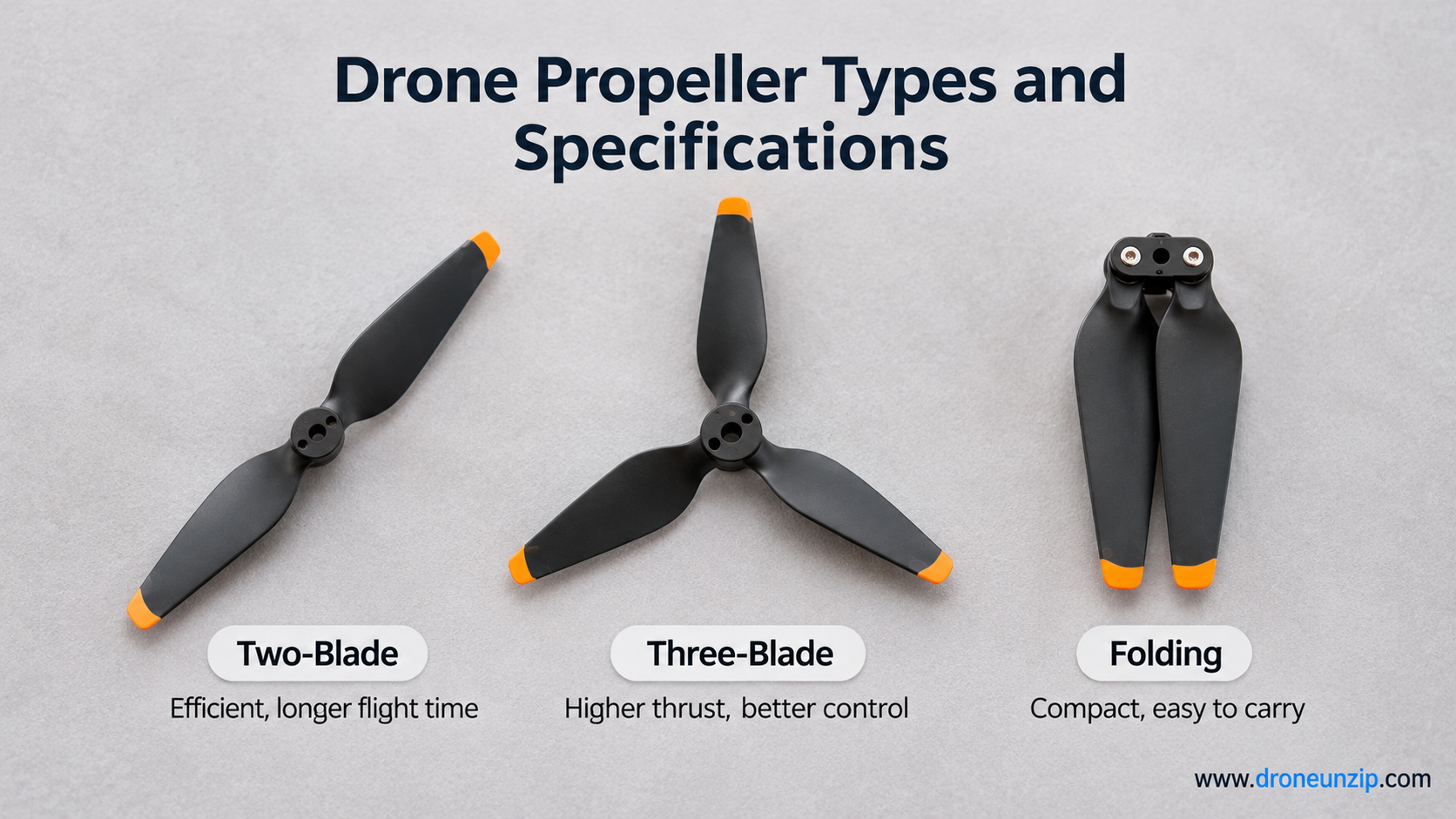
Fixed-blade propellers
Rigid propellers are common on FPV and racing drones. Their mounting and dimensions must match the motor and frame.
Folding propellers
Folding blades pivot at the hub for convenient transport and are common on compact camera drones. They must be installed using the aircraft manufacturer’s approved mechanism.
Two-blade propellers
Two-blade designs are used on efficiency-focused aircraft and many camera drones. Performance depends on the full motor and blade design.
Three-blade and multi-blade propellers
Three-blade designs are common in freestyle and racing FPV aircraft. Additional blades can provide different thrust and response characteristics within a restricted diameter, but also alter loading and energy consumption. Four-blade and higher-count designs appear on some compact ducted aircraft.
Understanding Drone Propeller Size, Pitch and Blade Count
Common FPV markings such as 5 × 4 × 3 or 5040-3 usually describe a five-inch diameter, four-inch nominal pitch and three blades. Manufacturers do not all follow the same marking convention.
| Specification | What it describes | Why it matters |
|---|---|---|
| Diameter | Diameter of the swept circle | Thrust potential and frame clearance |
| Pitch | Theoretical axial advance per revolution without slip | Blade loading and performance characteristics |
| Blade count | Number of blades | Aerodynamic loading and response |
| CW/CCW | Intended rotation direction | Correct thrust and yaw control |
| Mounting | Hub, shaft and fastener type | Secure physical compatibility |
Diameter
A larger diameter acts on a larger area of air, but also changes torque demand and required clearance. Never fit a larger blade without checking the manufacturer’s supported combination.
Pitch
Pitch is a geometric specification, not the distance the aircraft actually travels per rotation. Higher pitch is not universally faster, more efficient or better.
Blade count
More blades change blade area and aerodynamic interaction. Compare tested propeller and motor combinations, not blade count alone.
Two-Blade vs Three-Blade Drone Propellers
| Factor | Two-blade | Three-blade |
|---|---|---|
| Typical use | Efficiency-focused builds, camera drones | FPV freestyle and racing |
| Motor load | Often lower for comparable designs | Often higher for comparable designs |
| Responsiveness | Depends on motor and design | Often selected for responsive handling |
| Flight time | Can favour endurance | May draw more power |
Neither is always better. Diameter, pitch, airfoil, RPM, aircraft weight and motor capability determine the outcome. Camera-drone owners should normally use the manufacturer-approved propeller rather than changing blade count.
CW vs CCW Drone Propellers: Why Rotation Direction Matters
CW means clockwise; CCW means counterclockwise. Multirotors use propellers intended to generate the correct thrust while rotating in the specified direction. Installing the wrong orientation can prevent takeoff or cause an immediate loss of control.
Manufacturers may identify direction using hub markings, colours, matching motor marks or mounting mechanisms. There is no universal colour convention or motor numbering scheme. Follow the aircraft’s manual; custom builders should use the flight controller’s frame-specific motor diagram. ArduPilot’s motor connection guidance documents rotation and testing procedures.
How Propellers Affect Thrust, Flight Time and Noise
Thrust and responsiveness
Thrust depends on geometry, rotational speed and operating conditions. A propeller also influences how quickly thrust changes as the flight controller commands a motor.
Flight endurance
Endurance depends on total aircraft efficiency, mass, battery energy, wind and flying style. A propeller that increases current draw can reduce endurance, but blade count alone cannot predict flight time. For the broader picture, read our drone battery guide.
Noise
Blade-tip speed, airfoil, loading and turbulence affect sound. A low-noise design may reduce noise in its intended operating conditions, but simply adding blades does not guarantee a quieter aircraft.
Matching Propellers With Motors and ESCs
Check diameter, pitch, blade count, rotation, hub dimensions, fasteners, frame clearance, motor recommendations, ESC current limits and battery compatibility. A propeller that physically fits may still overload the system.
For custom builds, use manufacturer test data for the intended motor-propeller-battery combination and check current and temperature. For proprietary camera drones, follow the official replacement part number. Our drone motors guide
Can larger propellers improve flight time?
Sometimes, in a properly engineered setup, but there is no guaranteed improvement. Larger blades also change torque requirements, control dynamics and clearance. Do not experiment with unsupported aftermarket dimensions on a ready-to-fly aircraft.
How to Identify Damaged or Unbalanced Propellers
Inspect every propeller before flight and after a strike. Look for cracks near the hub, chipped tips, warping, loose fasteners, abnormal wear and visible differences between matching blades. Even a small chip can affect balance or create a stress concentration.
Unusual vibration can also come from loose mounting, damaged motors or bent shafts. Do not assume replacing the blade will solve every vibration problem. DJI’s accessory safety guidance advises replacing damaged or loose propellers.
For other fault symptoms, see DJI Drone Troubleshooting.
How to Replace Drone Propellers Safely
- Power down: switch off the aircraft and controller, and remove the battery when instructed and possible.
- Verify the replacement: match model, part number, pitch, diameter, direction and mounting method.
- Remove the old propeller: follow the manufacturer-specific quick-release, screw or nut procedure; never force it.
- Inspect the motor: check the shaft, hub, fasteners and surrounding structure for damage.
- Install correctly: match the marked positions and use specified fasteners and tightening instructions.
- Inspect again: verify secure seating and adequate clearance.
- Check cautiously: use the manufacturer’s post-maintenance procedure and stop if abnormal noise or vibration occurs.
For custom motor-direction tests, ArduPilot instructs users to remove propellers before testing. Review our beginner drone safety checklist before the next flight.
Choosing Propellers for Camera, FPV and Agricultural Drones
| Aircraft | Primary selection consideration |
|---|---|
| Consumer camera drone | Manufacturer-approved compatibility and smooth operation |
| FPV freestyle | Thrust response, durability and motor matching |
| FPV long range | Efficiency and adequate endurance |
| Racing drone | Response matched to the racing setup |
| Cinewhoop | Performance within compact or ducted geometry |
| Agricultural drone | Validated load-carrying performance and approved components |
For heavier commercial aircraft, unsupported changes may affect propulsion loads and safety margins. Use the approved parts and maintenance procedures.
Common Drone Propeller Mistakes
- Buying by diameter alone while ignoring pitch, rotation and mounting.
- Mixing clockwise and counterclockwise positions.
- Assuming more blades always improve thrust or endurance.
- Flying with chipped, warped or loose blades.
- Ignoring motor, ESC and battery limits.
- Mixing unmatched designs across motors.
- Performing custom motor-direction tests with propellers attached.
FAQs
What do drone propeller numbers mean?
They commonly indicate diameter, pitch and blade count. For example, 5 × 4 × 3 typically means a five-inch diameter, four-inch pitch and three blades; check the manufacturer’s convention.
Are three-blade propellers better than two-blade propellers?
Not universally. Three blades can suit responsive FPV handling; two blades can favour efficiency. Performance depends on the complete propulsion system.
Do bigger propellers increase flight time?
They sometimes improve efficiency in a properly matched system, but also change motor loading and clearance. No increase is guaranteed.
What is the difference between CW and CCW propellers?
They are intended for opposite rotation directions and must match the aircraft’s motor arrangement.
Can I mix propeller brands?
Only when compatibility is explicitly supported or appropriately validated for a custom build. Similar appearance does not establish equivalence.
How often should drone propellers be replaced?
There is no universal interval. Follow the aircraft manufacturer’s maintenance schedule and replace damaged or unserviceable parts promptly.
Can a chipped propeller be repaired?
Replacement is generally safer than attempting to repair a structural defect. Follow manufacturer guidance.
Why does my drone vibrate after replacing propellers?
Possible causes include incorrect installation, imbalance, loose mounting or motor damage. Stop flying and investigate.
Are carbon-fibre propellers better than plastic ones?
Not automatically. Stiffness, weight, failure behaviour, cost and compatibility all matter.
Can the wrong propellers make a drone flip during takeoff?
Yes. Incorrect rotation, orientation or motor configuration can prevent correct thrust and control.
Final Verdict: Choose Compatibility Before Performance
Diameter, pitch, blade count and rotation affect how a multirotor flies, but none can be evaluated independently of the aircraft. For most camera-drone owners, manufacturer-approved replacements are the safest default. FPV builders should rely on tested combinations and check electrical and mechanical limits. A propeller that fits is not necessarily a propeller that is safe or suitable.
