
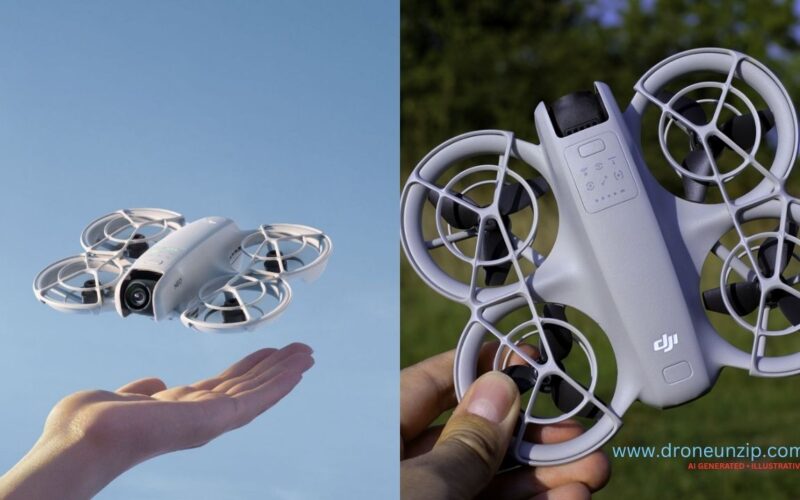
DJI Neo is a 135 g palm-launch camera drone designed for short, simple self-filming sessions. It offers automated QuickShots, subject tracking and 4K/30fps video without requiring a conventional remote controller for its basic shooting modes. The trade-offs are significant: DJI rates flight time at up to 18 minutes in controlled conditions, the camera uses a small 1/2-inch sensor, and the Neo has no obstacle avoidance. For Indian buyers, seller provenance, support eligibility and the total cost of extra batteries matter as much as the headline specification.
Review disclosure: This is a research-based assessment using DJI documentation and attributed independent reviews. DroneUnzip has not physically tested the aircraft. This article covers the original DJI Neo introduced in September 2024, not the DJI Neo 2.
DJI Neo at a glance
| Product | Original DJI Neo (2024) |
|---|---|
| Best for | Casual solo creators, short clips, beginners who value portability |
| Weight | Approx. 135 g (DJI) |
| Camera | 1/2-inch sensor; 12 MP JPEG photographs |
| Video | Up to 4K/30fps; vertical 1080p |
| Stabilisation | Single-axis mechanical tilt gimbal plus electronic stabilisation |
| Battery | Up to 18 minutes, manufacturer-rated |
| Obstacle avoidance | Not supported |
| Review basis | Research-based, not hands-on |
| India price | No reliably verified current Indian retail quotation included; confirm seller-specific pricing before purchase |
DJI Neo pros and cons
Pros
- Small, lightweight body and fully enclosed propellers make transport and close-range filming convenient.
- Palm takeoff and pre-programmed shots reduce the need for a controller in basic use.
- 4K video and electronic stabilisation can suit daylight social-media clips.
- Several control options allow owners to grow beyond basic palm operation.
Cons
- Short rated battery life, with real sessions potentially shorter.
- No obstacle avoidance, despite its automated filming features.
- Small sensor and limited camera controls reduce flexibility in difficult light.
- No microSD expansion, according to independent reviewers; check internal-storage workflow before buying.
- Indian warranty, availability and service arrangements must be confirmed for the exact seller and product region.
DJI Neo price in India: what buyers should check
A dependable current India-wide price could not be established for this review. DJI’s September 2024 launch announcement and official product page provide historical overseas pricing, but converting those figures into rupees would not establish the Indian selling price. Independent listings may bundle a controller, charging hub or extra batteries. Ask for an itemised invoice, exact package name, product-region information, written warranty terms and return policy. Do not assume a third-party seller is DJI-authorised.
Before purchase: compare the aircraft-only package with the Fly More Combo on total battery count, controller inclusion, charging equipment and actual after-sales coverage, not just the sticker price. Our DJI drone buying guide for India explains the wider buying context.
DJI Neo specifications that matter
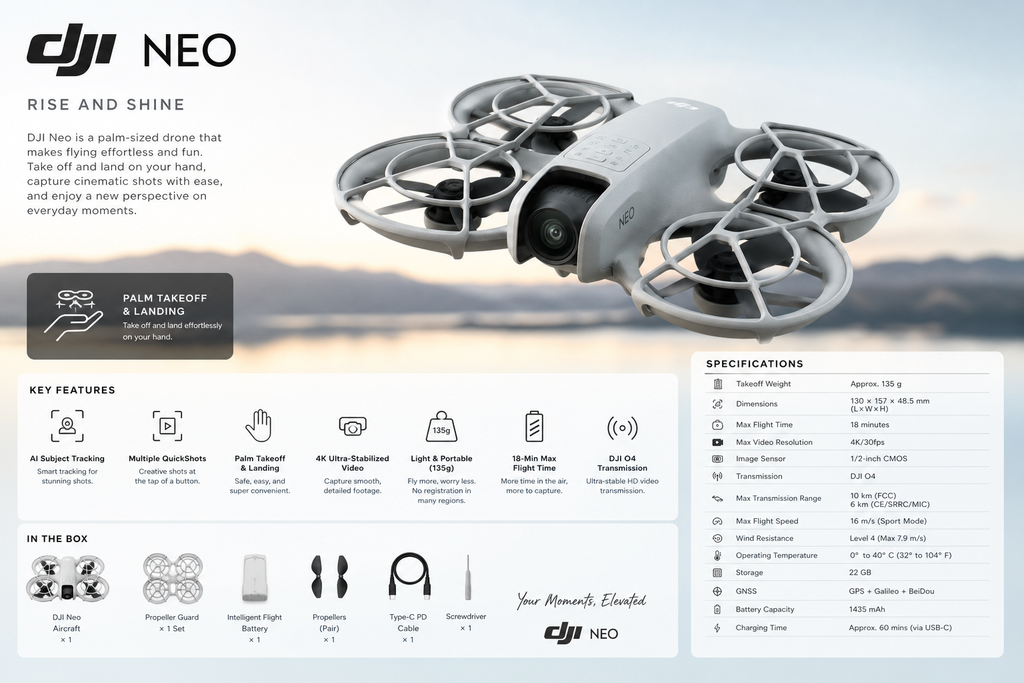
| Specification | DJI’s stated figure | Why it matters |
|---|---|---|
| Weight | Approx. 135 g | Portable, but local flying rules still apply |
| Dimensions | 130 × 157 × 48.5 mm | Compact carry size |
| Sensor | 1/2 inch | Less flexibility in challenging light than larger-sensor cameras |
| Photos | 12 MP JPEG | No manufacturer-listed RAW photo capture |
| Video | 4K/30fps, electronic stabilisation enabled | Suitable resolution for standard clips |
| Vertical video | 1080 × 1920 | Native portrait output is not 4K |
| Gimbal | Single-axis mechanical tilt | Relies on electronic correction for other axes |
| Rated flight time | Up to 18 minutes | Plan for shorter usable sessions and a return reserve |
| Wind resistance | 8 m/s (Level 4) | Not a guarantee of stable results in gusts |
| Positioning | Downward vision system | Surface texture and lighting affect close-range positioning |
DJI’s flight-time figure comes from controlled conditions and is not an independently measured endurance result.
Design, palm takeoff and flight controls
Neo’s defining design choice is an enclosed-propeller, palm-sized body that can launch preset shots without a traditional controller. DJI’s FAQ instructs users to keep their palm level and steady and to prefer windless conditions for palm operation. Propeller guards reduce exposure but do not eliminate injury or collision risks. Neo can also be controlled through compatible DJI Fly and supported controllers or immersive accessories, with features varying by setup. Check the current compatibility chart rather than assuming every controller works.
Camera quality: where 4K helps and where it does not
DJI specifies a 1/2-inch sensor, 12 MP JPEG photographs and 4K/30fps video. The camera uses a single-axis mechanical gimbal with RockSteady or HorizonBalancing electronic stabilisation depending on settings. That combination is intended for convenient handheld-style aerial clips, not professional grading or low-light cinematography. Amateur Photographer’s hands-on review found good convenience and value but mixed image quality, particularly in poor light. That is the reviewer’s observation, not DroneUnzip’s own test result.
Vertical recording is listed at 1080p, an important distinction for creators expecting full-resolution portrait 4K. The aircraft is better suited to daylight reels and personal clips than demanding commercial shoots. For broader sensor and camera terminology, see our 4K drone camera explainer.
Flight time, wind and real-world limitations
DJI quotes a maximum of approximately 18 minutes, or 17 minutes with the specified propeller guards, under controlled test conditions. Time spent manoeuvring, filming in wind and returning with a sensible battery reserve can reduce usable shooting time. Space.com’s review identifies wind sensitivity and short battery endurance among the practical compromises. Treat DJI’s 8 m/s wind-resistance rating as an operating limit, not a recommendation to fly in strong wind.
Neo does not support obstacle avoidance, according to DJI. Automated tracking therefore does not mean the drone can reliably detect and route around trees, cables, walls or bystanders. DJI’s manual also warns that downward positioning can struggle over water, reflective surfaces and poorly textured ground. Plan open, well-lit locations and maintain visual contact.
QuickShots and subject tracking: the real attraction
Neo’s preset modes and tracking are designed to capture a person without requiring a second camera operator. This is the product’s strongest differentiator for solo vloggers. But a preset camera move is not autonomous collision avoidance: choose a clear route, keep people and obstacles away and review the manual’s mode-specific limits before using it.
DJI Neo versus DJI Mini 3: which makes more sense?
| Buying factor | DJI Neo | DJI Mini 3 |
|---|---|---|
| Main purpose | Quick self-filming and palm-launched clips | Conventional aerial photography and video |
| Takeoff | Palm-launch shooting modes available | Conventional controller-based operation |
| Camera emphasis | Convenience and automated close-range shots | More traditional camera-drone controls |
| Battery emphasis | Short, frequent sessions | Longer planned flights, subject to battery and operating conditions |
| Best buyer | Solo social-video creator | Buyer prioritising landscape and travel footage |
This is a use-case comparison, not a controlled side-by-side test. Read our DJI Mini 3 guide for its verified specifications before comparing local offers.
DJI Neo in India: legal, seller and service considerations
At approximately 135 g, Neo falls within India’s nano weight category under the Drone Rules’ weight classification, but that does not mean unrestricted flying. Airspace restrictions, operating conditions and any applicable requirements still matter. Consult the Drone Rules, 2021 and check current requirements rather than assuming rules from overseas reviews apply in India. Our Indian airspace guide is a practical starting point.
Confirm whether the specific imported or locally offered unit has a valid invoice, the right app and controller compatibility, eligible warranty support and accessible replacement batteries. DJI’s Neo support page provides manuals and service links, but an international support page does not prove local Indian warranty eligibility.
Who should buy the DJI Neo?
Consider it if you mainly want short daytime clips of yourself, value a compact palm-launch design and accept that you must carefully manage flight time and obstacles. Look elsewhere if you need professional still photography, strong low-light quality, extended flight endurance, obstacle sensing or reliable local service without further verification.
FAQs
Is DJI Neo good for beginners?
Its preset filming modes and lightweight design can simplify the first steps, but beginners still need to understand airspace, wind, positioning limits and collision risks.
Does DJI Neo record 4K video?
Yes, DJI lists up to 4K/30fps video. Native vertical video is listed at 1080p.
Does DJI Neo avoid obstacles?
No. DJI explicitly states that Neo does not support obstacle avoidance.
How long does DJI Neo fly?
DJI advertises up to 18 minutes under controlled conditions. Real usable filming time may be lower.
Does DJI Neo need a controller?
Basic palm-based shooting modes can work without a conventional controller. Other control methods and capabilities depend on compatible accessories and apps.
Can I buy DJI Neo with an official Indian warranty?
Do not assume so. Verify the exact seller, region, invoice and DJI service eligibility before paying.
Final verdict: is DJI Neo worth buying in India?
The original DJI Neo makes the most sense as a compact, easy-access personal filming drone, not as a replacement for a more capable aerial camera platform. Palm takeoff, automated shots and 4K recording are meaningful advantages for short daytime content. The lack of obstacle avoidance, limited flight endurance, modest sensor and uncertain seller-specific Indian support are the main reasons to pause before buying. Our recommendation is conditional: consider it only after checking a current genuine offer, included accessories and support terms. This is a research-based editorial judgement, not a field-tested verdict.
