

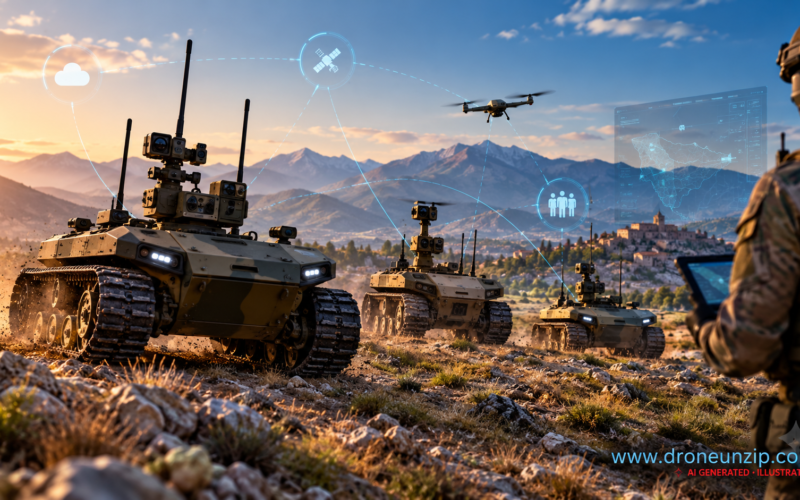
European defence partners have completed a major demonstration of the Combat Unmanned Ground Systems (CUGS) project in Italy, testing how robotic vehicles, sensors and supporting aerial systems from different manufacturers can operate through a shared command architecture. The milestone is an interoperability trial, not evidence that a unified European robotic combat force has entered service.
Key Takeaways
- The European Defence Agency-backed CUGS programme completed its final major demonstration in October 2026.
- Leonardo coordinated a consortium involving nine participating countries and 28 industry partners.
- Simulated scenarios combined ground vehicles, an aerial scout and loitering-munition elements while human operators retained oversight.
- Common interfaces, resilient communications and reliable navigation remain central hurdles before operational adoption.
What Europe Demonstrated
The project brought together systems built by different European companies in three simulated operational scenarios. Participants included the Lince VTLM-2 with Hitrole, Milrem Robotics’ THeMIS with the Hornet weapon station, Poland’s ZSMU 1276 and scout vehicle, Rheinmetall’s Wiesel, Finland’s Patria AMV, a Thales scout UAV and MBDA loitering-munition systems. A command post several kilometres from the operational area coordinated the activity.
According to reporting based on the project announcement, integrated modules supported navigation, situational awareness, command-and-control cooperation and management of onboard effectors. Artificial intelligence assisted functions such as detecting, tracking and classifying potential threats, with operators remaining in the loop and able to intervene.
Why Interoperability Matters More Than Any Single Robot
Military ground robots can be built to carry supplies, scout dangerous routes or support armed formations. But combining systems from different suppliers requires compatible communications, control interfaces, sensor data and operating procedures. Without those connections, each vehicle risks becoming an isolated capability.
CUGS is an attempt to establish common functional building blocks rather than depend on one manufacturer’s complete system. This could eventually help European militaries assemble mixed fleets and upgrade components without replacing entire platforms.
Related coverage: Ukraine’s reported autonomous ground-robot logistics mission offers another perspective on the challenges of deploying unmanned vehicles beyond controlled demonstrations.
What Earlier Arctic Trials Revealed
The final demonstration followed a February trial in Norway that examined robotic vehicles in winter conditions and disrupted communications. Researchers at the Norwegian Defence Research Establishment described the challenge of connecting incompatible subsystems, agreeing on technical definitions and maintaining reliable links. They cautioned that substantial work remained before such systems could be relied upon in combat.
What Is Confirmed and What Is Not
The consortium reported successful interoperability during the final simulated demonstration. That does not independently establish battlefield reliability, operational procurement, unrestricted autonomous weapons use or performance against an adaptive opponent. The systems were demonstrated under human supervision; the published account does not establish that machines independently authorised the use of force.
DroneUnzip Analysis: The Opportunity Beyond the Prototype
Analysis: The most consequential result may be the integration model. If European partners can turn demonstration interfaces into widely adopted standards, the market for modular autonomy, rugged communications, sensor fusion and mission-control software could grow alongside demand for vehicles. Conversely, unresolved interoperability and communications problems could slow adoption even when individual robots perform well.
For Indian manufacturers and defence planners, the relevant lesson is the importance of open interfaces and realistic multi-vendor trials. This is an analytical implication, not a claim that India participates in CUGS.
What Happens Next?
The next test is whether the consortium’s architecture moves beyond a controlled demonstration into repeatable military trials, procurement requirements and measurable performance standards. Public reporting reviewed for this article does not establish a production contract arising directly from the final demonstration.
Sources
EDR Magazine; Norwegian Defence Research Establishment; Asia Pacific Defence Reporter.
