
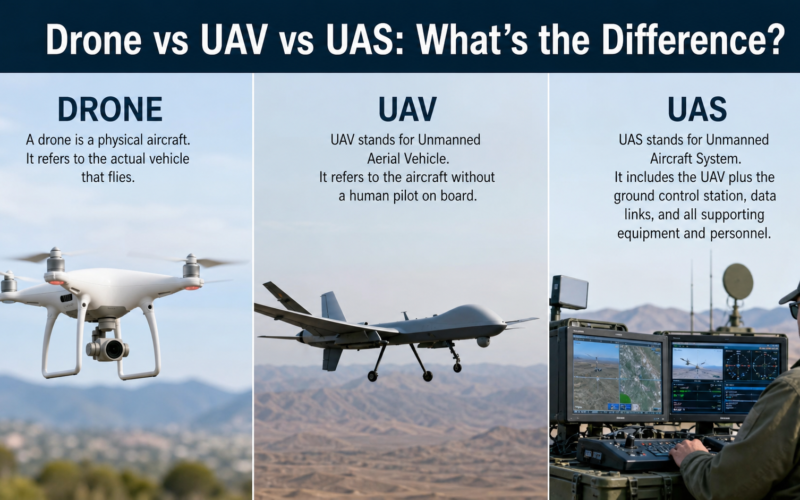
Drone vs UAV vs UAS: these terms overlap, but they are not identical. Drone is the everyday word for an uncrewed vehicle, especially an aircraft. UAV means unmanned aerial vehicle and usually identifies the aircraft itself. UAS means unmanned aircraft system: the aircraft plus the components needed to operate it, such as its control station and communications link. The distinction matters when reading specifications, defence reports, tenders and Indian aviation regulations.
Drone, UAV and UAS: the difference in one table
| Term | Full form | What it describes | Example |
|---|---|---|---|
| Drone | Common term, not a single standard acronym | Usually an uncrewed aircraft in everyday speech; sometimes an uncrewed vehicle in another domain | A camera quadcopter called a drone |
| UAV | Unmanned aerial vehicle | The flying vehicle without an onboard human pilot | The aircraft in a military reconnaissance system |
| UA | Unmanned aircraft | Formal aircraft term used by regulators | The aircraft portion of a UAS |
| UAS | Unmanned aircraft system | Aircraft plus associated elements required for operation | Aircraft, controller, command link and related equipment |
| RPA | Remotely piloted aircraft | An unmanned aircraft piloted from a remote station | A remotely controlled survey aircraft |
| RPAS | Remotely piloted aircraft system | RPA, remote pilot station, control links and other specified components | A remotely piloted aircraft with its ground station |
The US Federal Aviation Administration defines a UAS as an unmanned aircraft and equipment necessary for its safe and efficient operation. Its aviation glossary specifically identifies the aircraft, control station and data link as the three central elements. India’s Drone Rules, 2021 separately define unmanned aircraft, UAS, RPA and RPAS. FAA definition; FAA glossary; Indian Drone Rules.
What is a drone?
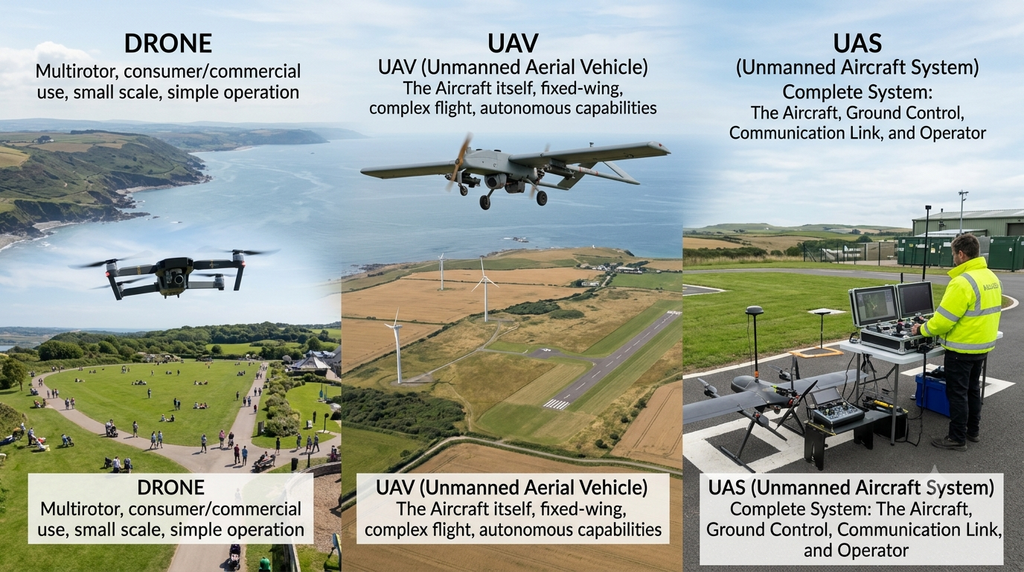
In everyday aviation reporting, a drone is an aircraft that flies without a human pilot aboard. A palm-sized camera quadcopter, an agricultural spraying platform and a long-endurance military aircraft may all be called drones, despite their very different missions and capabilities. The word is convenient, but it does not tell the reader how the aircraft is controlled, whether it is autonomous, or what other equipment is needed to operate it.
Outside aviation, people also use terms such as underwater drone and ground drone. Those may be useful descriptions in general reporting, but an underwater robot is not thereby a UAV or a UAS in the aviation-regulatory sense. DroneUnzip covers those adjacent unmanned systems while using precise aviation terminology where it matters.
What is a UAV?
UAV is short for unmanned aerial vehicle. It points primarily to the flying machine. It can be a multirotor, fixed-wing or hybrid aircraft. The term is common in defence, engineering and product descriptions, although regulations often use the related term unmanned aircraft (UA).
For example, if a news report discusses a UAV’s wingspan, endurance, propulsion or payload, those are attributes of the aircraft. If the same report describes its control station, communications network and operating architecture, it is discussing more than the air vehicle alone.
Important: UAV does not automatically mean autonomous. An aircraft can be unmanned yet controlled continuously by a remote pilot. Equally, automation may handle parts of a mission without removing human oversight.
What is a UAS?
UAS means unmanned aircraft system. The FAA says the aircraft is only one component of that system. A practical UAS can include the aircraft, a control station, command-and-control communications, and other equipment required for the operation. The exact system boundary depends on the aircraft and regulatory or procurement context.
Why the word ‘system’ matters
A manufacturer might supply an aircraft, but an operator needs more than a fuselage and propellers to conduct a safe mission. A ground control station, software, antennas, batteries, launch or recovery equipment, maintenance arrangements and trained personnel can be operationally important. Not all these items are necessarily included in every formal definition or commercial package. That is why a procurement document describing ‘five UAS’ should not automatically be interpreted as five airframes: the actual contract scope must be checked.
In reporting, the most useful habit is to ask whether a claim concerns the aircraft or the complete operating system. A claimed 30-hour endurance is an aircraft performance statement; an integrated command network is a system-level capability.
UAV vs UAS: a simple example
Imagine an agricultural operator flying a spraying aircraft over an authorised field. The airframe, motors, propellers, tank and flight-control hardware make up the flying vehicle. The controller, control link and other associated operating components together form the broader aircraft system. The word drone may describe the aircraft informally, while UAS is more precise when discussing the complete operation.
That distinction also applies to a defence reconnaissance mission. A remotely piloted surveillance aircraft is the UAV or UA; its remote pilot station and command-and-control link belong to the RPAS or broader system description.
Where do RPA and RPAS fit?
RPA means remotely piloted aircraft. RPAS means remotely piloted aircraft system. India’s Drone Rules define an RPA as an unmanned aircraft piloted from a remote pilot station, and RPAS as that aircraft together with its associated remote pilot stations, required command-and-control links and other specified components. The Airports Authority of India’s aeronautical information also uses these distinctions. AAI aeronautical information.
RPAS emphasises the remote-pilot arrangement. It is not simply a fancier synonym for any autonomous aircraft. In technical or legal writing, prefer the exact term used by the relevant regulator or source document.
Are drones and UAVs autonomous?
Not necessarily. Unmanned describes the absence of an onboard pilot, not the absence of human control. A remotely piloted aircraft may depend on continuous human commands. An automated drone may follow a programmed route or perform a preset manoeuvre. More autonomous systems may make limited navigation or task decisions using sensors and software, subject to their design and operational constraints.
These capabilities exist on a spectrum. A ‘fully autonomous’ label should be treated carefully unless the developer explains what decisions the aircraft makes, under which conditions, and what a human operator can override. Our FPV drone guide provides a contrasting example of a pilot-directed flying experience.
How India uses these terms in drone regulations
India’s Drone Rules, 2021, with published amendments use the formal term unmanned aircraft system and define related categories and components. The rules distinguish unmanned aircraft, remotely piloted aircraft and remotely piloted aircraft systems. That vocabulary matters for registration, certification, operation and compliance; the casual label ‘drone’ alone cannot determine which legal obligations apply.
For a real flight, operators should verify the latest applicable DGCA and Ministry of Civil Aviation requirements, airspace restrictions and any exemptions rather than relying on terminology alone. See our drone registration guide and Indian drone airspace guide. This article explains vocabulary; it is not legal authorisation to fly.
Why military reports switch between UAV and UAS
Military reporting often uses UAV when discussing a particular aircraft’s performance or design, and UAS when discussing the full operational package. But usage is not perfectly consistent across countries, manufacturers and procurement agencies. A defence contract may count air vehicles, systems, launchers or control stations separately. Before comparing orders, check the unit of measure and the original contract wording.
Likewise, UCAV means unmanned combat aerial vehicle, a mission-oriented aircraft term. It does not automatically establish that a platform is operational, autonomous or equipped with a particular weapon. For an Indian example of a development programme, read our Ghatak UCAV explainer.
What about UGVs, USVs and UUVs?
These acronyms describe different physical domains. A UGV is an unmanned ground vehicle; a USV is an unmanned surface vessel; and a UUV is an unmanned underwater vehicle. They can be remotely controlled or exhibit varying levels of autonomy, but they are not UAVs because they do not fly. The aviation-specific term UAS should not be stretched to include them without an explicit broader definition from the source.
This is why a publication covering autonomous systems benefits from a clear naming convention: use the exact platform type in technical coverage, and reserve ‘drone’ for general-audience language when it will not cause confusion.
Common mistakes when reading drone specifications
- ‘UAV means fully autonomous.’ False. A UAV may be remotely piloted.
- ‘UAS is another name for the aircraft.’ In formal usage, UAS includes associated operating elements.
- ‘One UAS always equals one aircraft.’ Not necessarily in procurement or operational descriptions; verify the contract.
- ‘All unmanned vehicles are UAVs.’ False. Ground and marine robots operate in different domains.
- ‘Drone weight tells you all the rules.’ False. Weight is only one part of an applicable regulatory framework.
FAQs
Is a UAV the same as a drone?
In everyday conversation, often yes when discussing an unmanned aircraft. Technically, UAV identifies the air vehicle, while ‘drone’ is a looser everyday term.
What is the difference between UAV and UAS?
A UAV is the flying vehicle; a UAS includes the aircraft and its associated operating elements, such as control and communication equipment.
What is the full form of RPAS?
Remotely Piloted Aircraft System. It includes the remotely piloted aircraft and specified components such as remote pilot stations and command-and-control links.
Is a quadcopter a UAV?
A quadcopter without an onboard pilot is a type of UAV. ‘Quadcopter’ describes its four-rotor configuration, not its regulatory or operational status.
Are all UAVs military aircraft?
No. UAVs are used for photography, surveying, agriculture, inspection, research, emergency response and defence.
Does UAS include the pilot?
Regulatory definitions generally describe the aircraft and associated system elements. A remote pilot is essential to many operations, but should not automatically be counted as a physical system component. Follow the wording of the relevant regulation or contract.
Bottom line
Use drone for accessible general discussion, UAV or UA when the aircraft itself is the subject, and UAS when the whole operating system matters. Use RPA/RPAS when the remote-pilot arrangement is important. For Indian regulatory questions, the formal wording of the applicable rules should take precedence over casual usage.
