

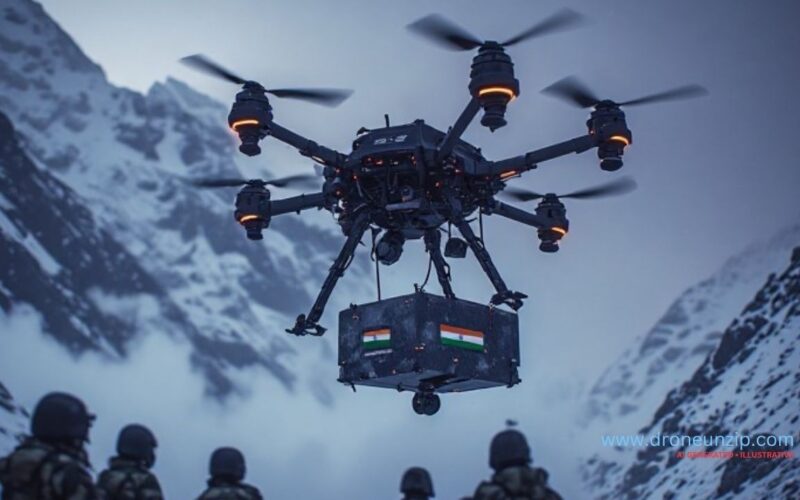
India has committed ₹151 crore in debt financing to help Mumbai-based ideaForge Technology develop YETI, a heavy-lift autonomous aerial logistics vehicle designed for payloads of up to 200 kg and a targeted range of up to 200 km. The Technology Development Board (TDB), under the Department of Science and Technology, announced the agreement on 14 October as part of a ₹302-crore project intended to move the platform from Technology Readiness Level (TRL) 4 towards TRL 9.
Key Takeaways
- TDB support: ₹151 crore through debt financing under the government’s Research Development and Innovation (RDI) Fund.
- Total project cost: ₹302 crore, with the stated goal of advancing YETI from TRL 4 to TRL 9.
- Planned design targets include a payload of up to 200 kg, a range of up to 200 km and operation at altitudes up to 6,500 metres above mean sea level.
- YETI is being developed as a hybrid vertical take-off and landing, fixed-wing UAV. The published figures are design targets, not proof of operational performance.
Who Is Developing YETI?
YETI is being developed by ideaForge Technology Limited, the Mumbai-based drone company, with financial support from the Technology Development Board. The government describes the programme as a deep-technology project in the intelligent-systems and robotics sector. The support is structured as debt financing, rather than a procurement order for an already fielded aircraft.
What Is the YETI Heavy-Lift Drone Designed to Do?
The proposed aircraft combines vertical take-off and landing with a fixed-wing configuration. In principle, that combination is intended to let it operate from relatively compact sites while using fixed-wing flight for longer-distance travel. TDB says YETI is designed for unprepared landing areas of approximately 15 metres by 15 metres and for logistics missions where conventional transport is difficult, slow or constrained.
The project description also lists a proposed communication link of up to 200 km, navigation in environments where Global Navigation Satellite System (GNSS) signals are unavailable, a redundant propulsion and power architecture, swarm operations and containerised transport for rapid deployment. These are programme objectives and planned capabilities; the public announcement does not establish that every feature has completed testing or been validated in service.
When Was the Funding Announced?
The Department of Science and Technology announced the agreement on 14 October 2026. The ₹151-crore support forms part of a ₹302-crore project. The stated development goal is to progress from TRL 4, associated with technology validation at an early stage, towards TRL 9, which represents a system demonstrated in its intended operational environment. Reaching that goal depends on further engineering, integration, testing and validation, as well as applicable safety and regulatory requirements.
Where Could a Heavy-Lift Logistics UAV Be Useful?
TDB identifies high-altitude regions, deserts and marine environments among the challenging settings the design is intended to address. A vehicle with the planned payload and range could be relevant to moving supplies between locations with limited ground access, but actual usefulness will depend on performance under real weather, terrain, payload and communications conditions. The published announcement does not provide a confirmed deployment date or demonstrate that YETI is already operational.
Why Does the YETI Project Matter for India’s Drone Industry?
The project targets a demanding part of the drone market: moving substantially heavier loads over longer distances without relying on a runway. It also highlights that building an indigenous airframe is only one part of the challenge. Propulsion, navigation, communications, fault tolerance, flight testing and the ability to operate safely in difficult conditions all have to work together before a platform can become a dependable logistics tool.
The government-backed financing is therefore a development milestone, not a guarantee of commercial success or military adoption. The key next evidence will be the programme’s progress through integration and testing, with independently verifiable demonstrations of its payload, range, altitude and navigation claims.
The development also sits within a wider push to build India’s domestic drone ecosystem. DroneUnzip has previously covered the industry’s drive towards scaling Indian drone manufacturing and the growing role of indigenous systems in defence requirements.
What Happens Next?
According to TDB, the funded programme will support further technology development, engineering, integration, testing and validation as ideaForge works towards the stated TRL-9 target. Publicly reported milestones to watch include flight demonstrations with defined payloads, range and altitude, evidence of navigation in GNSS-denied conditions, and progress towards the relevant approvals. Until those results are documented, YETI’s headline specifications should be treated as design targets rather than verified operational capability.
Sources
