

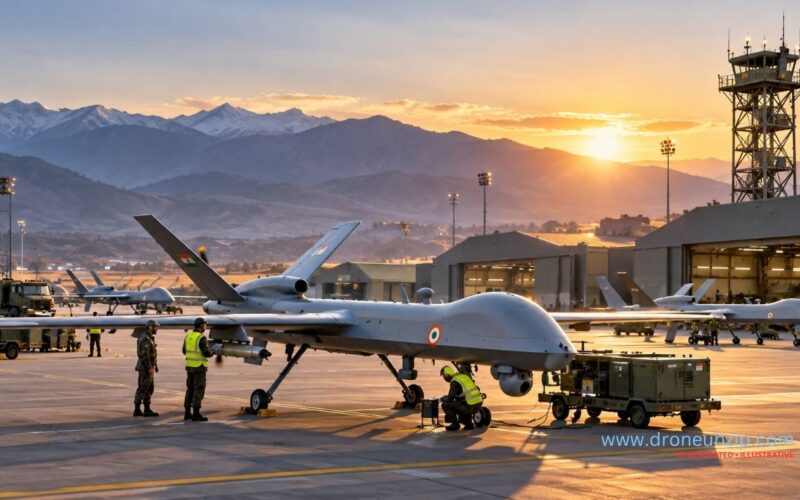
Long-range military drones need more than an aircraft with enough endurance to stay airborne. They also need suitable runways or launch areas, maintenance, communications, trained crews, fuel and power, secure data links, and procedures for operating safely in changing conditions. For India, the question of where long-range unmanned aircraft could operate is becoming an important part of the wider conversation about surveillance, deterrence and military infrastructure.
Reports have suggested that the Indian Air Force may consider underused airfields in the north as backup operating locations for long-range unmanned aerial vehicles (UAVs). That proposal has not been officially confirmed in the sources reviewed for this article. It should therefore be treated as a reported possibility, not an approved basing plan. A separate proposal for a dedicated drone facility in Meerut has been reported, but it does not independently confirm the backup-airfield claim.
What is a long-range military drone operating base?
A drone operating base is the place and support system used to prepare, launch, recover, maintain and control an unmanned aircraft. Depending on the aircraft and mission, it may use a conventional runway, a prepared strip, a launch-and-recovery area or another specialised facility.
For larger long-endurance UAVs, the base may need runway access, hangars, ground-control equipment, communications links, power, spares, maintenance teams and secure mission-planning facilities. The exact requirements vary by aircraft. A small tactical drone and a high-altitude long-endurance (HALE) platform do not need the same infrastructure.
In this context, a “base” does not necessarily mean a newly built, permanently staffed airbase. An existing airfield might be adapted for limited or contingency use, but suitability would depend on engineering, security, airspace, logistics, communications and operational requirements that are not publicly established for the reported Indian proposal.
Why distributed operating locations can matter
Relying on a small number of operating locations can concentrate maintenance, support and aircraft activity. In general, having more than one suitable location can give a military additional flexibility when a primary site is unavailable, congested, undergoing maintenance or affected by a disruption.
For long-range UAVs, distributed basing may also help planners position support closer to different areas of interest. But the benefit is not automatic: moving operations across locations can add costs, require duplicated equipment and personnel, and complicate maintenance, communications, airspace coordination and security. Additional airfields are useful only if they can support the specific aircraft and mission safely.
These are general operational considerations, not confirmation that the Indian Air Force has adopted a particular distributed-basing plan.
What has been reported about India’s plans?
A report published by IDRW on 3 September 2026 said the Indian Air Force may consider using underutilised northern airfields as backup locations for long-range drones. The report attributed the idea to unnamed sources. A later article by Indian Masterminds discussed a similar possibility, but repeating the same claim does not amount to independent official confirmation.
Separately, Hindustan Times reported in February 2026 that the Border Roads Organisation had issued an e-tender for a proposed dedicated drone runway or aviation facility in Meerut. The report described a planned runway measuring 2,110 metres by 45 metres and a project value of about ₹406 crore. Those details should be understood as reported tender/project information, not evidence that the facility is complete or operational.
Confirmed facts versus unconfirmed claims
| Point | What the available reporting supports |
|---|---|
| Backup use of northern airfields | Reported as a possible IAF consideration by IDRW; no official confirmation located in the sources reviewed. |
| Meerut drone facility | Hindustan Times reported a BRO tender for a proposed facility. A tender is not proof of completion or operational status. |
| India’s wider UAV needs | India operates and develops different classes of unmanned systems, but the exact basing requirements for any specific future fleet are not publicly established here. |
The distinction matters. A reported proposal, a tender, an approved project, construction, testing and operational deployment are different stages. Readers should not treat them as interchangeable.
Which kinds of drones could require specialised infrastructure?
Long-endurance surveillance UAVs, high-altitude platforms and larger remotely piloted aircraft can require substantial ground support. Their operating needs depend on factors such as aircraft size, take-off and landing performance, endurance, payload, communications architecture and the way the service intends to use them.
Smaller tactical drones may be launched from much more modest locations, while some loitering munitions are designed for different launch arrangements altogether. The term “military drone” therefore covers systems with very different infrastructure needs. For background on one distinct category, see DroneUnzip’s beginner’s guide to kamikaze drones. India’s stealth unmanned combat-aircraft ambitions are a separate subject again, explored in our Ghatak UCAV explainer.
What would India need to assess before using backup airfields?
Before an existing airfield could serve as an alternative UAV operating location, planners would need to assess runway condition and length, aircraft compatibility, ground handling, secure communications, maintenance access, weather, airspace coordination, protection of personnel and equipment, and the availability of trained crews. These are general planning factors; the sources reviewed do not establish which locations have been selected or assessed under the reported proposal.
There are also trade-offs. Keeping multiple locations ready can improve flexibility, but it can spread resources thinly and increase costs. Infrastructure decisions would need to balance operational value with construction or adaptation costs, environmental and local considerations, safety and the need to integrate unmanned aircraft into existing airspace procedures.
Why this matters for India’s drone ecosystem
Drone capability is not only about designing or buying air vehicles. It also depends on the infrastructure, maintenance, communications, training and operating procedures that allow systems to be used reliably. As India develops its unmanned-aircraft ecosystem, the supporting infrastructure deserves attention alongside platforms and payloads.
For now, the reported backup-airfield idea remains unconfirmed. The Meerut project is a separate infrastructure development reported in the press, and its progress should be assessed on its own evidence. Official statements, tender documents and verified project milestones will be more useful indicators than repeated reports based on unnamed sources.
FAQs
Has the Indian Air Force officially confirmed plans to use northern airfields for long-range drones?
No official confirmation was located in the sources reviewed for this article. The idea has been reported by media outlets and should be described as an unconfirmed possibility.
Is the proposed Meerut drone facility the same project?
The available reporting treats Meerut as a separate proposed facility. It does not independently verify the claim about using underutilised northern airfields as backup locations.
Do all military drones need a runway?
No. Infrastructure needs vary by aircraft design and launch-and-recovery method. Larger long-endurance UAVs may need runway and ground-support infrastructure, while smaller systems can use other arrangements.
What does HALE mean?
HALE stands for high-altitude long-endurance. It describes a class of aircraft designed to operate at high altitude for extended periods. Specific performance depends on the platform.
Conclusion
More operating locations could, in principle, give long-range military UAV operations greater flexibility, but the value depends on aircraft requirements, infrastructure, cost and operational planning. In India’s case, the reported northern backup-airfield proposal remains unconfirmed in the sources reviewed. The separately reported Meerut facility is a distinct project and should not be used as proof of that proposal. Clear official documentation and verified milestones are needed before stronger conclusions can be drawn.
