

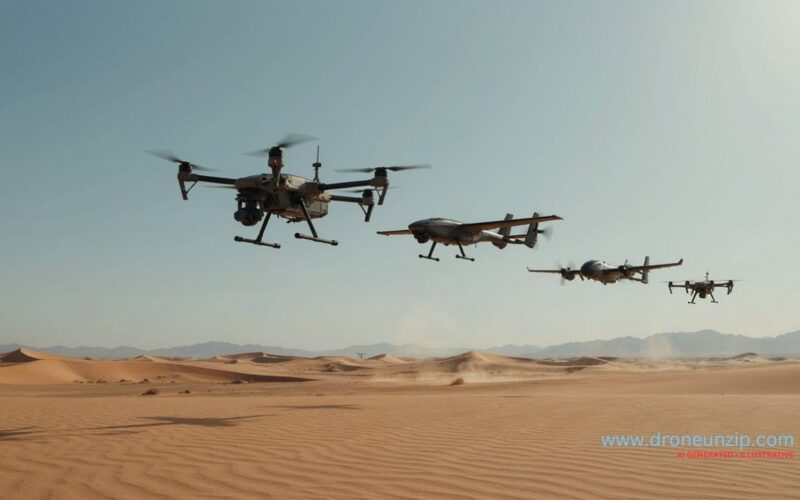
The Indian Air Force (IAF) has taken its unmanned and autonomous systems roadmap directly to India’s drone industry, using a New Delhi outreach programme to spell out the capabilities it wants domestic companies, startups and research partners to develop. Around 100 representatives from drone companies and affiliated industry partners attended the 21 October programme at Vigyan Bhawan, according to the Ministry of Defence.
Key Takeaways
- The IAF shared its long-term requirements for unmanned and autonomous systems with industry on 21 October 2026.
- The roadmap envisages a layered, networked family of unmanned systems designed to complement existing and future crewed aircraft.
- Four priority technology areas are indigenous propulsion, autonomous software, resilient navigation and standardised interfaces.
- The outreach follows the release of the IAF UAS Roadmap at Dronathon 2026 in Pokhran on 14 September.
Who Is Driving the IAF Unmanned-Systems Roadmap?
The programme was chaired by Air Marshal Premkumar K, Director General (Weapon Systems) at Air Headquarters. The Ministry of Defence said participants included micro, small and medium enterprises (MSMEs), startups and other industry partners. The event was intended to help suppliers understand the Air Force’s longer-term operational needs, rather than develop products in isolation from military requirements.
What Did the IAF Ask Industry to Prioritise?
The roadmap describes a layered and networked family of unmanned systems. The IAF says these capabilities are intended to complement current and future manned platforms. The official announcement does not identify platform-by-platform orders, budgets or induction dates, so the roadmap should be read as a statement of capability priorities, not as a procurement award.
The Ministry of Defence identified four areas for focused work:
- Indigenous propulsion: developing domestic engine and propulsion capabilities to reduce reliance on overseas suppliers.
- Autonomous software: building the software needed for unmanned systems to perform defined tasks with greater autonomy.
- Resilient navigation: improving the ability of systems to navigate reliably in challenging or disrupted environments.
- Standardised interfaces: making it easier to integrate components and systems across a broader unmanned ecosystem.
When and Where Was the Roadmap Shared?
The industry outreach took place at Vigyan Bhawan in New Delhi on 21 October 2026. The IAF had first released its UAS Roadmap during Dronathon 2026 at the Pokhran Field Firing Range in Rajasthan on 14 September. That three-day event brought together defence companies, startups, MSMEs and public-sector organisations to demonstrate unmanned and counter-unmanned technologies under operationally demanding conditions.
At Dronathon, the IAF said demonstrations covered surveillance and reconnaissance, autonomous operations, swarm technologies, electronic warfare and counter-unmanned aircraft systems. It also demonstrated Vayu UTtaM, an indigenous multi-mode unmanned traffic management system that detected and tracked both military and civilian unmanned aircraft during the exercise, according to the Ministry of Defence.
Why Does the IAF Roadmap Matter for India’s Drone Industry?
The outreach gives Indian manufacturers and technology developers a clearer signal about the systems and enabling technologies the Air Force wants to build at home. For smaller firms, understanding operational priorities early could help guide research, partnerships and investment. For the IAF, the stated goal is to accelerate collaboration and translate emerging technology into reliable capabilities that can operate alongside crewed aircraft.
The emphasis on propulsion, software, navigation and interfaces also points beyond the airframe itself. A capable unmanned platform depends on the wider stack of components, control systems and integration work that makes it useful in service. DroneUnzip has also tracked the manufacturing challenge in India’s move from small-batch drone manufacturing towards mass production and the wider defence demand signal in its report on an Indian Army drone tender.
What Happens Next?
The next test will be whether the roadmap leads to sustained industry collaboration, validated systems and clearly defined acquisition pathways. The official announcement describes the IAF’s intended direction but does not announce new contracts or specify when individual capabilities will enter service. Those milestones will need to be assessed separately as the Air Force and industry move from requirements to demonstrable operational results.
