

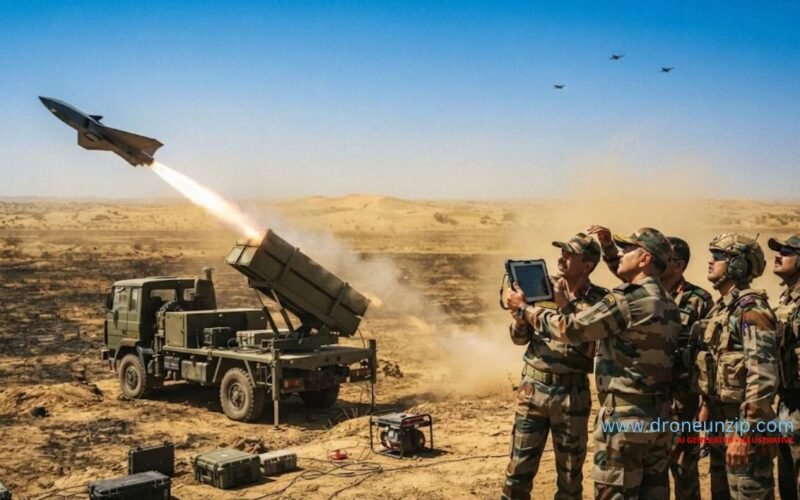
The Indian Army is preparing to evaluate indigenous systems offered by domestic defence companies. The Times of India reported that about 60 firms responded to the July 2026 request for information, 18 submitted bids and 11 qualified for the trial stage. Reported contenders include Bharat Forge with VEDA Aeronautics, NIBE, Adani Defence and SMPP with NewSpace Research and Technologies. The list is reporting-based rather than an independently verified official shortlist.
Key Takeaways
- Indian Army plans Pokhran trials for 540 jet-powered loitering munitions in a reported ₹2,000 crore programme involving 11 Indian bidders.
- The Jet Based Kamikaze Drone System programme reportedly seeks 540 high-speed loitering munitions through a fast-track procurement route, with an estimated value of ₹2,000 crore.
- The trials could test India’s ability to integrate expendable jet engines, guidance, warheads, launch vehicles and sustainment into a fieldable package.
What is the Army seeking?
The Jet Based Kamikaze Drone System programme reportedly seeks 540 high-speed loitering munitions through a fast-track procurement route, with an estimated value of ₹2,000 crore. The requested capability is broader than an aircraft alone: reports describe launch and transport vehicles plus mission-planning support. A procurement requirement is not an awarded contract.
When and where will the trials take place?
Reports published on 13–15 November said trials were expected at Pokhran in Rajasthan during the following week. No publicly verified trial results or winner were available at the time of this draft. The programme’s schedule should therefore be described as planned rather than completed.
Why jet propulsion matters
Jet propulsion can shorten transit time to a target compared with many propeller-driven loitering munitions, but speed alone does not establish survivability or strike accuracy. The Times of India cites speeds around 450 km/h for the category; individual bidder specifications and test conditions have not been independently verified. Ukraine’s work on interceptors against faster jet-powered attack UAVs illustrates the countermeasure challenge these systems face.
India’s industrial test
The trials could test India’s ability to integrate expendable jet engines, guidance, warheads, launch vehicles and sustainment into a fieldable package. A separate Indian drone production expansion highlights the difference between announcing capacity and delivering qualified military equipment. The next verified milestones are trial results, bidder selection, contract signature and deliveries.
