

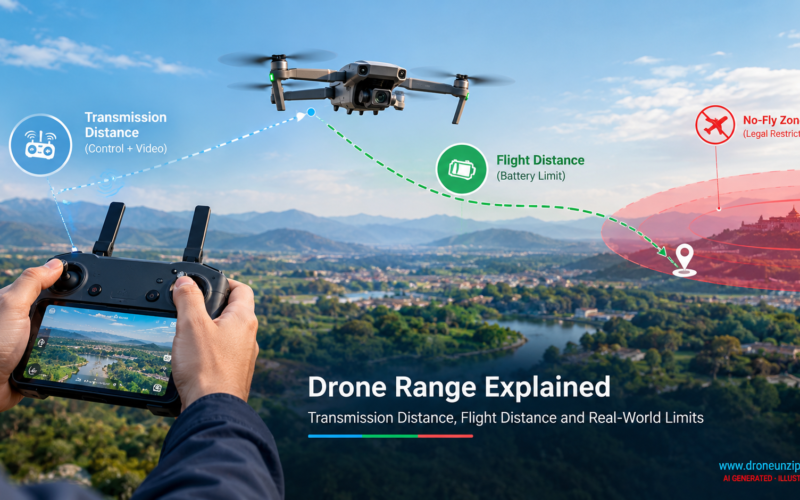
A drone manufacturer advertises a transmission range of 10 km. Does that mean you can fly 10 km away, record footage and bring the aircraft home safely? Not necessarily. Drone range can refer to communication distance, total flight distance or the distance within which a flight can be conducted safely and legally. These are different measurements.
For beginners in India, the useful question is not how far the signal might travel in ideal conditions. It is how far a particular aircraft can operate reliably, return with adequate battery reserves and comply with applicable operating rules.
What Does Drone Range Actually Mean?
Transmission range is the distance over which the aircraft and controller can maintain a communication link, potentially carrying commands, telemetry and video. Flight distance is how far the aircraft can travel during a flight, constrained by energy, speed, wind and other conditions. Operational range is the distance within which a mission can be carried out safely and with the required permissions.
| Factor | Transmission range | Flight distance |
|---|---|---|
| Main constraint | Communication link | Battery and aircraft performance |
| Affected by interference | Directly | Indirectly |
| Affected by wind | Usually indirectly | Directly |
| Guarantees safe return | No | No |
| Establishes legal operating distance | No | No |
A long-range radio cannot compensate for an insufficient battery. Likewise, a drone with ample battery capacity may lose its control link in a difficult radio environment.
Why Advertised Drone Range Differs From Real-World Range
Manufacturers typically report maximum communication performance under defined test conditions, often involving unobstructed paths and limited interference. DJI’s product specifications distinguish transmission figures from other performance measurements and may report different values under different radio standards or interference conditions. Such numbers are manufacturer-reported test figures, not guarantees for every location.
Buildings, hills, trees, antenna orientation and competing radio signals can reduce usable link quality. A drone may encounter weak signal at a relatively short distance if terrain blocks the path, even though its advertised maximum is much greater.
Does a 20 km transmission range mean a 20 km flight?
No. The advertised figure does not establish enough battery energy for a 20 km outward journey and a safe return. It also does not authorise a flight of that distance. Transmission range is a communication capability, not a recommended flight target.
What Affects a Drone’s Real-World Range?
1. Communication technology
Basic drones may use comparatively simple wireless links; more advanced aircraft may use dedicated digital transmission systems. Range depends on the complete design, antenna arrangement, operating environment and applicable radio limits, not merely a technology label.
2. Buildings, trees and terrain
An unobstructed radio path generally supports a more reliable connection than a route hidden behind buildings or hills. A close aircraft can still lose signal when an obstruction intervenes.
3. Radio interference
Congested environments contain competing wireless transmissions that can affect link quality. Real-world performance may vary between an open rural location and a dense urban setting.
4. Battery and flight endurance
A published maximum flight time does not convert directly into a safe operating radius. The drone must retain energy for its return, manoeuvres and landing, including a reserve for unexpected conditions.
5. Wind
A tailwind on the outward leg may become a headwind on the way back, changing energy consumption. Do not calculate a safe turnaround point simply by dividing maximum flight time in half.
6. Speed, payload and battery condition
Speed selection, additional permitted payload, battery age, temperature and state of charge can all change endurance. A drone may perform differently from the manufacturer’s controlled test.
How Far Can Different Types of Drones Fly?
| Drone type | What limits practical range |
|---|---|
| Basic toy drone | Simple control link and limited endurance |
| Beginner camera drone | Transmission, battery, positioning and environment |
| Advanced consumer drone | Long-range radio capability, but still subject to endurance and rules |
| FPV drone | Specific radio/video setup, battery and pilot skill |
| Enterprise drone | Mission equipment, communications architecture and approvals |
These are qualitative categories, not universal kilometre estimates. Check the actual specifications and documented failsafe behaviour of the model you intend to fly.
What Happens When a Drone Goes Out of Range?
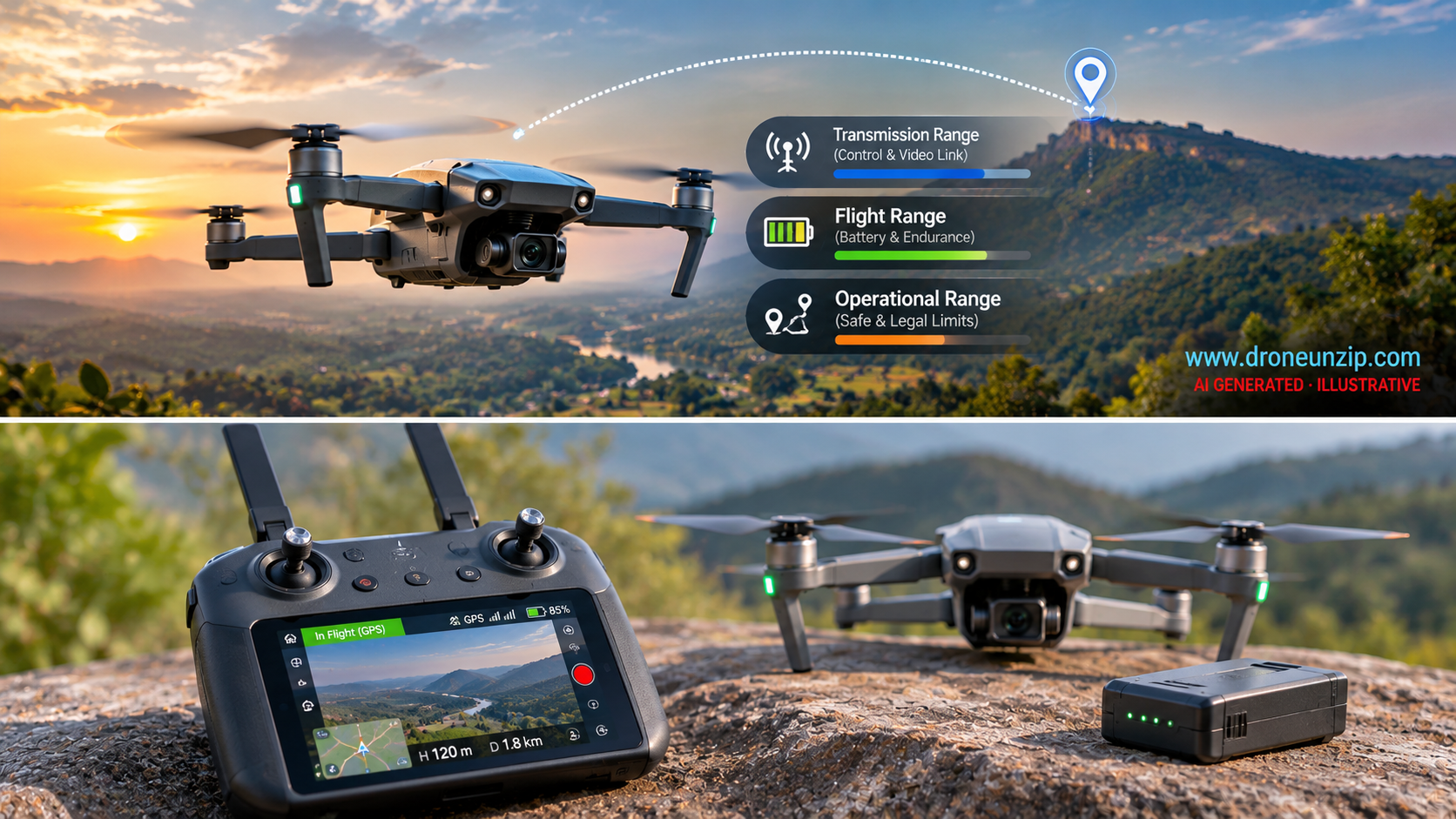
The outcome depends on the aircraft and its configured failsafe. Some systems initiate Return-to-Home or Return-to-Launch; others may land, hover or take another programmed action. ArduPilot documents multiple radio-failsafe options. A lost signal does not guarantee that every drone will return automatically.
Can Return-to-Home fail?
Yes. Return-to-Home depends on conditions such as valid positioning, a correctly recorded home point, suitable configuration, available battery and an unobstructed route. It is a recovery aid, not a substitute for preflight planning. Understand how to interrupt or recover from an automated action according to the manufacturer’s instructions.
How Far Can You Legally Fly a Drone in India?
A drone’s technical capability and the legal permission to use it are separate. India’s Drone Rules establish an airspace framework and require pilots to check applicable restrictions on Digital Sky before operating. Whether a specific flight is permitted depends on current rules, airspace, aircraft and any necessary approvals.
Do not treat a 10 km or 20 km transmission specification as permission to conduct a beyond-visual-line-of-sight flight. Beginners should maintain the visual contact required for their operation and verify current DGCA guidance and Digital Sky restrictions before takeoff. This guide does not assert a single universal numerical legal-distance limit.
How to Choose a Drone Based on Range
- Check what the advertised range measures and the test conditions used.
- Compare the actual control and video transmission system.
- Review battery endurance and manufacturer low-battery warnings.
- Confirm the aircraft’s lost-signal failsafe and Return-to-Home prerequisites.
- Consider wind, obstacles, interference and battery reserves.
- Check whether the intended flight is permitted in the operating area.
- Prioritise reliable control and safety features over the largest kilometre figure.
For related fundamentals, read GPS vs Non-GPS Drones, Drone Flight Modes Explained and Drone Safety for Beginners in India.
Six Common Drone Range Mistakes
- Treating advertised range as guaranteed range in any environment.
- Ignoring the energy needed for the return journey.
- Assuming a strong GPS signal means a strong controller connection.
- Assuming Return-to-Home will always succeed.
- Confusing maximum transmission range with legal operating distance.
- Continuing outward when signal quality is already deteriorating.
FAQs
How far can a drone fly?
It depends on its battery, transmission system, weather, payload and operating conditions. The advertised transmission figure is not a safe flight-distance guarantee.
Can a drone fly 10 km away?
Some aircraft advertise communication capability of 10 km or more in specified conditions. That does not prove a 10 km outward flight is safe, achievable with a return journey or legally permitted.
What is the difference between drone range and flight time?
Range describes distance; flight time describes duration. Speed, wind and energy use determine the relationship between them.
Does GPS increase drone range?
GPS supports navigation and positioning; it does not directly increase the radio communication link’s maximum range.
What happens when a drone loses signal?
Depending on its settings, it may return, land, hover or take another action. Check the aircraft’s failsafe documentation.
Can a drone return home without controller signal?
Some equipped and correctly configured aircraft can initiate autonomous return after a link loss, but success is conditional.
Do trees and buildings reduce drone range?
They can obstruct or weaken radio signals and reduce usable communication distance.
Is Wi-Fi drone range always shorter than dedicated radio transmission?
Not in every configuration. Compare model-specific measurements and test conditions rather than assuming a universal result.
Is a 20 km drone range legal in India?
A 20 km advertised transmission capability does not authorise a 20 km flight. Applicable airspace, operating requirements and permissions must be checked.
What drone range is enough for beginners?
Prioritise dependable control, safe endurance, suitable failsafe features and compliant operation rather than maximum advertised distance.
Final Verdict
The best beginner drone is not necessarily the one with the longest advertised transmission range. Battery endurance, wind, signal conditions, failsafe settings, pilot skill and legal restrictions determine what is practical. Drone range is a capability to understand, not a distance to test.
