

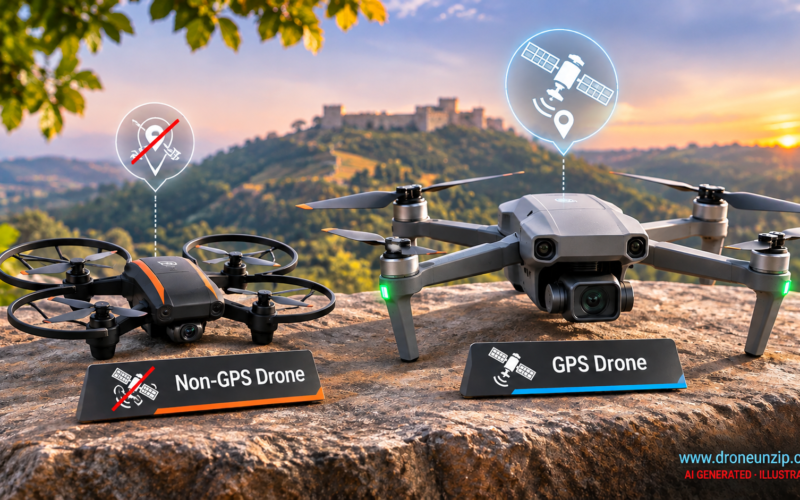
A drone advertised with GPS may cost more than a similar-looking model without it. Both may offer cameras, altitude hold and beginner-friendly controls. The important difference is how each aircraft determines and maintains its position.
In a GPS vs non-GPS drones comparison, GPS-equipped aircraft can use satellite navigation for position-assisted flight and, on supported models, return-to-home. Non-GPS drones may still fly smoothly using inertial, barometric or optical sensors. The right choice depends on whether you want basic practice or regular outdoor flying.
GPS vs Non-GPS Drones: Key Differences at a Glance
| Feature | GPS drone | Non-GPS drone |
|---|---|---|
| Satellite positioning | Yes, when reception is adequate | No |
| Horizontal position hold | Common on suitable models | Depends on optical or other sensors |
| Altitude hold | Often available | Available on many models |
| Return-to-home | May support navigation-based RTH | Generally unavailable without alternative positioning |
| Indoor use | Satellite reception often poor | Some models are designed for indoor use |
| Wind resistance | Depends on aircraft design and power | Depends on aircraft design and power |
| Camera quality | Separate feature | Separate feature |
| Beginner suitability | Often easier for outdoor use | Can suit controlled practice |
These are typical capabilities, not guarantees. Manufacturers combine sensors and flight software differently.
1. What Is a GPS Drone and How Does It Work?
A GPS drone uses satellite navigation to estimate its geographic position. Depending on the receiver, it may support other Global Navigation Satellite Systems (GNSS), including Galileo, GLONASS or BeiDou. Its flight controller combines positioning information with inertial sensors, a barometer, a compass and sometimes downward-facing cameras.
GPS does not directly keep the aircraft balanced. Instead, positioning information helps the controller detect displacement. If a breeze pushes the drone sideways, an appropriately equipped aircraft can command corrective movement to hold its location. This is commonly called position hold.
What GPS does not do
GPS does not automatically provide obstacle avoidance, better camera quality, stronger wind resistance or a guaranteed return flight. Satellite reception can deteriorate near tall buildings or beneath dense vegetation. GPS is a positioning aid, not a replacement for a pilot.
2. What Is a Non-GPS Drone?
A non-GPS drone does not rely on satellite navigation. That does not necessarily make it fully manual. Basic models use gyroscopes and accelerometers to help maintain orientation; others use a barometer for altitude hold. More capable models can use optical flow, downward-facing cameras and distance sensors to estimate movement relative to the ground.
A self-levelling drone may remain upright but drift horizontally. An altitude-hold drone may maintain height while drifting sideways. An optical-positioning drone may hold its horizontal position in suitable lighting and over a textured surface. Non-GPS does not automatically mean unstable.
3. GPS vs Non-GPS Drones: Which Is Easier to Fly?
For many outdoor beginners, a well-designed GPS drone with reliable position hold reduces the number of corrections needed during hovering. Releasing the directional controls can allow the aircraft to stop and maintain its position. However, controller response, propeller protection, flight modes, software and sensor quality also matter.
When a non-GPS drone makes sense
A compact, predictable non-GPS aircraft can be useful for short practice sessions in a suitable controlled environment. Ask what happens when you release the sticks: does it hold height, hold position or continue drifting? That is more useful than a vague one-key takeoff claim.
When GPS is worth paying for
GPS is particularly valuable for outdoor hovering, aerial photography and repeated flights where predictable positioning matters. For regular outdoor use, a capable GPS-equipped drone can be a better long-term purchase than repeatedly upgrading very basic models.
4. Does GPS Make a Drone More Stable?
Stability has three different meanings. Attitude stability helps the drone maintain controlled orientation. Altitude stability helps it maintain height. Position stability helps it stay over the same location. A seller may advertise altitude hold as stability even though the aircraft cannot resist horizontal drift.
GPS can support horizontal position hold, but optical positioning and other systems can also provide it. Conversely, GPS hardware alone does not ensure good control performance.
5. Return-to-Home: The Biggest Practical Difference?
On supported aircraft, return-to-home (RTH) navigates towards a recorded home point after pilot activation or under certain predefined conditions. Some models also respond to low battery or signal loss. The outcome depends on positioning quality, battery level, configuration, wind and obstacles.
Some inexpensive non-GPS drones advertise one-key return, but this can mean a directional manoeuvre rather than navigation to a recorded geographic location. Confirm how the home point is established and how the aircraft behaves when satellite or controller signals are lost.
Even with RTH, use the precautions in our Drone Safety for Beginners in India guide.
6. GPS vs Non-GPS Drones for Indoor and Outdoor Flying
Indoor flying
Satellite signals are often weak indoors. A GPS aircraft may depend on vision positioning or a different flight mode. A compact non-GPS drone with propeller guards may be practical indoors, but walls, fans, people and confined spaces create hazards. Optical positioning can fail over reflective, featureless or poorly illuminated surfaces.
Outdoor flying
Outdoor flight places greater demands on wind handling, positioning and recovery. GPS position hold is useful for beginners, but basic non-GPS drones can also fly outdoors in suitable conditions. Neither category should exceed its manufacturer’s environmental limits; GPS cannot compensate for weak motors.
7. Does GPS Improve Drone Camera Quality?
No. Camera quality depends on the sensor, lens, image processing, bitrate and lighting. Smooth footage also depends on mechanical or electronic stabilisation. GPS position hold can make framing easier, but it does not replace a gimbal or improve the sensor. Compare positioning and camera specifications separately using our Drone Camera Guide.
8. GPS vs Non-GPS Drones in India: What Should Buyers Consider?
Indian buyers should verify the exact model and manufacturer’s documentation. Product listings sometimes use terms such as GPS-like stability, smart return or professional drone without explaining the underlying system. Check documented flight modes, spare-part availability, batteries, repairs and firmware support.
For compact aircraft, our Mini Drone Buying Guide covers additional buying considerations.
Check weight and applicable rules
India’s drone classification is based on maximum all-up weight, including payload, rather than whether the aircraft has GPS. A non-GPS drone is not automatically exempt from airspace restrictions. Check current DGCA requirements and the official Digital Sky airspace map before operating. For registration-related context, read our Drone Registration in India guide.
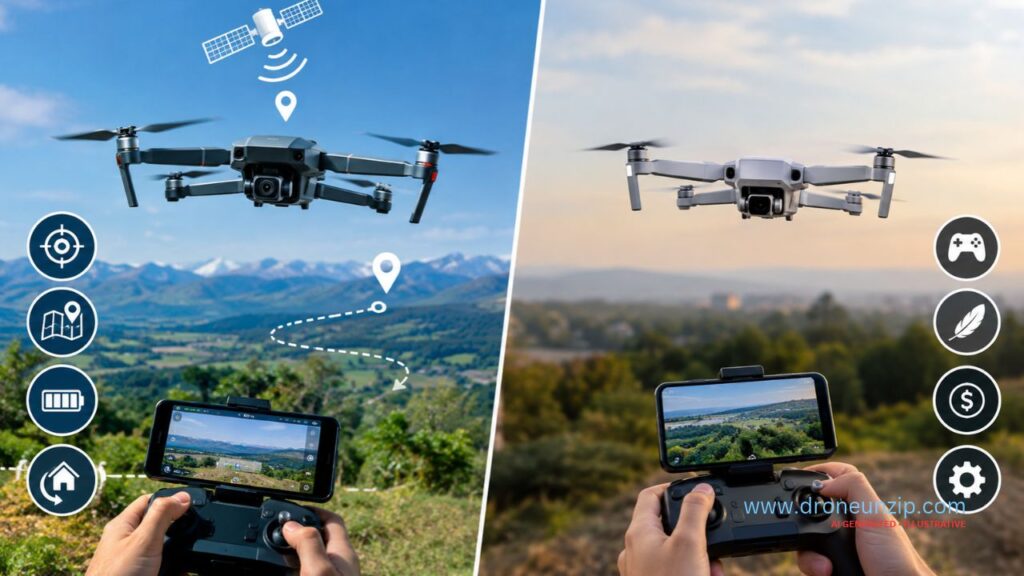
9. Which Drone Should You Buy? A Practical Decision Guide
| Your purpose | Better starting point | Reason |
|---|---|---|
| Basic indoor practice | Suitable compact non-GPS drone | Controlled, lower-cost practice |
| Outdoor practice | Capable GPS drone | Position hold can reduce workload |
| Aerial photography | GPS camera drone with good stabilisation | Positioning and imaging complement each other |
| Manual control practice | Suitable non-GPS model | Encourages active correction |
| Long-term hobby use | GPS drone with documented support | More positioning and recovery options |
| Very limited budget | Well-documented basic model | Avoid paying for unverified claims |
These are buying principles, not product endorsements. No hands-on comparative flight testing was performed for this guide.
10. Seven Questions to Ask Before Buying a GPS Drone
- Does it have a documented GNSS receiver, and which systems does it support?
- Can it maintain horizontal position when the sticks are released?
- How and when is the home point recorded?
- What happens when satellite reception weakens?
- Does it have genuine navigation-based return-to-home?
- What wind and environmental limits does the manufacturer specify?
- Are batteries, propellers, repairs and firmware support available?
FAQs
Is a GPS drone better than a non-GPS drone?
For many outdoor beginners, reliable GPS position hold is helpful. A suitable non-GPS drone can still work well for basic controlled practice.
Can a non-GPS drone fly outdoors?
Yes, when designed for outdoor operation and flown within suitable conditions. Basic models may require more manual correction.
Does a GPS drone need the internet?
Ordinary satellite positioning does not require mobile internet. Map downloads, account services or software updates may need connectivity.
Can GPS drones fly indoors?
Some can, but satellite reception is often weak indoors. They may rely on vision positioning or another flight mode; follow the manufacturer’s instructions.
Can a drone hover without GPS?
Yes. Barometric altitude hold and optical positioning can support hovering, although a basic self-levelling aircraft may still drift.
Does GPS prevent crashes?
No. GPS does not guarantee obstacle avoidance or safe flight.
Do all GPS drones have return-to-home?
No. Check whether the specific model supports it and under which conditions.
Is GPS legally required for a drone in India?
GPS is not by itself the universal determinant of operating eligibility. Applicable rules depend on the aircraft, operation and current regulations.
Is GPS worth the extra money?
Often for regular outdoor use, provided the aircraft has reliable position hold and documented recovery functions. A simpler model can suffice for occasional controlled practice.
Final Verdict: GPS or Non-GPS for Your First Drone?
For most beginners planning regular outdoor flights, a well-designed GPS drone is the stronger long-term choice. For inexpensive indoor practice, a suitable non-GPS model may be enough. Buy the flight capability you need, not merely the technology printed on the box.
