

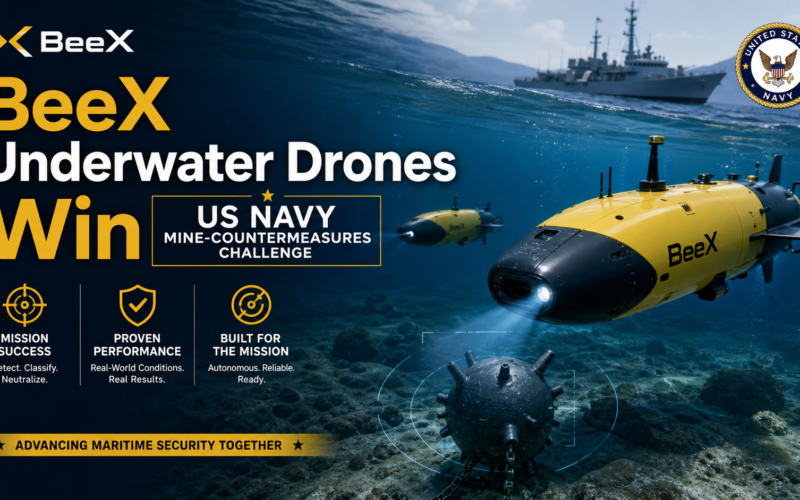
Singapore-based underwater robotics developer BeeX has won a prize in a mine-countermeasures modernization challenge run by the U.S. Defense Innovation Unit (DIU) and U.S. Navy. In an October 2 announcement, BeeX said its autonomous underwater drones demonstrated mine-threat reacquisition and neutralisation tasks during the competition and were progressing toward Navy integration.
The award is a concrete competition result. However, the performance details below are company-reported, and the announcement does not establish that the U.S. Navy has completed operational integration or fielded the systems.
What BeeX says its underwater robots demonstrated
The challenge sought modular, communications-resilient uncrewed systems capable of reacquiring and neutralising underwater mine threats. BeeX says its drones were assessed against bottom and volume mine-neutralisation missions and could perform reacquisition with untethered autonomous perception and acoustic sensing.
BeeX also reported a reacquire-to-engage sequence over high-latency, low-bandwidth communications links, with the drones operating without a dedicated mine-countermeasures platform. These claims are attributed to BeeX rather than presented as independently validated naval capability.
Why mine countermeasures are an important autonomy test
Underwater mine clearance is hazardous, and traditional operations can depend on specialist vessels and closely controlled remotely operated vehicles. A system able to locate and approach a mine-like contact autonomously could reduce operator workload and allow personnel to remain farther from danger. Actual safety and cost benefits will depend on validated mission performance and deployment arrangements.
Underwater robots face challenges that aerial drones do not: satellite navigation signals cannot be used directly underwater, acoustic communications are constrained, and visibility and currents vary. These conditions make resilient onboard autonomy especially relevant.
From commercial inspection to naval missions
BeeX’s roots are in offshore and underwater inspection, including energy and coastal infrastructure work. The company says that experience informed the perception and navigation systems it is now applying to defence tasks. Its wider business includes underwater inspection platforms, and it has separately announced partnerships and commercial deployments.
The broader trend is dual-use maritime robotics: commercially developed inspection systems adapting to naval minehunting, seabed intelligence and infrastructure protection. Winning a prize challenge can open a route to further testing, but it is not the same as a procurement contract or fleet-wide adoption.
What to watch next
The next verifiable milestones would be a U.S. Navy contract or integration announcement, independently documented trials, performance requirements and evidence of deployment. It will also be important to establish which BeeX vehicle configurations were tested and which tasks required operator authorization.
Sources
