
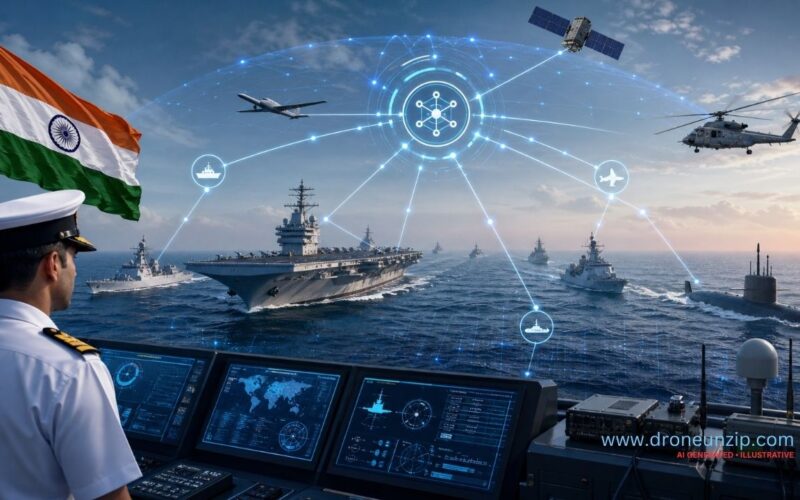
The Indian Navy’s fifth Swavlamban innovation and indigenisation seminar is taking place in New Delhi on 26–27 October, with a planned release that could be important for India’s naval technology ecosystem: the Naval Unified Systems, Ethernet and Tactical Utilisation (NAUSETU) Interface Standards.
According to the Ministry of Defence’s 19 October curtain-raiser announcement, NAUSETU is among three documents slated for release at Swavlamban 2026, alongside the Swavlamban 5.0 document and a Compendium on Technology Imperatives. The seminar brings together the armed forces, industry, startups, MSMEs, academia and investors to connect naval requirements with indigenous technology development.
What the Indian Navy has announced
The Navy has identified maritime surveillance, counter-unmanned aircraft systems (counter-UAS), artificial intelligence, quantum technologies, nuclear, biological, chemical and damage-control technologies, and safety and efficiency improvements among the exhibition’s focus areas. Its 24 October statement also highlighted the Swavlamban 5.0 document and technology-imperatives compendium as references for future industry engagement.
Vice Admiral Ajay Kochhar, Vice Chief of the Naval Staff, said during the curtain-raiser that indigenous niche technologies must progress toward deployable systems at sea. That distinction matters: a successful prototype is only one step toward equipment that can operate reliably during long naval deployments.
What is NAUSETU, and why could interface standards matter?
NAUSETU stands for Naval Unified Systems, Ethernet and Tactical Utilisation. The Defence Ministry has announced the name and planned release of its interface standards, but the public announcements reviewed for this report do not describe the specifications, scope, mandatory status or supported equipment in detail.
In general, interface standards can help different equipment and software systems exchange information more consistently. For a navy evaluating sensors, autonomous vehicles, communications equipment and command systems from multiple suppliers, common interfaces could potentially reduce integration friction. That is an industry implication, not a confirmed capability of NAUSETU. Its actual significance will depend on what the published document requires.
Why this matters for drones and autonomous maritime systems
Autonomous maritime operations may involve uncrewed surface vessels, underwater robots, shipboard sensors, aerial drones and human operators. Making those components work together requires more than individual platform performance: data exchange, cybersecurity, command authority, testing and reliability all matter.
If NAUSETU addresses relevant integration interfaces, Indian developers could gain clearer technical targets when building compatible products. But the Navy has not yet publicly established, in the announcements cited here, that the standards cover specific unmanned systems or guarantee vendor interoperability.
What Indian startups and manufacturers should watch
- Publication and accessibility: whether the full NAUSETU specifications are made publicly available and to whom.
- Scope: whether the standards address sensors, shipboard networks, unmanned platforms or other naval subsystems.
- Compliance: whether conformance testing, certification or procurement requirements are defined.
- Technology priorities: which requirements in the Compendium on Technology Imperatives create actionable development opportunities.
- Commercial follow-through: whether announcements lead to funded trials, contracts and operational deployment.
Related DroneUnzip coverage includes the commissioning of INS Samarthak for unmanned-systems trials, the Indian Navy’s first EyeROV TROUT underwater ROV deliveries, and a recent surveillance-drone tender. These developments provide context for the Navy’s broader unmanned-systems activity; they are not evidence that any platform already complies with NAUSETU.
The bigger picture
Swavlamban has operated since 2022 as a bridge between the Navy’s operational needs and India’s innovation ecosystem. The 2026 programme also includes investor engagement and discussions on scaling promising technologies, underscoring that manufacturing, financing and adoption can be as consequential as invention.
The next milestone is documentary, not ceremonial: the release and technical examination of NAUSETU and the accompanying Navy technology-priority documents. Until then, claims about specific plug-and-play naval drone capabilities would be premature.
Sources
