

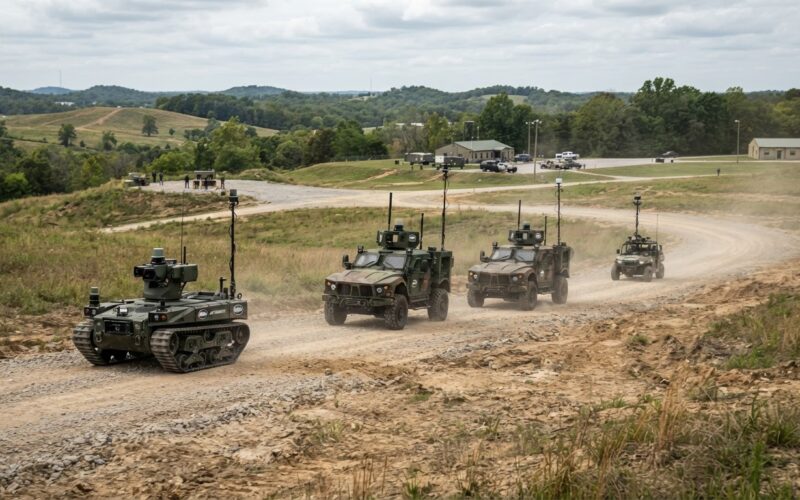
Four autonomous ground vehicles operated as a coordinated team during an October 15 demonstration at Fort Knox, showing how robotic mobility, onboard sensing and aerial payloads can be combined under human command. The U.S. Army reported the test on October 22 as a proof-of-concept experiment under DARPA’s Robotic Autonomy in Complex Environments with Resiliency (RACER) programme.
The vehicles negotiated terrain and conducted reconnaissance with minimal direct driving input. Three carried drone payloads. The exercise connected satellite-derived information, autonomous ground movement, target detection and simulated effects, while retaining human approval for engagements.
How the four-vehicle demonstration worked
According to the Army’s account, an operator received a simulated threat cue based on satellite imagery and tasked the robotic team. One vehicle moved ahead to search the area, detected a possible target and stopped. Two additional vehicles advanced to provide support before a simulated strike was carried out. The fourth vehicle then moved forward.
The vehicles were designed to traverse complex terrain using onboard sensors and autonomous driving software. The trial also integrated kinetic and non-kinetic payload concepts. The Army reported the integration of Anduril one-way attack platforms with Overland AI ground vehicles for engagements against simulated targets, subject to mission-commander approval.
Human control remained central
DARPA technical adviser Jason Gregory emphasized that autonomous vehicles could move, search and detect targets, but an operator had to approve any engagement. This is a critical distinction: the demonstration did not establish that the vehicles independently selected and attacked targets without human authorization.
Why it matters for military ground robotics
Rather than testing an unmanned vehicle in isolation, the event explored a networked team that could carry different sensors and mission payloads. In principle, modular robotic vehicles could support reconnaissance, resupply, casualty evacuation or other tasks, but those potential applications should not be confused with proven operational performance.
Another important development is the link between space-based reconnaissance, ground robotics and aerial systems. The Army described this as an end-to-end test, moving from satellite imagery to tactical ground action.
What comes next
DARPA officials said they expected to seek feedback from soldiers in December. The questions to watch are whether the system can remain reliable under disrupted communications, electronic warfare, poor visibility and varied terrain, and whether multiple robots actually reduce operator workload in demanding field conditions.
The Fort Knox exercise is evidence of coordinated autonomous mobility and supervised mission execution in a controlled test. It is not evidence of broad combat deployment or fully autonomous lethal decision-making.
Sources
