

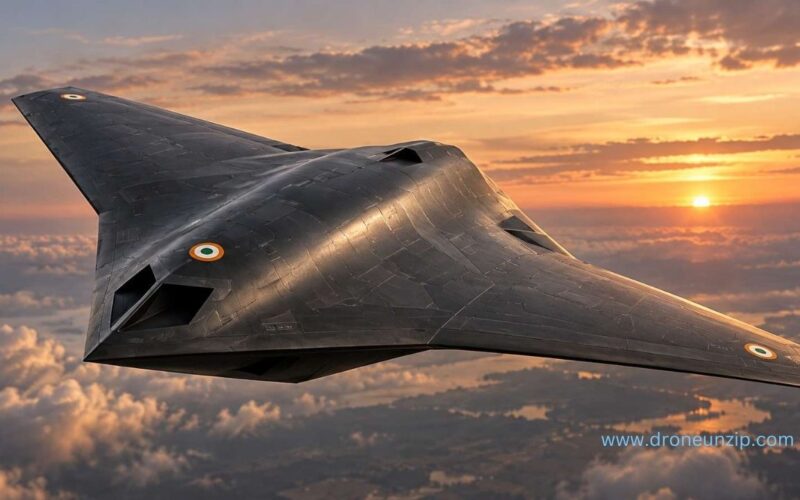
India’s Ghatak programme is intended to deliver a stealthy unmanned combat aerial vehicle (UCAV), but developing a full-scale flying-wing aircraft involves significant aerodynamic, control and flight-testing challenges. One of the visible steps in this effort is the Stealth Wing Flying Testbed (SWiFT), also described by the Defence Research and Development Organisation (DRDO) as the Autonomous Flying Wing Technology Demonstrator.
SWiFT is not the full-scale Ghatak UCAV. It is a technology demonstrator designed to help validate technologies relevant to future unmanned aircraft. Its flight trials have provided public evidence of progress in autonomous flight, flying-wing control and landing systems.
What is the DRDO SWiFT demonstrator?
SWiFT is a flying-wing unmanned aerial vehicle developed by DRDO’s Aeronautical Development Establishment (ADE), Bengaluru. DRDO has described it as an indigenous high-speed flying-wing UAV and a technology demonstrator. Its role is to test and mature technologies that can inform the development of future unmanned aircraft, including the broader Ghatak effort.
The demonstrator’s flying-wing configuration is significant because it has no conventional tail. Such layouts can support low-observable aircraft designs, but they also place demanding requirements on aerodynamic stability and flight-control systems. SWiFT provides a platform for testing these challenges at demonstrator scale rather than beginning with a full-size combat aircraft.
SWiFT’s maiden flight in 2022
DRDO successfully conducted SWiFT’s maiden flight on 1 July 2022 at the Aeronautical Test Range in Chitradurga, Karnataka. According to the Ministry of Defence’s announcement, the aircraft operated in fully autonomous mode and completed take-off, waypoint navigation and a smooth touchdown.
The official release identified ADE as the design and development organisation. It also stated that the aircraft used a small turbofan engine, while its airframe, undercarriage, flight-control systems and avionics were developed indigenously.
The maiden flight was an important milestone, but it should be understood in context: it demonstrated the flight of the technology demonstrator, not the first flight of the full-scale Ghatak UCAV.
The 2023 tailless flight trial
A further milestone came on 15 December 2023, when DRDO announced a successful flight trial in a tailless configuration. The organisation said the maiden flight in July 2022 had been followed by six additional flight trials in different developmental configurations, using two prototypes manufactured in-house. The December 2023 event was described as the seventh successful flight in the final configuration.
DRDO said the earlier trials contributed to the development of aerodynamic and control systems, integrated real-time and hardware-in-the-loop simulation, and a ground control station. The team also optimised avionics integration and flight operations ahead of the seventh flight.
The 2023 trial was notable because it demonstrated control of the flying-wing aircraft in a tailless configuration. DRDO described the achievement as evidence of progress in the country’s ability to control this type of aircraft. The statement did not, however, publish a complete set of performance specifications.
Autonomous landing and navigation
One of the most consequential capabilities reported in the 2023 trial was autonomous landing without ground radar, supporting infrastructure or an onboard pilot. DRDO said the demonstrator could take off and land from runways whose coordinates had been surveyed.
The system used onboard sensor-data fusion alongside satellite-based augmentation with GPS Aided GEO Augmented Navigation (GAGAN) receivers. DRDO said this approach was intended to improve the accuracy and integrity of GPS navigation.
Autonomous take-off and landing are important development areas for unmanned aircraft because they reduce reliance on a pilot onboard and can lessen dependence on some ground-based equipment. The public announcement establishes that the demonstrator performed the reported trial; it does not provide enough information to infer operational reliability in every weather, runway or contested environment.
Indigenous materials and onboard systems
DRDO reported that the SWiFT prototype used a complex arrowhead wing platform manufactured with lightweight, indigenously developed carbon prepreg composite material. The composite structure also incorporated fibre interrogators for structural health monitoring.
These details point to a broader purpose of the programme: the demonstrator is not only a flying test article but also a way to evaluate structural, avionics and control technologies. The official releases identify several indigenous elements, but do not disclose a full bill of materials or all supplier relationships.
How SWiFT is connected to Ghatak
SWiFT is associated with the development of Ghatak, India’s planned stealth UCAV. Its flying-wing trials are relevant to the larger programme because they help develop and demonstrate technologies for controlling an autonomous aircraft with this configuration.
However, the two aircraft should not be treated as interchangeable. SWiFT is a demonstrator, while Ghatak is the larger combat-aircraft ambition. Publicly reported SWiFT trial results do not, by themselves, confirm Ghatak’s final dimensions, range, payload, engine configuration, production timeline or service-entry date.
For readers following the wider programme, our Ghatak UCAV overview provides the broader context, while this article focuses on the demonstrator and the capabilities publicly reported from its trials.
What SWiFT has demonstrated, and what remains unknown
| Area | Publicly reported information |
|---|---|
| Developer | DRDO’s Aeronautical Development Establishment (ADE) |
| Maiden flight | 1 July 2022, at Chitradurga, Karnataka |
| Flight mode | Fully autonomous during the reported maiden flight |
| December 2023 milestone | Seventh successful flight, in a tailless configuration |
| Navigation and landing | Autonomous landing using onboard sensor fusion and GAGAN-supported navigation, as reported by DRDO |
| Materials | Indigenous lightweight carbon prepreg composite structure |
| Full performance specifications | Not comprehensively disclosed in the cited official releases |
Why the SWiFT programme matters
SWiFT offers a public window into the technical work behind India’s flying-wing UCAV ambitions. Its reported trials have demonstrated autonomous flight and landing functions, along with progress in controlling a tailless configuration. The use of indigenous airframe materials and onboard systems also highlights the programme’s domestic technology-development component.
At the same time, a demonstrator’s successful flights are not equivalent to a combat aircraft being ready for operational use. Ghatak’s eventual capabilities and timeline will depend on further development, integration and testing. SWiFT is an important part of that story, but it is one step in a much larger programme.
FAQ
What does SWiFT stand for?
SWiFT stands for Stealth Wing Flying Testbed. DRDO also refers to it as the Autonomous Flying Wing Technology Demonstrator.
When did the DRDO SWiFT drone first fly?
Its maiden flight took place on 1 July 2022 at the Aeronautical Test Range in Chitradurga, Karnataka. DRDO said it flew autonomously, completing take-off, waypoint navigation and touchdown.
Is SWiFT the same as the Ghatak UCAV?
No. SWiFT is a technology demonstrator associated with the Ghatak programme. It is not the full-scale Ghatak combat aircraft.
What did the December 2023 SWiFT trial demonstrate?
DRDO reported a successful seventh flight in the final configuration, including a tailless flying-wing configuration and autonomous landing using onboard sensor fusion and GAGAN-supported navigation.
Has DRDO disclosed SWiFT’s range and top speed?
The cited official DRDO and Ministry of Defence releases do not provide a comprehensive set of range and speed figures. Unverified figures circulating elsewhere should not be treated as confirmed specifications.
Sources
