

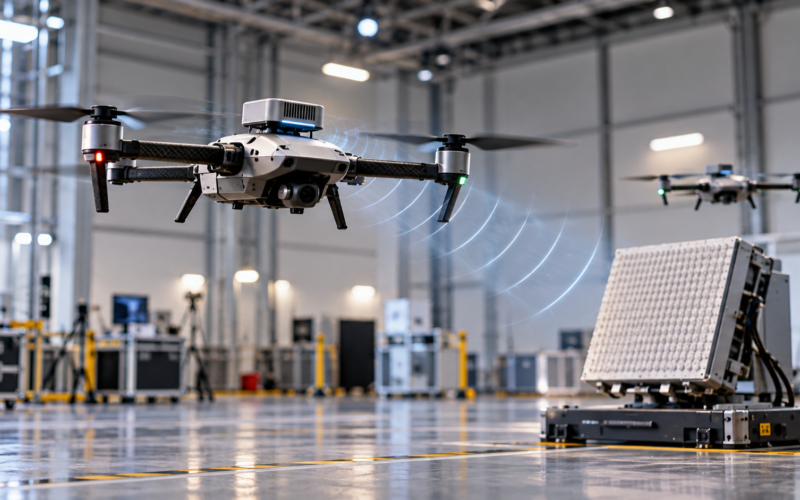
Wireless power beaming for drones moved from a laboratory concept to a public flight demonstration at the MOSA Industry & Government Summit & Expo in National Harbor, Maryland. GuRu Wireless says it operated two small unmanned aircraft indoors while replenishing their batteries in flight, without battery swaps, landings or a physical tether. The company has also reported outdoor demonstrations involving a Group 1 unmanned aircraft system (UAS).
The October 2 demonstration puts a spotlight on a persistent challenge in drone operations: flight time is often limited not by the mission, but by the energy the aircraft can carry. GuRu’s approach attempts to move part of that energy supply from the airframe to a ground-based system. The demonstration is a technical milestone, but it does not by itself establish that drones can remain airborne indefinitely in routine field conditions.
How GuRu’s wireless power beaming system works
GuRu’s long-range wireless power beaming platform uses a ground-based Generation Unit built around a software-steered 24 GHz phased array. Rather than relying on a cable, the array transmits focused radio-frequency (RF) energy toward a receiver carried by the aircraft.
The onboard Recovery Unit captures that energy, converts it into regulated direct-current power and supplies the drone’s battery or power-management system. In principle, this allows the aircraft to continue flying while receiving energy from the ground, reducing or potentially removing the need to land for a battery change during a supported operation.
Keeping the energy beam aligned with a moving aircraft is a central engineering challenge. GuRu says its system uses closed-loop tracking, beamforming and RF lensing to direct and concentrate energy as the drone moves. The company’s description emphasizes a coordinated ground-and-air arrangement: a transmitter, a tracking function and a compact airborne receiver must work together for the system to be useful.
What the MOSA Summit demonstration showed
At the MOSA Industry & Government Summit & Expo, GuRu demonstrated two drones operating indoors while receiving wireless power in flight. The company said the demonstration was completed without battery swaps, landings or a physical tether. It also reported earlier outdoor work in which a Group 1 UAS received power continuously at operational altitude.
GuRu states that its technology has reached Technology Readiness Level 6 (TRL 6) and that it has demonstrated more than 96 hours of continuous drone flight with wireless recharging at 200 feet. These are company-reported figures; the public announcement does not provide a full independent test report, power-transfer efficiency across the flight profile, or the environmental conditions behind the endurance result.
The distinction matters. A demonstration can establish that a system works under specific test conditions, while operational deployment also depends on reliability, weather tolerance, airspace rules, safety procedures and the ability to maintain a stable energy link. The 96-hour figure should therefore be read as a reported demonstration result, not a universal endurance figure for ordinary drones.
Why in-flight recharging could matter
For small drones such as FPV platforms, battery capacity, payload and endurance are tightly connected. Adding a larger battery can increase weight, while carrying a useful camera or communications payload consumes part of the aircraft’s energy budget. Wireless power beaming offers a different design trade-off: instead of carrying all the energy needed for a long mission, a drone could receive some of it while airborne, provided it remains within the system’s effective coverage.
GuRu identifies intelligence, surveillance and reconnaissance (ISR), communications, industrial inspection and maritime surveillance among the potential applications for its platform. In these roles, persistent observation or a communications relay can be valuable, particularly when repeated landings would interrupt coverage or require personnel to manage battery changes.
That does not mean every drone mission is a suitable candidate. The aircraft must be compatible with the onboard receiver, and the ground unit must be positioned and powered. Terrain, obstacles, aircraft movement and line-of-sight constraints can all affect whether a power link can be maintained. A ground-based transmitter also introduces equipment and deployment requirements that a conventional battery-powered drone does not have.
What remains to be proven
The most important questions for operators concern performance outside a controlled demonstration. Publicly available details in the announcement do not establish how much usable power reaches the aircraft at different distances, how the link behaves during rapid manoeuvres, or how rain and other environmental conditions affect it. Nor does the announcement set out the cost, maintenance burden or deployment footprint of a complete operational system.
Safety and regulatory considerations will also shape adoption. RF power transmission requires careful management of exposure, beam control and the surrounding operating environment. Any deployment would need to meet applicable requirements and demonstrate that the system can keep the beam directed safely while sharing airspace with other users.
GuRu’s reported TRL 6 status and endurance demonstration suggest the company has moved beyond a purely conceptual stage. However, readiness for a particular mission depends on evidence gathered in conditions representative of that mission. Independent performance data and repeatable field trials would help clarify where the technology offers practical value.
A potential change to the drone endurance equation
Wireless power beaming does not remove the physical limits of aircraft design, nor does it make every UAV capable of continuous flight. Its promise is more specific: for compatible small drones operating within a suitable coverage area, it could reduce the interruptions caused by battery limitations.
The MOSA Summit demonstration gives GuRu a public milestone to build on. Whether the approach becomes a routine tool for persistent drone operations will depend on power delivery, tracking reliability, safety and economics in real deployments. For now, the reported flights show a way to extend endurance that is distinct from simply fitting a larger battery.
Sources: Unmanned Systems Technology, October 2, 2026; GuRu Wireless official website.
