

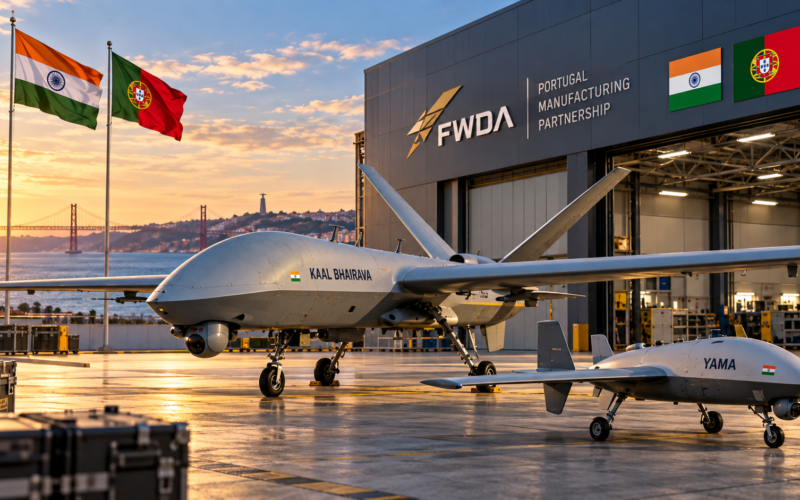
Indian defence technology company Flying Wedge Defence & Aerospace (FWDA) has signed a manufacturing agreement with Portugal’s Keydef, the defence and aerospace division of Sketchpixel, to produce the Kaal Bhairava autonomous unmanned aerial vehicle (UAV) and YAMA swarm interceptor in Portugal for international markets. The agreement includes an initial investment of €6 million from Keydef, according to company statements reported by Indian and Portuguese media.
The agreement was signed at Keydef’s facilities in Braga, Portugal, in the presence of India’s Ambassador to Portugal, Puneet Roy Kundal. The arrangement gives FWDA a planned manufacturing base in Europe, while Keydef is expected to contribute to the development of electronic components and artificial intelligence systems for the aircraft.
The deal formalises a partnership that had already been reported in May 2026. The latest development is the signed manufacturing agreement and the disclosed initial investment, rather than the first announcement of cooperation between the companies.
What the FWDA-Keydef agreement covers
The companies intend to manufacture FWDA’s Kaal Bhairava autonomous UAV and YAMA interceptor in Portugal, with output aimed at international markets. The planned production scope is broader than these two platforms: reports say it is expected to cover FWDA’s portfolio of surveillance systems, air-defence platforms and civilian applications, including precision agriculture.
Keydef and its parent company, Sketchpixel, are expected to work on parts of the electronic and AI architecture. The division of work is described as a combination of Indian-origin systems and Portuguese engineering capabilities. The precise production split for each platform has not been publicly detailed in the reports reviewed.
FWDA is based in Bengaluru and develops autonomous unmanned systems. Its Kaal Bhairava programme is described by the company and media reports as an autonomous UAV, while YAMA is identified as a swarm interceptor. The agreement does not, by itself, establish that either system has entered serial production in Portugal or that deliveries to export customers have begun.
€6 million initial investment, with the factory site undecided
Keydef’s initial investment is reported at €6 million. Portuguese reporting has also described the project as having the potential to grow to €50 million over the coming years. That larger figure is a reported future possibility, not the confirmed initial investment or a guaranteed spending commitment under the agreement.
The manufacturing site has not yet been finalised. Keydef is assessing proposals from municipalities, with factors including land, infrastructure, fiscal incentives and access to skilled workers among the considerations. Until a location and implementation schedule are confirmed, the scale and timing of the planned production operation remain subject to change.
The companies have presented Portugal as a route to international markets, including Europe. They have also stated an intention to pursue NATO certification for systems produced in Portugal. Certification is a goal, not an approval already secured; individual systems would still need to meet the applicable requirements and complete the relevant processes.

How Kaal Bhairava and YAMA fit into the plan
Kaal Bhairava and YAMA represent different parts of FWDA’s reported portfolio. Kaal Bhairava is the autonomous UAV named in the manufacturing agreement, while YAMA is described as a swarm interceptor. The agreement places both within a proposed Portuguese production programme, but published details do not yet provide a complete production timetable, confirmed output capacity or customer delivery schedule.
The wider portfolio described in coverage includes surveillance and air-defence systems, alongside civilian applications such as precision agriculture. This breadth suggests that the planned facility is intended to support more than a single aircraft type. However, the agreement’s public summaries do not specify which products will be manufactured first or how production volumes will be allocated across the portfolio.
For readers following India’s unmanned combat aircraft programmes, DroneUnzip has also covered the Ghatak UCAV programme and the IG Defence KAL long-range attack drone. These are separate programmes and should not be conflated with FWDA’s Portugal agreement.
A parallel long-endurance UAV research project
Alongside the manufacturing agreement, FWDA and Keydef are collaborating with the University of Minho on a separate long-endurance uncrewed aircraft project. The stated ambition is to develop a platform capable of reaching 100 hours of endurance. This is a development target, not a verified operational performance figure for a completed aircraft.
The research effort is related to the companies’ broader aerospace collaboration, but it is distinct from the production plans for Kaal Bhairava and YAMA. Public reporting has also referred to a planned joint laboratory from 2028. Further details about the research programme, milestones and division of responsibilities have not yet been fully disclosed.
What to watch next
The next milestones to watch are the selection of a Portuguese factory location, a clearer production schedule and any formal updates on certification. Details on the role of local suppliers, the products entering production first and the terms of the reported longer-term investment would also help establish how quickly the agreement can move from planning to manufacturing.
For FWDA, the arrangement represents a proposed international manufacturing foothold. For Keydef, it creates a route to participate in the production and technology work around Indian-origin unmanned systems. The extent to which the agreement translates into operational output will become clearer as the companies disclose implementation details.
