

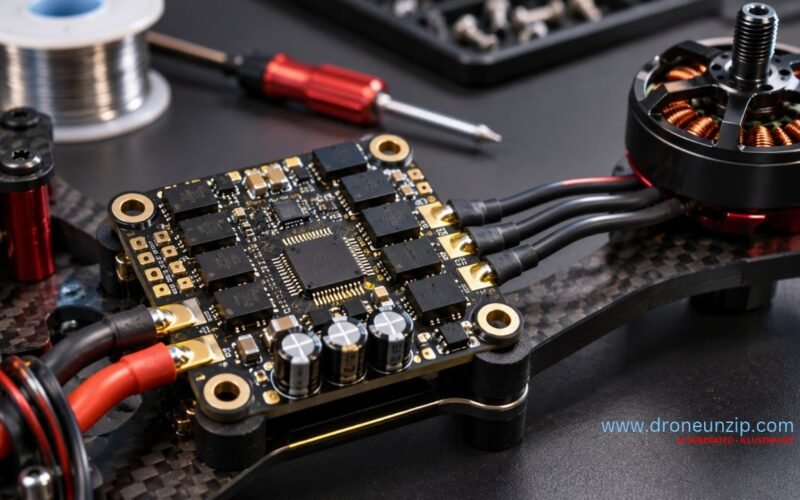
Every time a quadcopter climbs, turns or corrects its position, its propulsion motors must respond to changing flight-control commands. An important component making that possible is the Electronic Speed Controller (ESC).
A drone ESC is an electronic motor controller that receives commands from the flight controller and regulates the electrical drive supplied to a motor. On a typical brushless multirotor, each motor requires its own ESC control channel, although four channels may share one circuit board.
Understanding ESCs is particularly useful for FPV builders, engineering students, repair technicians and owners of modular UAVs. This guide covers how ESCs work, their components and types, current and voltage ratings, DShot and other protocols, firmware, motor compatibility, selection and troubleshooting.
What Is an ESC in a Drone?
ESC stands for Electronic Speed Controller. It is the electronic interface between the drone’s flight-control system and its electric propulsion motor. The flight controller decides the desired motor outputs based on pilot commands, sensor inputs and its control algorithms; the ESC provides the motor-drive switching needed to implement those commands.
The ESC does not independently navigate or stabilize the aircraft. Its job is different from the flight controller’s job, even though both systems contain electronics and sometimes a microcontroller.
Where does an ESC sit in the drone?
The power path can be summarized as Battery → ESC power stage → Motor, while the command path is Flight controller → ESC signal/interface. Compatible systems may also send ESC telemetry back to the autopilot.
For the aircraft-side control logic, see Drone Flight Controllers Explained.
How Does a Drone ESC Work?
A typical brushless motor needs its phase windings energized in a coordinated sequence. The ESC performs this electronic commutation, generally using power transistors controlled by firmware.
- Receive a command: The flight controller outputs a supported command using PWM, DShot or another interface.
- Interpret the command: The ESC firmware determines the requested drive response within its configuration and limits.
- Switch the motor phases: MOSFETs and gate drivers change current through the motor windings.
- Produce rotation: The motor’s electromagnetic field interacts with its rotor, generating torque.
- Use feedback where available: Electrical measurements, sensor estimates or telemetry may support motor control and diagnostics.
A motor command is not automatically an independently measured RPM. Actual speed depends on load, voltage, motor characteristics, firmware and control conditions. An ESC that supports reporting rotational speed may provide electrical RPM data, which compatible software can convert using the motor pole count.
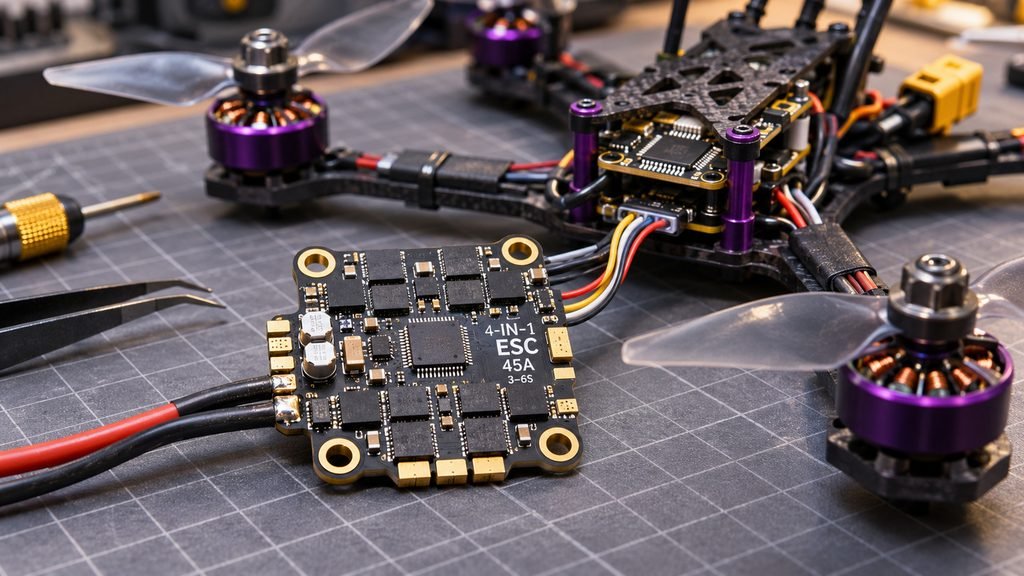
Main Components of a Drone ESC
Microcontroller and firmware
The controller interprets motor commands and runs the ESC’s commutation and supporting logic. Available configuration, protection and telemetry features depend on the firmware and hardware.
MOSFETs and gate drivers
MOSFETs are high-speed electronic switches that control current through the motor phases. Gate drivers manage their switching. Power-stage efficiency and thermal design influence the ESC’s usable operating range.
Capacitors and power circuitry
Capacitors help handle switching-related electrical disturbances and voltage variation. Some FPV assemblies recommend additional appropriately rated capacitors, but their selection, polarity and placement must follow the specific hardware instructions.
Power, motor and signal connections
A conventional three-phase brushless ESC commonly has battery inputs, three motor-phase connections and a control interface. Other products may expose telemetry, regulated power or networked connectors. There is no universal wiring pinout, so visually similar products should not be assumed interchangeable.
ESC vs Flight Controller: Key Differences
| Feature | Flight controller | ESC |
|---|---|---|
| Main purpose | Calculates aircraft control outputs | Drives an assigned motor |
| Typical inputs | Pilot, sensor and navigation data | Motor commands, power and supported feedback |
| Typical output | Actuator commands | Controlled phase switching |
| Firmware | Flight software such as PX4, ArduPilot or Betaflight | ESC-specific software |
| Manages complete flight? | Coordinates flight control | No |
| Handles motor drive current? | Not through its ordinary signal electronics | Yes, via power stage |
A more expensive ESC does not automatically give an aircraft improved navigation or obstacle avoidance. Flight performance depends on the combined flight controller, ESC, motor, battery, propeller and tuning.
Types of Drone ESCs: Single, 4-in-1 and Integrated
Single ESC
A standalone ESC usually controls one motor. Distributed mounting can offer flexibility and permit replacing an individual module, but requires separate wiring and mounting arrangements.
4-in-1 ESC
A 4-in-1 unit places four motor-control channels on a shared board, commonly used with compact FPV flight-controller stacks. It may reduce wiring complexity, but concentrates heat and can make repairs board-level rather than module-level.
| Consideration | Single ESC | 4-in-1 ESC |
|---|---|---|
| Motor channels | Usually one | Four |
| Arrangement | Separate modules | Shared board |
| Wiring | Distributed | Potentially simplified |
| Service | One module may be replaced | A channel fault may require board replacement |
| Thermal behaviour | Depends on placement | Depends on combined-board cooling |
| Typical use | Custom/modular UAVs | Many compact FPV quadcopters |
Integrated and networked ESC systems
Some industrial propulsion systems integrate an ESC with a motor assembly or use CAN-based protocols such as DroneCAN. Different UAV designs prioritize serviceability, telemetry, packaging or redundancy, so no single ESC form factor is inherently best.
Understanding ESC Current and Voltage Ratings
Continuous current
An ESC marketed with a 45A continuous rating is claiming a current capability under the manufacturer’s stated conditions. The number should not be interpreted as guaranteed indefinitely in every airframe. Cooling airflow, ambient temperature, enclosure and load can change the thermal margin.
Burst current
Burst current ratings refer to short-term operation. Duration and conditions are product-specific. Do not use a burst rating as a substitute for sustained capability.
Input voltage and battery cell count
A label such as 3S–6S describes a supported battery cell-count range, usually for a specified battery chemistry. For a conventional lithium-polymer cell charged to 4.2V, six cells in series reach approximately 25.2V at full charge. Different battery chemistries can have different maximum voltages; verify the ESC’s explicit electrical limits.
Illustrative ESC selection
Suppose a documented motor-and-propeller combination draws a maximum 32A in the manufacturer’s test conditions, and a candidate ESC has a documented continuous rating of 45A. The advertised numbers suggest potential margin, but do not prove safe compatibility until thermal conditions, voltage, connectors, firmware, motor behaviour and all specifications are checked.
Current rating alone is never a complete compatibility test. Overheating may arise from excessive load, poor cooling, wiring faults, high ambient temperature or mechanical problems.
ESC Communication Protocols: PWM, OneShot, MultiShot, DShot and DroneCAN
The protocol determines how control commands reach the ESC. Different autopilots support different outputs, so confirm both the flight controller and the ESC support the same interface. PX4 documents PWM, OneShot, DShot, DroneCAN and other supported arrangements.
PWM
Traditional servo-style PWM communicates motor commands using the timing of electrical pulses. The command signal is distinct from the internal high-frequency switching used to drive motor phases.
OneShot and MultiShot
These pulse-based protocols use different, generally shorter signaling durations than conventional servo PWM. Their use depends on compatible hardware and firmware. The fact that a protocol exists in a configuration menu does not mean every connected ESC supports it.
DShot
DShot is a digital motor-command protocol. Common names include DShot150, DShot300 and DShot600; they identify signaling rates, not maximum RPM or ESC amperage. Digital frames use a checksum and generally do not need the analogue throttle-endpoint calibration used by some older PWM configurations.
DroneCAN
DroneCAN supports networked communication on appropriate CAN-based hardware, including certain propulsion controllers. It is not physically interchangeable with a simple single-wire PWM or DShot connection.
| Protocol | Command method | Important limitation |
|---|---|---|
| PWM | Timed pulses | Timing calibration may be required |
| OneShot | Short-duration pulses | Both devices must support it |
| MultiShot | Fast pulse signaling | Not universally supported |
| DShot | Digital frames with checksum | Compatible digital hardware/firmware required |
| DroneCAN | CAN network messages | Network-capable hardware and setup required |
What is bidirectional DShot?
Compatible bidirectional DShot configurations let an ESC return motor-speed-related telemetry on the same signal line used for commands. Betaflight can use these measurements for RPM filtering to target motor-related vibration frequencies. This is different from separate ESC telemetry links: support for one method does not guarantee support for the other. PX4 documentation also describes extended DShot telemetry for additional data on suitable hardware.
ESC Firmware: BLHeli_S, BLHeli_32, AM32 and Proprietary Options
ESC firmware controls how the controller interprets commands, switches its motor outputs and exposes supported configuration functions. Different firmware families support different microcontrollers, targets, protocols and configurators.
BLHeli families
BLHeli_S and BLHeli_32 are distinct implementations associated with different hardware and capabilities. Do not treat their names as evidence of interchangeable firmware or identical telemetry support.
AM32
AM32 is an open-source firmware project for supported ESC hardware. Its open-source license does not mean it can safely run on every controller. ArduPilot documents compatible BLHeli/AM32 configuration using supported pass-through connections.
Manufacturer-specific firmware
Some integrated industrial ESCs have proprietary firmware or model-specific update procedures. These may be tightly associated with their motor, network interface or autopilot ecosystem.
| Firmware | Key consideration |
|---|---|
| BLHeli_S | Hardware-specific capabilities and configurators |
| BLHeli_32 | Different BLHeli-family implementation; check hardware target |
| AM32 | Open-source project for supported targets |
| Proprietary | Manufacturer-controlled features and compatibility |
Safety: Flashing an unsupported target can render an ESC unusable or unsafe. Follow the exact hardware revision and vendor instructions; avoid experimenting with firmware on a flight-ready aircraft.
How ESCs Work With Brushless Motors
ESC compatibility begins with the complete propulsion system: motor characteristics, propeller size and pitch, battery voltage, expected current, mechanical load and cooling. Motor KV is a nominal speed constant, commonly expressed in RPM per volt under unloaded conditions; it is not a direct current rating.
Changing a propeller or battery can materially change current draw. Likewise, a motor that works with one ESC may not be suitable for another firmware or electrical setup. See Drone Motors Explained and Drone Battery Guide for the two adjacent components.
Motor direction
Motor direction depends on phase sequencing and supported settings or wiring arrangements. The correct way to change it is hardware-specific. For multirotors, incorrect rotation direction or propeller orientation can prevent safe flight.
ESC Telemetry and Motor Monitoring
Supported ESC telemetry may report electrical RPM, voltage, current, temperature or fault status. The exact fields vary by hardware and interface; missing data can simply mean an unsupported feature.
- RPM-related readings: Useful for supported monitoring or dynamic filtering, with conversion rules as documented.
- Current and voltage: Can help assess propulsion loading if the ESC actually measures and reports them.
- Temperature: Supports thermal monitoring where a sensor and interface exist.
- Warnings: May indicate a firmware, electrical or drive condition, depending on implementation.
Telemetry is not an independent physical inspection. A sensor reading cannot establish that a propeller is crack-free, that wiring is undamaged or that a motor bearing is healthy.
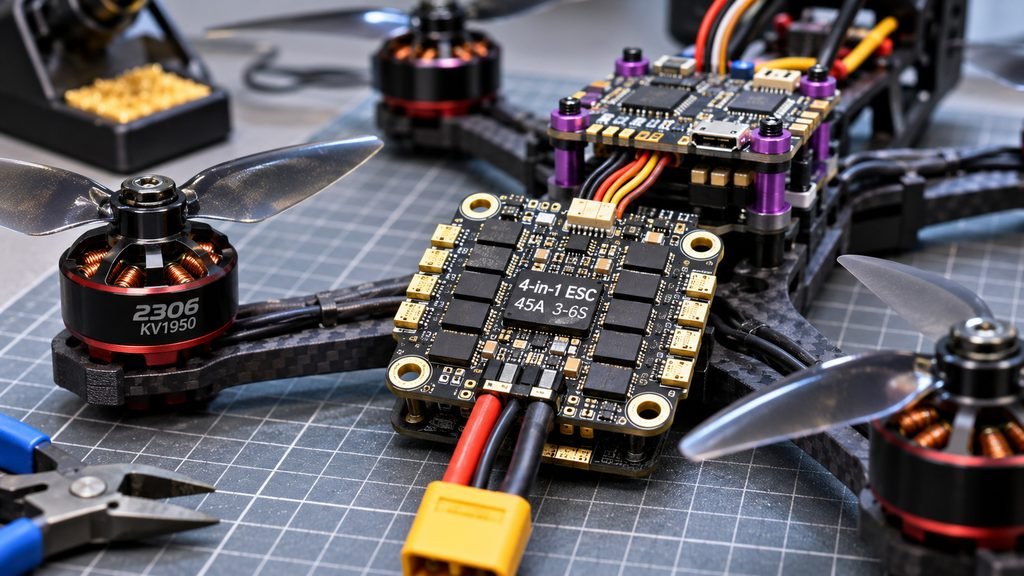
How to Choose the Right Drone ESC
Choose from verified motor-and-propeller load data and the aircraft’s electrical requirements. Then examine the ESC’s voltage, sustained current, cooling, size, protocol and firmware support together.
| Factor | What to verify |
|---|---|
| Battery voltage | Maximum charged voltage and allowed range |
| Current | Documented continuous load under appropriate cooling |
| Motor compatibility | Motor type, phases and drive requirements |
| Protocol | Flight-controller and ESC compatibility |
| Firmware | Correct hardware target and features |
| Form factor | Single, multi-channel or integrated arrangement |
| Cooling | Actual installation airflow and heat dissipation |
| Connectors | Correct power, motor and signal wiring |
| Telemetry | Data types and supported interface |
| Documentation | Reliable specifications and service instructions |
For an FPV quadcopter
Check stack mounting dimensions, board spacing, connector pinouts, expected propeller loading and Betaflight-compatible signaling. A matching mounting pattern, such as 20 × 20mm or 30.5 × 30.5mm, does not demonstrate matching electrical pinouts.
For larger UAVs
Longer-duty industrial platforms may emphasize cooling, service life, monitoring and networked ESC integration. Documented autopilot compatibility and protection mechanisms may matter more than minimal board size.
Considerations for builders in India
Prefer suppliers who publish a credible hardware revision, electrical ratings, operating conditions and warranty/service information. Read the documentation before choosing a cheaper lookalike controller; visually similar ESCs can use different components and firmware.
Common Drone ESC Problems and Troubleshooting
ESC problems can resemble motor, battery, signal or flight-controller issues. Begin diagnosis with the aircraft safely grounded and propulsion power isolated as prescribed.
| Symptom | Possible cause | Safer first step |
|---|---|---|
| Motor will not start | Signal, configuration, connection or hardware fault | Inspect official status and documented wiring |
| Motor stutters | Phase connection, motor or ESC issue | Do not attempt flight |
| ESC runs very hot | Load, cooling or electrical problem | Stop operation and investigate |
| Arming fails | Protocol, configuration or safety warning | Review flight-controller error message |
| One motor behaves differently | Propeller, motor, ESC or output fault | Inspect components and any available logs |
| Telemetry absent | No support, wiring or settings | Confirm documented telemetry capability |
| Smoke or burning smell | Serious electrical fault | Stop use and disconnect power safely if possible |
Does an ESC need calibration?
Some PWM-based systems use throttle-range calibration, but DShot generally avoids that type of endpoint calibration. Apply a procedure only when the specific controller and firmware support and require it.
Can an ESC damage a motor?
An electrical or configuration fault can contribute to motor damage; conversely, a failed or overloaded motor can stress the ESC. Diagnosis should consider the complete power system.
Safety during testing
Remove propellers for permitted bench motor tests, keep hands and cables away from moving parts and never energize visibly damaged electrical hardware. If the cause of a propulsion fault is uncertain, seek qualified assistance. Our Drone Maintenance Guide covers broader inspections and preventative care.
FAQs
What does ESC stand for in drones?
Electronic Speed Controller. It controls electrical drive to a motor according to flight-controller commands.
Does every drone motor need a separate ESC?
Brushless motors require suitable electronic control, but several channels may be integrated on one board.
What is a 4-in-1 ESC?
A single circuit board containing four motor-control channels, common in compact FPV drones.
Is a 45A ESC better than a 35A ESC?
Not automatically. Continuous-current ratings depend on specified operating conditions, thermal behavior and real compatibility.
Can any ESC work with any brushless motor?
No. Verify input voltage, load current, motor type, control protocol and firmware compatibility.
What is the difference between PWM and DShot?
PWM motor commands use pulse timing; DShot sends digitally encoded commands with checksums.
What is bidirectional DShot?
A supported method for returning motor-speed telemetry on the same DShot signal connection, useful for RPM filtering.
Is AM32 better than BLHeli?
There is no universal winner. Hardware support, features, documentation and intended application determine suitability.
Do ESCs need cooling?
Yes. Power electronics dissipate heat; actual cooling requirements depend on electrical load, board design and installation.
Can a damaged ESC be repaired?
Some repairs are possible technically, but propulsion power electronics can be hazardous. Uncertain faults are safer to refer to a qualified technician or replace using approved parts.
Conclusion
A drone ESC is the electronic bridge between the flight controller’s motor commands and the motor’s electrical drive. Its suitability depends on the whole propulsion system, not just a printed amp rating or whether the board fits.
For beginners, understanding ESCs clarifies how a multirotor changes thrust and attitude. For builders, selecting the right unit means checking documented voltage and current limits, motor compatibility, cooling, protocols and firmware. Prioritize credible specifications and safe ground procedures over guesswork.
