

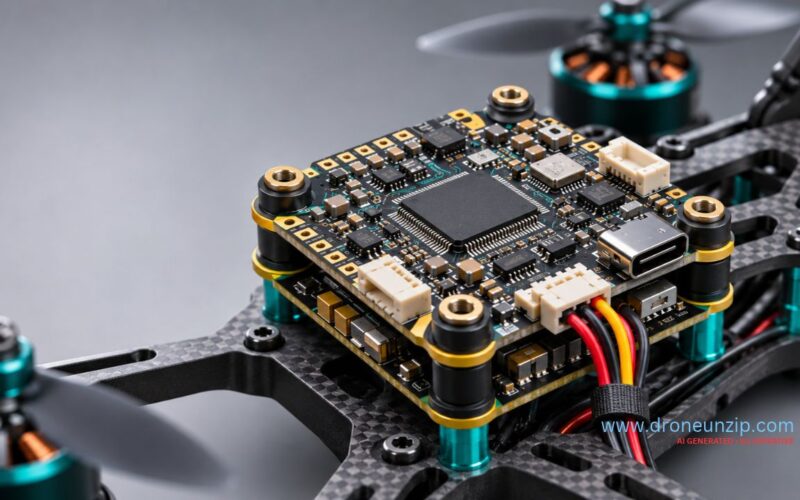
A drone flight controller is the onboard computing system that helps an aircraft remain stable, respond to pilot commands and perform supported automated flight functions. It reads sensors, estimates the aircraft’s movement, calculates corrections and sends control signals to motors or other actuators.
The same basic principles apply to an FPV quadcopter, a camera drone and a surveying UAV, but the hardware, firmware and navigation requirements can differ substantially. This guide explains the entire control process, compares major flight-controller types and software, and provides practical guidance for selecting and troubleshooting a controller.
What Is a Drone Flight Controller?
A flight controller is the onboard electronic control unit responsible for the real-time functions that keep an aircraft controllable. In a typical quadcopter, it combines a processor, an inertial measurement unit (IMU), firmware and input/output interfaces. A remote controller is different: it sends pilot instructions, while the aircraft’s flight controller interprets them and calculates the required response.
Its responsibilities may include angular-rate and attitude stabilisation, motor output calculation, sensor monitoring, receiver processing, arming checks and, where supported, altitude or position control. Features such as automatic return-to-home require suitable software, sensors and configuration; they are not guaranteed merely because a board is called a flight controller.
How Does a Drone Flight Controller Work?
The central principle is closed-loop feedback. Instead of issuing a fixed motor command and assuming the aircraft will behave as expected, the controller repeatedly compares the desired movement with its measured or estimated state and corrects the difference.
The six-stage flight-control process
- Input: A pilot, flight mode or mission planner supplies the desired rotation rate, attitude, velocity or position.
- Sensing: Gyroscopes and accelerometers report motion; other supported sensors may provide pressure, heading, position or distance.
- State estimation: Firmware combines relevant measurements to estimate aircraft orientation, movement and possibly position.
- Control: Algorithms compare the target and current values and calculate a corrective response.
- Actuator allocation: The system distributes commands among the available motors and, on appropriate aircraft, servos.
- Feedback: Sensors measure the resulting motion and the cycle runs again.
Example: A quadcopter hit by a wind gust
Suppose a gust rolls a hovering quadcopter unexpectedly. The gyro detects its rotational motion and the controller adjusts the relative thrust commands of the motors to oppose the unwanted rotation. However, recovering a level attitude is not the same as holding a fixed position. Resisting horizontal drift also requires suitable position or velocity estimation and a corresponding active control mode.
PX4’s architecture documentation separates estimator, controller and actuator functions, making it a useful technical model for this process. See the PX4 architectural overview.
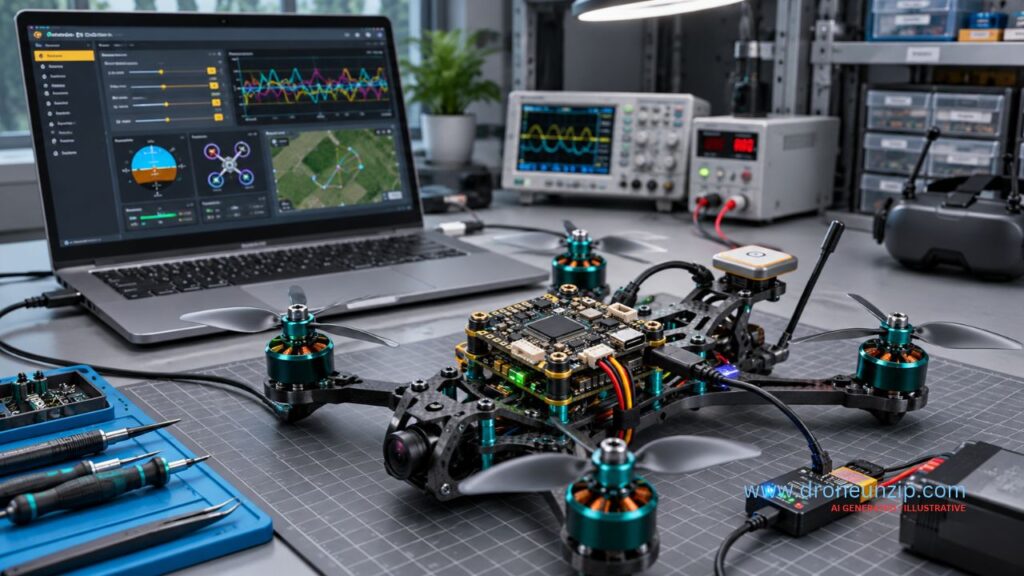
Main Components of a Drone Flight Controller
Processor and memory
The microcontroller or processor executes flight-control firmware, reads sensor data, calculates control outputs and communicates with connected devices. Many DIY boards use STM32-family microcontrollers, but processing resources alone do not establish whether a controller supports a specific firmware release. Memory, peripheral assignments and the exact firmware target also matter. Some boards provide flash memory or removable storage for diagnostic flight logs.
Inertial measurement unit (IMU)
An IMU generally contains a gyroscope, which measures angular velocity, and an accelerometer, which measures specific force. These signals help the control system determine how the aircraft is moving. Certain autopilot boards include multiple IMUs, but redundancy is useful only when the software can properly evaluate and manage the measurements. For the underlying sensor technologies, see Drone Sensors Explained.
Barometer, power circuitry and interfaces
A barometer, when present, provides pressure measurements that can help estimate altitude. Flight-controller power may come from a compatible regulated supply or dedicated power module, sometimes with separate battery-voltage and current monitoring. UART, I²C, SPI, CAN, USB and actuator outputs connect peripherals such as GNSS receivers, telemetry radios, ESCs and external computers. Connector appearance never substitutes for checking pin assignments and voltage limits.
Flight Controller vs ESC vs Radio Receiver
| Component | Function | Relationship to the system |
|---|---|---|
| Flight controller | Calculates flight-control corrections | Processes inputs and sends commands to actuators |
| Electronic speed controller (ESC) | Regulates power delivered to a brushless motor | Receives compatible motor commands from the controller |
| Radio receiver | Receives pilot-radio commands | Passes the pilot’s instructions to the controller |
When a pilot commands a roll, the radio receiver forwards that command. The flight controller compares the requested motion with sensor feedback and commands the ESCs appropriately; the motors then change thrust. An integrated four-in-one ESC simply places several ESC channels on one assembly, without eliminating the flight controller’s job. Read Drone Motors Explained and Drone Propellers Explained for related propulsion concepts.
Types of Drone Flight Controllers
The following are practical application groups rather than formal, mutually exclusive industry categories.
| Category | Typical aircraft | Priorities | Watch-outs |
|---|---|---|---|
| FPV-oriented | Racing, freestyle and cinematic FPV multirotors | Compact form, responsive control, receiver and video integration | Navigation support varies by firmware and sensors |
| Autopilot-oriented | Research, survey and custom navigation aircraft | GNSS and other sensors, telemetry, logging, multiple outputs | More involved setup and validation |
| Integrated consumer | Ready-to-fly camera drones | Tightly integrated manufacturer-specific systems | Limited interchangeability and repair options |
| Industrial and VTOL | Specialised multirotors and hybrid aircraft | Vehicle-specific actuation, connectivity and reliability engineering | Compatibility requires system-level evaluation |
Pixhawk is a hardware-standard ecosystem associated with autopilot controllers, not a single interchangeable board model. A board’s actual capabilities depend on its hardware revision, firmware, vehicle configuration and attached peripherals.
Drone Flight Controller Firmware: Betaflight, INAV, ArduPilot and PX4
Drone flight controller firmware implements the software functions running on a compatible board. Its target support, estimators, controllers, configuration options and communication protocols strongly influence what an aircraft can do.
Betaflight
Betaflight is widely used for configurable FPV multirotor flight, with detailed settings for rates, filtering, motor protocols, receiver integration and Blackbox logging on supported hardware. FPV use extends beyond racing, but exact board-target support must be checked for each firmware version.
INAV
INAV combines flight control with supported navigation functions on appropriate multirotor and fixed-wing configurations. Position hold, return-to-home and waypoint features require suitable sensors and setup. Hardware support may change between releases, so older-controller compatibility should not be assumed.
ArduPilot
ArduPilot is a broad open-source autopilot ecosystem supporting various aircraft and robotic vehicle types. It provides extensive navigation, telemetry, logging and peripheral integration for compatible platforms, together with detailed vehicle-specific setup procedures.
PX4
PX4 provides a modular autopilot architecture with distinct estimation, flight-control and actuator functions and options for companion-computer integration. It is an important reference for research and custom UAV development.
| Firmware | Typical emphasis | Fit to consider |
|---|---|---|
| Betaflight | Configurable FPV handling | Supported FPV builds |
| INAV | Flight control with navigation | Supported navigation-focused multirotors and planes |
| ArduPilot | Extensive vehicle and autopilot functions | Custom UAVs, surveying and research |
| PX4 | Modular flight stack and system integration | Research and autonomous-platform development |
These are typical strengths, not exclusivity claims. Always consult the firmware’s supported-board list and documentation for the exact version being installed.
How Flight Controllers Keep a Drone Stable
Aircraft rotation is described by roll (rotation about the longitudinal axis), pitch (rotation about the lateral axis) and yaw (rotation about the vertical axis). Control software can regulate these motions through several layers.
- Angular-rate control: Regulates how quickly the aircraft rotates.
- Attitude control: Tries to achieve a desired orientation and may supply targets to the inner rate-control loop.
- Position control: Uses position estimates to guide movement or resist drift, typically through lower-level controllers.
Many systems use proportional-integral-derivative (PID) control or related feedback techniques. The proportional term responds to current error, the integral term to accumulated error, and the derivative term to rate of change. Actual flight stacks may use multiple coupled loops, constraints and filters. There is no universal PID setting: airframe mass, motor response, propellers and vibration affect results. Our Drone Flight Modes Explained guide describes how these control functions appear to pilots in different modes.
How Controllers Connect to Motors, Sensors and Computers
ESC outputs may use PWM-style signalling or supported digital motor protocols such as DShot. Sensors and peripherals connect through board-specific serial or data interfaces. A GNSS module may use UART; other devices may use I²C, SPI or CAN. A companion computer can handle computationally intensive perception or mission software while the flight controller handles time-critical control.
There is no universal flight-controller wiring diagram. Two boards may look alike yet use different connector pinouts, voltage limits or output assignments. Follow the exact manufacturer pinout and firmware setup documentation. Before bench-testing motors, remove propellers and secure the aircraft.
Flight Controller vs Autopilot: Are They Different?
A flight controller commonly refers to the onboard hardware and real-time control functions, while autopilot describes broader automated guidance and flight functions. The same supported board may run stabilisation and navigation software. Neither the board name nor installing autopilot firmware guarantees waypoint flying, return-to-home, obstacle avoidance or full autonomy; each feature needs appropriate sensors, software and configuration.
GNSS-enabled position holding, automated waypoint navigation and obstacle avoidance are different technical capabilities. For their practical implications, see GPS vs Non-GPS Drones.
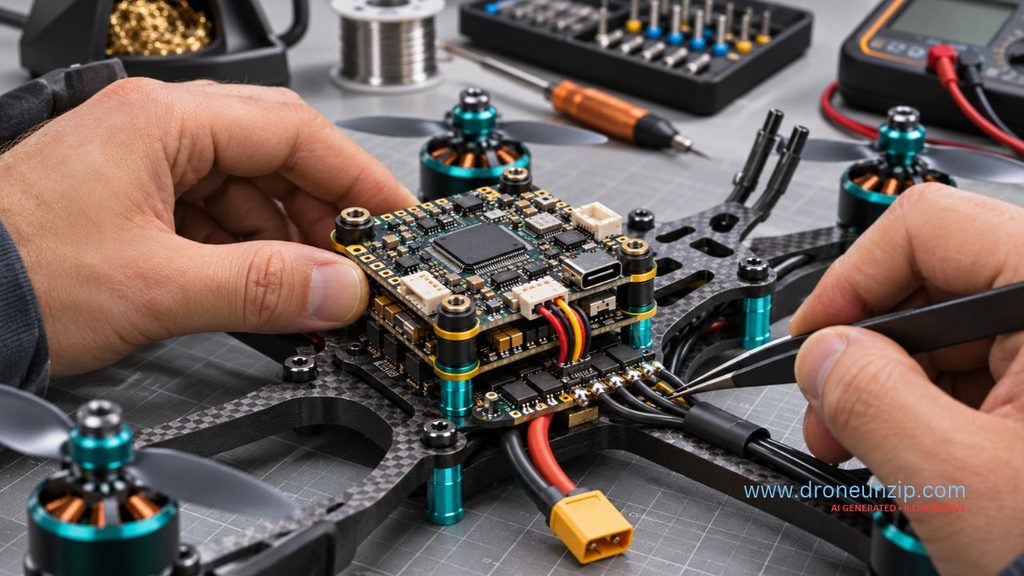
How to Choose a Drone Flight Controller
Start with the aircraft and mission, not the processor name. A simple FPV quadcopter may need a compact, well-supported board; a research aircraft may prioritise additional sensor ports, logging, telemetry and navigation software.
| Buying criterion | Questions to answer |
|---|---|
| Vehicle and actuators | Does the firmware support the airframe and the required motor or servo outputs? |
| Firmware compatibility | Is the exact board revision supported by the chosen software release? |
| Sensors and navigation | Are required IMU, barometer, GNSS and external sensors supported? |
| Interfaces | Are there sufficient suitable UART, CAN and other ports? |
| Power and mounting | Are supply voltage, power-module connections, dimensions and vibration requirements suitable? |
| Maintenance | Are documentation, diagnostic logging and software updates available? |
Higher processor specifications or a longer feature list are not meaningful improvements if the complete aircraft cannot use them. Prefer verified compatibility and dependable documentation over unsupported marketing claims.
Common Flight Controller Problems and Troubleshooting
A drone that will not arm or that oscillates is not necessarily suffering from a broken flight-controller board. Power, mechanical components, firmware configuration and peripherals can cause similar symptoms.
| Symptom | Possible causes | Safe first step |
|---|---|---|
| Will not arm | Failed pre-arm checks, receiver or sensor issue | Read the exact firmware warning and follow documented checks |
| Motor does not respond correctly | ESC, motor, wiring or output assignment | Remove propellers; inspect connections and configuration |
| Oscillation or poor stability | Propeller damage, vibration, filters or tuning | Inspect mechanical components before changing PID settings |
| IMU warning | Calibration, sensor or vibration issue | Review system messages and logged measurements |
| GNSS unavailable | Reception, antenna or serial configuration | Check receiver detection and documented setup |
| Telemetry fails | Wiring, port selection or communication settings | Verify interface and compatible protocol |
| Controller resets | Unstable power or hardware fault | Disconnect power and inspect supply requirements |
Where available, flight logs help distinguish what the sensors measured from what the controller commanded. Preserve a known configuration before making changes, investigate one cause at a time and do not fly with unresolved critical errors. Proprietary consumer drones may require manufacturer-approved service.
Flight Controllers in Indian Drone Applications
Indian engineering students can use documented open-source flight-control ecosystems to study sensing, control loops and simulation. Agricultural-drone projects may need integration among propulsion, navigation and payload mechanisms; the presence of autopilot firmware does not establish suitability for spraying. Surveying aircraft require appropriate positioning and payload integration, and an ordinary GNSS receiver alone does not establish survey-grade accuracy.
For commercial or custom UAV operation in India, flight-controller selection and regulatory compliance are separate questions. Aircraft classification, registration, certification and operating permissions must be assessed under the applicable current framework. Check official DGCA and Digital Sky resources before relying on any particular operating assumption.
FAQs
Can a drone fly without a flight controller?
A typical multirotor requires electronic flight-control functions to coordinate its motors for stable, controlled flight. Other aircraft architectures may implement those functions differently.
Does every flight controller include GPS?
No. Some boards require an external GNSS receiver, while others are intended for flight modes that do not depend on satellite positioning.
What is the difference between a flight controller and an ESC?
The controller computes the requested flight response; the ESC regulates electrical power delivered to the motor.
Which flight controller is best for beginners?
Choose hardware supported by your intended firmware and airframe, with clear documentation. FPV and navigation-oriented projects often need different boards.
Can I run Betaflight on any controller?
No. Support depends on the precise board target, its hardware revision and firmware release.
Is Pixhawk a flight controller or an autopilot?
Pixhawk refers to a flight-controller hardware ecosystem. Compatible implementations can run supported autopilot software.
What is the difference between PX4 and ArduPilot?
Both are open-source autopilot ecosystems, but software architecture, hardware support, tools and workflows differ. Compare against your project requirements.
Does upgrading a flight controller extend flight time?
Not automatically. Endurance depends on the complete aircraft, particularly propulsion, battery, weight and operating conditions.
Can a flight controller make a drone autonomous?
Appropriate software, sensors and configuration can enable automated flight functions, but autonomous navigation and obstacle avoidance require distinct capabilities.
Why will my drone not arm?
A pre-arm check may have detected a sensor, configuration or control-link issue. Diagnose the specific warning rather than bypassing safeguards.
Conclusion: Selecting the Right Control System
A flight controller is the link between a drone’s desired movement, sensor feedback and physical actuator response. Understanding that feedback process makes hardware and firmware choices easier to evaluate.
For FPV aircraft, compact hardware and configurable flight response may matter most. Navigation-focused platforms may need stronger sensor integration, telemetry, logging and a supported autopilot ecosystem. The best controller is therefore not necessarily the most expensive board: it is the one whose hardware, firmware, interfaces and documentation are verified for the intended aircraft.
