

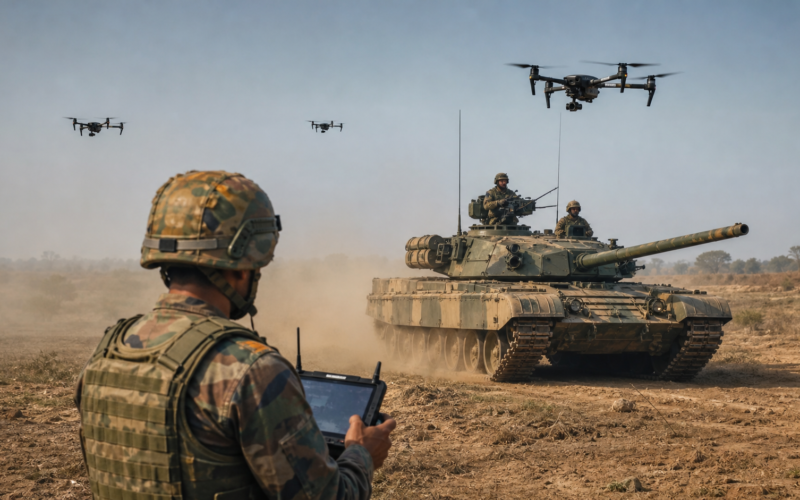
The Indian Army’s reported Shaurya drone squadrons mark an attempt to bring unmanned aerial reconnaissance and strike capabilities closer to armoured formations. Accounts published in March 2026 describe drones operating alongside tank units during Exercise Amogh Jwala at the Babina Field Firing Ranges. The development is significant for how mechanised formations may use unmanned systems, but reports differ on how far the programme has progressed.
Key Takeaways
- Shaurya squadrons are reported to support armoured units with drone surveillance and precision-strike capabilities.
- Exercise Amogh Jwala provided a public demonstration of the concept in March 2026.
- Published reports conflict on whether the formations were still awaiting approval or had already been activated.
- The programme should not be characterised as a new November announcement.
What Was Demonstrated at Babina?
According to The New Indian Express, the Army demonstrated the Shaurya Squadron concept during Exercise Amogh Jwala in March. The report said the proposed units would employ swarm and first-person-view drones to support real-time surveillance and attacks against armoured or logistics targets. Their intended purpose is to reduce the delay between detecting a target and responding to it.
India Today subsequently reported that six squadrons had been activated, describing integration with tank formations. That account goes further than the earlier report, which said additional trials and formal approval were pending. Without a current official Army statement reconciling the accounts, the precise number and operational status of Shaurya units should be treated as reported rather than independently verified.
Why Drone Integration Matters for Armoured Warfare
Armoured units traditionally rely on reconnaissance assets and coordination with other formations to understand terrain beyond direct visibility. Small UAVs could give commanders a faster picture of routes, obstacles and threats. FPV aircraft and loitering munitions may also provide additional options for engaging targets, although their effectiveness depends on training, communications, electronic-warfare resilience and tactical integration.
Embedding drones in tank formations would create new requirements for operators, batteries, maintenance, communications security and airspace deconfliction. A squadron’s existence alone would not establish that these challenges have been resolved.
What Remains Unconfirmed?
Public reporting does not establish a definitive Army-wide implementation schedule, a standard drone inventory for each squadron or independently measured operational performance. Further official statements and exercises will be needed to clarify those questions.
DroneUnzip Analysis
The larger trend is organisational rather than simply technological: military forces are seeking to make unmanned aircraft a routine part of ground manoeuvre. For India’s drone ecosystem, sustained adoption could create demand for rugged short-range UAVs, electronic-warfare-resistant links, training and field support. Those are potential implications, not confirmed procurement commitments.
Sources
The New Indian Express: Shaurya squadron development and demonstration; India Today: Reported activation and integration.
