
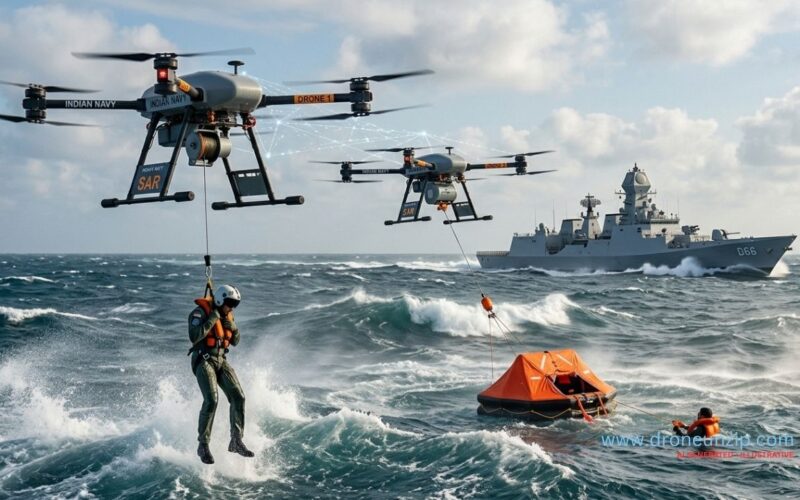
The Indian Naval Academy has developed a two-drone maritime rescue system that uses an AI-assisted search quadcopter to locate people in the water and a separate hexacopter to deliver a lifebuoy. The design separates detection from delivery while retaining human approval for the final drop, according to details provided by a member of the development team to ANI.
Key Takeaways
- A quadcopter searches using 2K optical and thermal cameras, with YOLO-based object detection.
- A hexacopter navigates towards the detected location and carries a lifebuoy; an operator authorises its release.
- Developer-reported endurance is 45 minutes for the search drone and 25 minutes for the delivery drone, with a stated 10 km operating radius for each.
- Operational deployment, independently measured rescue accuracy and performance in rough weather have not been established by the available reporting.
Who Developed the Two-Drone Maritime Rescue System?
The system was built by a team at the Indian Naval Academy. Midshipman Sudhanshu Tanwar, identified as one of its developers, described its architecture and specifications in reporting carried by ANI and subsequently published by The Economic Times on 27 October 2026. The Academy’s involvement makes this a naval training and engineering development; the reporting does not establish that the Indian Navy has inducted it as operational rescue equipment.
What Happens When the Search Drone Detects a Person at Sea?
The quadcopter scans the water with an optical camera and a thermal camera. A YOLO (You Only Look Once) object-detection model analyses the video feed and flags a possible person in distress. A separate hexacopter then flies towards the location using GPS guidance, carrying a lifebuoy as its payload.
The lifebuoy release is not described as fully autonomous. A human operator must authorise the drop. The hexacopter is designed to return to its launch point after delivery, while long-range radio-frequency communication connects the two aircraft. This distinction matters: automated detection and navigation do not mean that the complete rescue decision has been delegated to software.
When and Where Was the Development Reported?
The development was reported on 27 October 2026 in coverage of the Indian Naval Academy’s project. The reporting identifies the Academy as the development organisation but does not provide a verified date, sea location or conditions for a full operational rescue trial. It should therefore be described as a developed system rather than a proven deployment.
What Are the Reported Drone Specifications?
The following figures were supplied by the developer in ANI-linked reporting. They are reported specifications, not independently validated test results.
| Specification | Search quadcopter | Delivery hexacopter |
| Primary task | Detect person in water | Carry and deliver lifebuoy |
| Flight endurance | 45 minutes | 25 minutes |
| Payload capacity | 0.5 kg | 2.5 kg |
| Maximum speed | 50 km/h | 40 km/h |
| Operating radius | 10 km | 10 km |
| Key systems | 2K optical camera, thermal camera, YOLO detection | GPS-guided delivery, operator-authorised release |
Why the Two-Aircraft Approach Matters for Maritime Rescue
Search and delivery place different demands on an unmanned aircraft. The search drone needs sensors and time in the air to examine an area; the delivery drone must lift and release flotation equipment. Assigning those roles to separate aircraft could allow rescuers to send assistance towards a detected casualty without waiting for a boat to reach the same position. That is a potential operational advantage, not a measured response-time improvement demonstrated in the public report.
India’s National Disaster Response Force already lists remote-controlled lifebuoys among its flood-water rescue equipment, illustrating a wider interest in remotely delivered flotation support. The Academy’s concept adds airborne detection and a separate aerial delivery stage. It does not replace boats, divers or trained rescue personnel, particularly where a casualty cannot grab a flotation device.
What Must Be Verified Before Operational Use?
Important unanswered questions include detection accuracy in glare and high waves, the effect of wind on a lifebuoy drop, communications reliability, battery reserves for return flight, and whether the system has been tested with real rescue teams. Public reporting also does not establish procurement, fleet induction or a certified operating envelope. Those are the milestones to watch next.
Sources
ANI-origin reporting via The Economic Times NDRF flood-water rescue equipment reference
